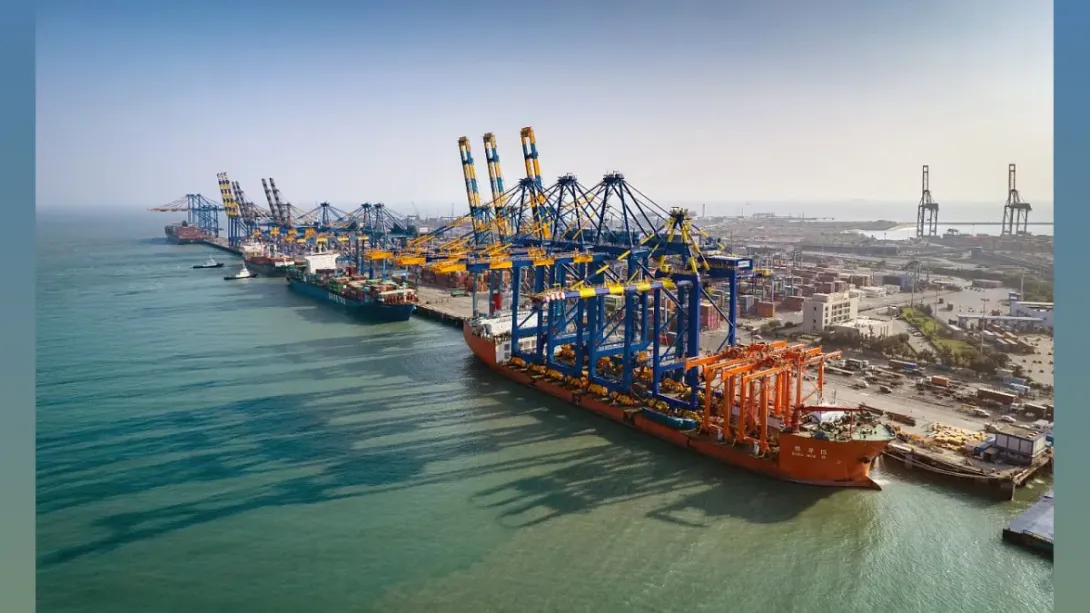
The Adani Group has announced a massive Rs. 53,000 crore investment in the development of the Vadhavan Port in Maharashtra, marking one of the largest private sector contributions to India’s maritime infrastructure. The project, designed to transform India’s western coastline into a global trade hub, will be executed in collaboration with the Jawaharlal Nehru Port Authority (JNPA) under a joint venture model. Once operational, the port is expected to handle over 23 million twenty-foot equivalent units (TEUs) annually, boosting India’s cargo handling capacity, trade efficiency, and competitiveness in global logistics.
A Strategic Maritime Expansion
Adani Ports and Special Economic Zone Ltd (APSEZ), India’s largest private port operator and a flagship entity of the Adani Group, will spearhead the Vadhavan Port development. The investment aligns with India’s long-term Maritime India Vision 2030, which aims to position the country as a leading player in global shipping and logistics.
The Vadhavan Port, located near Dahanu in Maharashtra, is strategically planned to serve as a deep-draft transshipment hub, capable of handling next-generation container vessels with capacities exceeding 20,000 TEUs. With proximity to key international trade routes and major industrial clusters, the port is poised to become a critical node in India’s supply chain network.
Partnership with JNPA and Project Scope
The project will be implemented through a joint venture between Adani Ports and the Jawaharlal Nehru Port Authority (JNPA), reflecting a strong public-private partnership (PPP) approach. The central and state governments have identified the Vadhavan Port as a priority infrastructure project, with the total cost estimated at around Rs. 76,000 crore, of which Adani Group’s share will be Rs. 53,000 crore.
According to initial development plans, the port will feature nine container terminals, a dedicated liquid cargo terminal, and multiple berths for bulk cargo. The design emphasizes advanced automation, digital logistics integration, and sustainable port management practices, including renewable energy utilization and carbon footprint reduction.
Economic and Trade Significance
The Vadhavan Port project is expected to be a game-changer for India’s maritime economy. With its world-class capacity and modern infrastructure, it will help decongest existing western ports such as JNPA and Mundra, both of which are nearing peak utilization levels.
Once operational, the port is projected to generate over 1 lakh direct and indirect jobs, while contributing significantly to regional economic growth. Analysts suggest that the facility could elevate India’s share of global container traffic and strengthen its role as a transshipment hub for South Asia, reducing dependency on ports in Colombo, Singapore, and Dubai.
Integration with National Infrastructure Corridors
The Vadhavan Port’s development will be closely linked to the Western Dedicated Freight Corridor (WDFC) and the Delhi-Mumbai Industrial Corridor (DMIC), enabling efficient cargo movement to and from northern India’s manufacturing centers.
Enhanced connectivity through rail, road, and coastal shipping networks will not only improve logistics efficiency but also lower operational costs for exporters and importers. Industry experts believe this multi-modal integration could reduce India’s logistics costs by up to 2% of GDP over the long term—aligning with the government’s broader target to make logistics more competitive and sustainable.
Sustainability and Technological Edge
Adani Ports has increasingly prioritized sustainability across its infrastructure portfolio, and the Vadhavan project will incorporate several eco-friendly measures. These include shore power facilities for vessels, electric equipment for cargo handling, and the use of renewable energy sources for port operations.
The port’s digital architecture will include advanced AI-based traffic management, smart warehousing systems, and automated terminal operations, positioning it as one of the most technologically advanced ports in Asia.
Strengthening India’s Global Trade Competitiveness
India’s export growth and industrial expansion depend heavily on modern, efficient ports. With global trade patterns shifting toward Asia, the Vadhavan Port could significantly enhance India’s connectivity with Europe, Africa, and Southeast Asia.
According to trade experts, the port’s deep-draft design and handling capacity will allow India to compete directly with major transshipment hubs such as Singapore and Colombo. This could help Indian exporters save time and reduce freight costs, improving overall competitiveness in the global market.
Conclusion
The Rs. 53,000 crore investment by the Adani Group in Vadhavan Port represents a decisive step toward reshaping India’s maritime and logistics infrastructure. Beyond its immediate economic benefits, the project underscores a broader national ambition—to transform India into a global trade powerhouse backed by state-of-the-art ports, digital logistics, and sustainable practices.
Comments