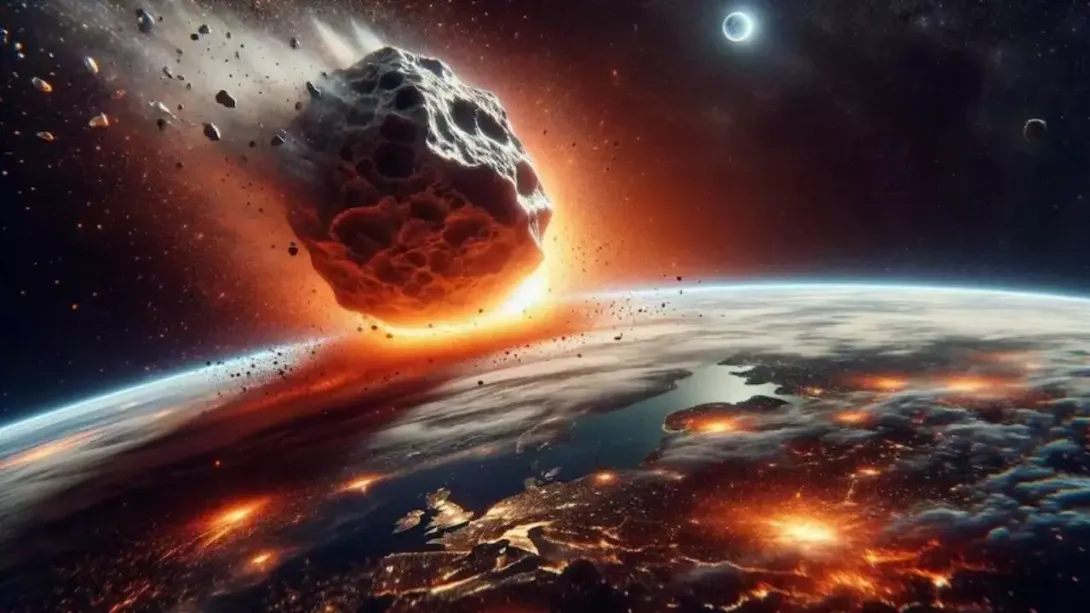
Astronomers have identified a newly tracked near-Earth object—asteroid 2024 YR4—with a potential trajectory that could intersect the Moon’s surface in the year 2032. While the celestial body poses no direct threat to Earth, researchers emphasize that its projected lunar impact could generate an explosion comparable in energy to a small nuclear detonation. The event, if it occurs, may provide an unprecedented opportunity to study impact physics and lunar geology. Scientists continue to monitor the asteroid's path while refining predictions based on updated orbital data and gravitational modeling.
Unveiling Asteroid 2024 YR4
Asteroid 2024 YR4 was detected earlier this year as part of ongoing deep-space surveillance programs aimed at cataloguing near-Earth objects (NEOs). With an estimated diameter between 15 and 25 meters, the object may be relatively small by asteroid standards but still capable of causing significant kinetic disruption upon impact.
Its orbit—an elongated ellipse intersecting the inner solar system—brings it close to both Earth and the Moon on a decadal scale. Current projections, based on early-stage observations, suggest a non-negligible probability of lunar impact sometime in 2032.
Potential Consequences of a Lunar Collision
If asteroid 2024 YR4 were to strike the Moon, scientists predict an explosive release of energy roughly equivalent to several kilotons of TNT, on par with a low-yield nuclear device. While such an event would not affect life on Earth, the spectacle would be visible through telescopes and could leave a noticeable scar on the lunar surface.
More importantly, the impact could offer scientific benefits. The collision would enable researchers to study crater formation in real time, assess lunar seismic response, and better understand the Moon’s subsurface composition. Space agencies are already considering placing observation equipment in strategic lunar orbits to collect relevant data should the event occur.
Tracking and Predictive Models
Despite the initial forecasts, experts stress that the margin of error in long-term orbital predictions remains significant. The Moon’s gravitational field, solar radiation pressure, and other minor perturbations could alter the asteroid’s path as it travels through space.
Over the next several years, astronomers will continue refining their models using radar data, infrared observations, and gravitational mapping. As with previous asteroid scenarios, what appears as a possible impact risk today could be downgraded or ruled out entirely as new data becomes available.
Nonetheless, the possibility of a Moon impact in 2032 remains on the scientific radar.
Earth’s Safety and Strategic Response
Unlike prior celestial threats that raised public concern, asteroid 2024 YR4 poses no risk of Earth impact. Its trajectory, even in worst-case simulations, does not bring it closer than tens of thousands of kilometers from Earth.
However, space agencies such as NASA, ESA, and ISRO remain engaged in ongoing planetary defense strategies. These include asteroid deflection missions, early detection systems, and coordinated international efforts to respond to real threats should they emerge.
The case of 2024 YR4 reinforces the importance of sustained surveillance of near-Earth space—not only to mitigate risks but to seize scientific opportunities.
A Rare Celestial Opportunity
While collisions of this scale are rare in human observational history, they are not without precedent. The 2013 Chelyabinsk meteor in Russia, which exploded in the atmosphere with the force of 400–500 kilotons of TNT, demonstrated how even small objects can produce outsized effects. A lunar version of such an event would unfold in the vacuum of space, without atmosphere to cushion or burn the object, producing a direct, high-velocity impact.
If 2024 YR4 does indeed collide with the Moon, it may open new doors in the study of planetary formation, impact science, and lunar resource distribution—especially relevant in the context of renewed interest in Moon colonization and mining.
Conclusion
While asteroid 2024 YR4 is unlikely to cause alarm among Earth’s inhabitants, its possible lunar impact in 2032 is drawing close scrutiny from the scientific community. The event, if it materializes, would be both a dramatic natural phenomenon and a valuable research opportunity. Until then, astronomers continue to monitor the heavens—reminding us that the universe remains as dynamic and unpredictable as ever.
Comments