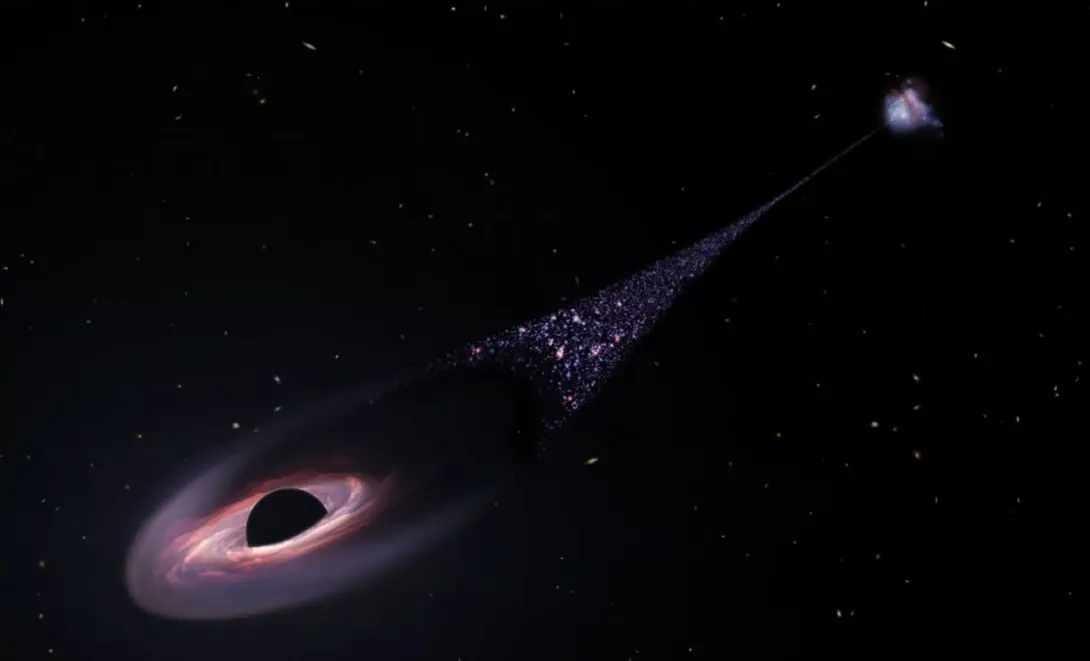
Astronomers have confirmed the presence of a massive black hole within the strikingly shaped Cosmic Owl galaxies, a distant galactic system named for its owl-like appearance in deep-space images. The discovery provides compelling evidence of active galactic processes shaping early cosmic structures. Using advanced observational data and spectral analysis, researchers identified energetic emissions consistent with a supermassive black hole actively accreting matter. Beyond its visual intrigue, the finding deepens scientific understanding of how black holes influence galaxy formation and evolution. The confirmation also highlights the growing role of high-precision instruments in uncovering hidden forces driving the universe’s most complex systems.
The Discovery Behind the Cosmic Owl
The Cosmic Owl galaxies drew attention initially for their symmetrical, eye-like features captured in high-resolution space imagery. Subsequent analysis revealed that these visual patterns were not merely aesthetic anomalies but indicators of intense gravitational activity at the system’s core.
Astronomers confirmed that a supermassive black hole lies at the center of the formation, exerting enormous influence on surrounding gas and stars. The conclusion was reached after detecting radiation signatures typically associated with high-energy accretion processes.
How Scientists Identified the Black Hole
Researchers relied on multi-wavelength observations, combining optical, infrared and X-ray data to build a comprehensive picture of the system. The presence of unusually energetic emissions and rapid gas motion provided clear evidence of a black hole actively feeding on nearby matter.
Such behavior is characteristic of active galactic nuclei, where black holes convert gravitational energy into intense radiation as material spirals inward.
Implications for Galaxy Formation Theories
The confirmation strengthens existing models that place black holes at the center of galaxy evolution. Scientists have long theorized that black holes play a decisive role in regulating star formation by heating or expelling gas through powerful outflows.
In the case of the Cosmic Owl galaxies, the black hole appears to be shaping the system’s distinctive structure, offering a rare observational link between visual morphology and underlying gravitational forces.
A Technological Milestone in Astronomy
The discovery underscores the impact of modern astronomical tools capable of resolving distant objects with unprecedented clarity. Advances in imaging sensitivity and data processing have enabled researchers to detect phenomena that were previously theoretical or hidden within cosmic noise.
Such capabilities are increasingly viewed as critical infrastructure for astrophysics, supporting both fundamental research and long-term exploration strategies.
Broader Scientific and Strategic Significance
Beyond pure science, discoveries like this reinforce the value of sustained investment in space research. Understanding black holes contributes to broader knowledge in physics, including gravity, energy transfer and the behavior of matter under extreme conditions.
From an institutional perspective, these findings strengthen international collaboration and justify continued funding for next-generation telescopes and analytical platforms.
Looking Deeper Into the Universe
The Cosmic Owl galaxies now stand as more than a visual curiosity; they are a powerful case study in how black holes sculpt the universe. As astronomers continue to analyze the system, further insights are expected into the relationship between extreme gravity and galactic architecture.
Comments