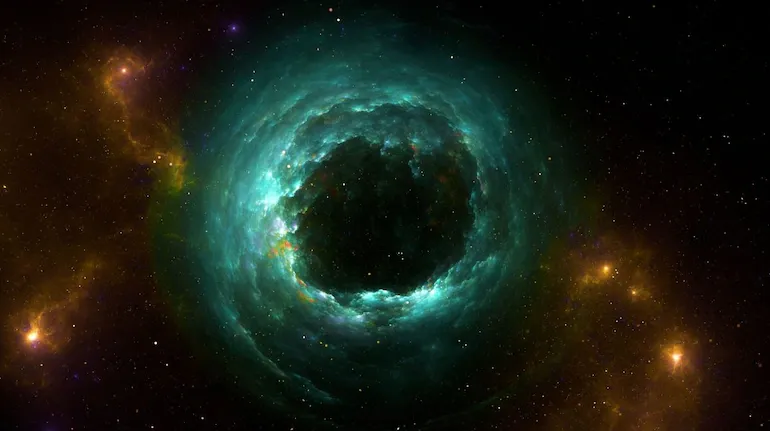
Astronomers have uncovered a mysterious dark object in a faraway galaxy that could reshape our understanding of cosmic evolution and dark matter. Using advanced telescope arrays and multi-wavelength imaging, researchers detected an unusually dense, invisible mass exerting a powerful gravitational influence on surrounding stars and gas. The object’s composition remains uncertain—it could be a colossal black hole, a dense cluster of dark matter, or an entirely new astrophysical phenomenon. Scientists believe that studying its properties may provide unprecedented insights into galaxy formation, the behavior of unseen cosmic forces, and the fundamental structure of the universe itself.
The Enigma of the Dark Object
In a breakthrough that has sparked global scientific interest, astronomers have detected a massive, light-absorbing entity deep within a galaxy located billions of light-years from Earth. The discovery was made using data from the James Webb Space Telescope (JWST) and the European Southern Observatory’s Very Large Telescope (VLT), both equipped to observe the faintest cosmic signals.
Initial analyses suggest the object’s immense gravity is distorting the light from nearby celestial bodies, a phenomenon known as gravitational lensing. However, unlike typical black holes, this structure exhibits no observable radiation or energy signatures, intensifying the mystery around its true nature.
Potential Explanations: Black Hole or Dark Matter Core?
Astrophysicists have proposed several hypotheses to explain the strange cosmic anomaly. One leading theory suggests that it could be a supermassive black hole that has not yet fully activated as a quasar, meaning it’s in a dormant phase of energy emission. Another possibility is that it represents a concentrated pocket of dark matter—a form of matter that neither emits nor absorbs light but makes up roughly 85% of the universe’s total mass.
A more speculative view is that the dark object could be an exotic “dark star,” powered not by nuclear fusion but by the annihilation of dark matter particles. If confirmed, such a discovery would revolutionize astrophysics and offer the first tangible link between dark matter theory and observable cosmic phenomena.
Tools Behind the Discovery
The detection was made possible through a combination of infrared and radio frequency data collected over several months. The James Webb Space Telescope, with its unparalleled ability to capture high-resolution images of distant galaxies, played a pivotal role in identifying the gravitational anomalies linked to the object.
Complementary observations from ground-based telescopes allowed scientists to map stellar motions and quantify the object’s gravitational pull. The resulting data revealed that the unseen mass could be millions of times heavier than the Sun—yet completely invisible.
Implications for Cosmology and Galactic Formation
If the object turns out to be a new class of astrophysical body, it could redefine current theories about galaxy formation and the role of dark matter in the cosmos. Scientists believe that such dark structures may have influenced the early clustering of galaxies after the Big Bang, shaping the cosmic web that defines the large-scale structure of the universe.
Understanding these hidden forces could also improve predictions about the future evolution of galaxies, including our own Milky Way. Moreover, confirming the existence of dark matter cores within galaxies could provide crucial evidence supporting long-standing theoretical models that remain unverified.
A Glimpse Into the Unknown
This discovery marks another milestone in humanity’s quest to understand the unseen dimensions of the universe. As astronomers continue to analyze data from upcoming observations, the dark object may hold answers to some of astrophysics’ most profound mysteries—ranging from the nature of dark matter to the mechanisms driving galactic evolution.
While much remains unknown, one thing is clear: the universe still hides secrets that defy even the most advanced scientific imagination. And with every dark discovery, we move one step closer to illuminating the cosmic shadows that surround us.
Comments