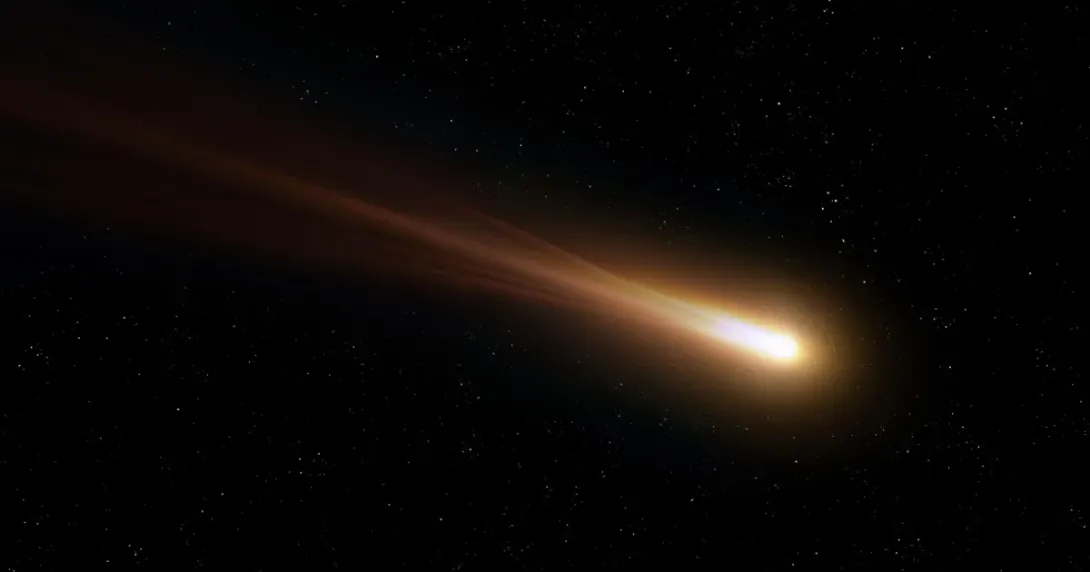
Astronomers have turned their attention to 3I/ATLAS, the third confirmed interstellar object detected traversing the solar system, offering a rare glimpse into material originating beyond our planetary neighborhood. Unlike typical asteroids or comets, 3I/ATLAS follows a hyperbolic trajectory, indicating an extrasolar origin. Observations using ground-based and space telescopes aim to analyze its composition, reflectivity, and rotation, providing clues about the conditions in distant star systems. Each interstellar visitor offers a unique opportunity to study the chemistry, structure, and dynamics of cosmic material beyond the Sun’s influence, enhancing understanding of planetary formation and the broader architecture of our galaxy.
Identifying 3I/ATLAS
3I/ATLAS was detected through survey telescopes designed to track near-Earth objects, quickly drawing attention for its unusual orbital path. Its hyperbolic trajectory confirms that it is not gravitationally bound to the Sun, distinguishing it from conventional solar system objects. Astronomers are cataloging its position and motion to predict its path and potential observational windows.
Composition and Structure
Preliminary spectral analyses suggest that 3I/ATLAS contains volatile ices and dust grains typical of comets but with notable differences in elemental ratios. Researchers are studying its albedo, surface heterogeneity, and outgassing behavior to compare with interstellar objects such as ‘Oumuamua and 2I/Borisov. These insights help build models of how planetary systems form and evolve beyond our own solar system.
Significance of Interstellar Visitors
Each interstellar object provides a natural probe of distant star systems. By studying 3I/ATLAS, scientists gain empirical data on planetary formation, chemical abundances, and the dynamics of material ejected from other stars. The object’s trajectory, speed, and composition offer a tangible record of processes occurring in environments far from Earth.
Future Observations
Observatories worldwide are coordinating follow-up observations to maximize data collection before 3I/ATLAS exits the inner solar system. High-resolution spectroscopy, photometric monitoring, and radar imaging aim to refine knowledge of its structure and activity. These efforts will contribute to a growing repository of interstellar objects, informing both theoretical models and potential future interstellar exploration missions.
Comments