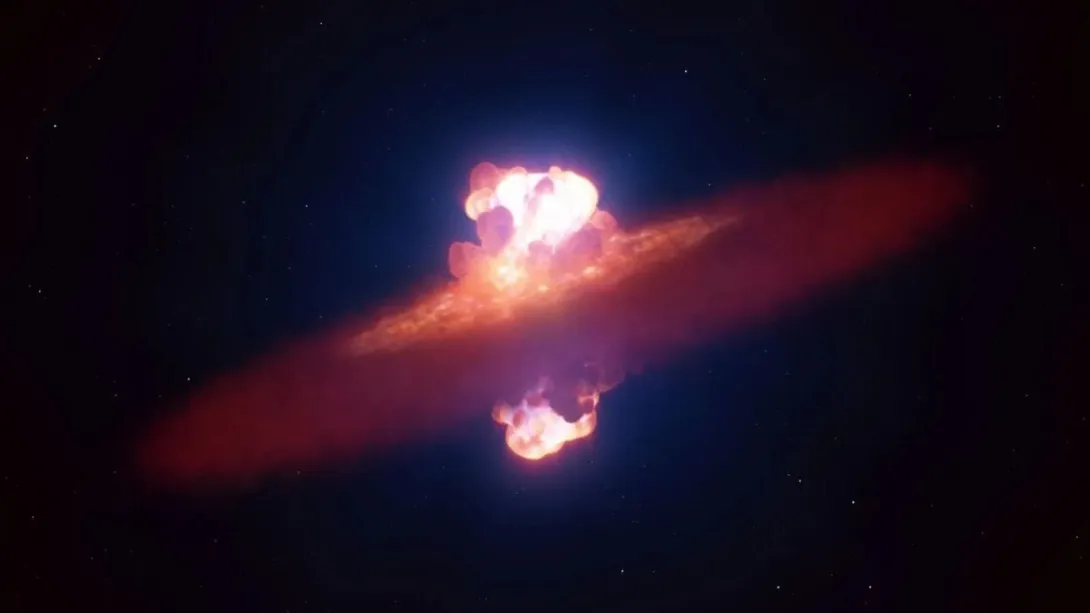
Astronomers have captured an extraordinary, first-of-its-kind image of a supernova shock wave mere moments after the colossal stellar explosion began — an achievement made possible through the advanced capabilities of the European Southern Observatory’s Very Large Telescope (VLT). This rare snapshot provides scientists with invaluable insight into the violent birth of a supernova, a process that unfolds too quickly and unpredictably for traditional observation. By documenting the shock wave at its earliest observable stage, researchers can now refine existing models of stellar death, element formation, and cosmic evolution, marking a pivotal milestone in high-energy astrophysics.
A Breakthrough in Supernova Observation
For decades, astronomers have attempted to capture the fleeting moment when a supernova’s shock wave first breaches the surface of a dying star. The event is so rapid — unfolding within minutes to hours — that even sophisticated telescopes often miss it. Using the VLT, researchers finally succeeded in capturing this elusive early-stage snapshot, offering a direct look at the explosive force generated when a star’s core collapses under immense gravitational pressure.
This breakthrough demonstrates both technological precision and international coordination, as the observation required continuous monitoring of potential supernova candidates.
Understanding the Shock Wave Phenomenon
A supernova’s shock wave originates from the star’s collapsing core, sending a high-energy blast outward at tremendous speed. As the wave punches through the outer stellar layers, it releases a brilliant flash of radiation — known as “shock breakout.”
Because this moment marks the true beginning of a supernova’s visible phase, early detection is crucial for understanding the physical properties of the progenitor star, including its size, temperature, and composition.
The newly captured snapshot gives researchers unprecedented data on these elements, expanding our understanding of how stars live, die, and enrich the universe with heavy elements.
Implications for Astrophysics and Cosmology
The significance of this discovery extends far beyond a single observation. By witnessing a shock breakout in real time, scientists can refine theoretical models that describe how supernovae distribute elements such as carbon, oxygen, and iron — building blocks essential for planets and life.
Additionally, insights from this event can help improve cosmic distance measurements, supernova classification, and the calibration of key astrophysical tools used to study the expansion of the universe.
This early-phase detection is expected to set a new benchmark for future research in transient astrophysical events.
A Technological Triumph for ESO’s VLT
The Very Large Telescope continues to reinforce its reputation as one of the world’s most advanced optical observatories. Its sensitivity, imaging stability, and precision tracking allowed astronomers to detect faint signals moments after the explosion began — a feat few instruments could accomplish.
The success also underscores the importance of automated supernova monitoring programs, which use rapid-response observations to catch short-lived cosmic events.
What Comes Next for Researchers
Following this discovery, astronomers will conduct spectroscopic and photometric analysis of the captured data, aiming to reconstruct the early dynamics of the explosion. The next step is to compare the observed shock wave behavior with predictions made by computational models.
If patterns align, the findings could influence how scientists interpret distant supernovae used as cosmological markers. If discrepancies emerge, the data may prompt a re-evaluation of long-held assumptions about stellar evolution.
Comments