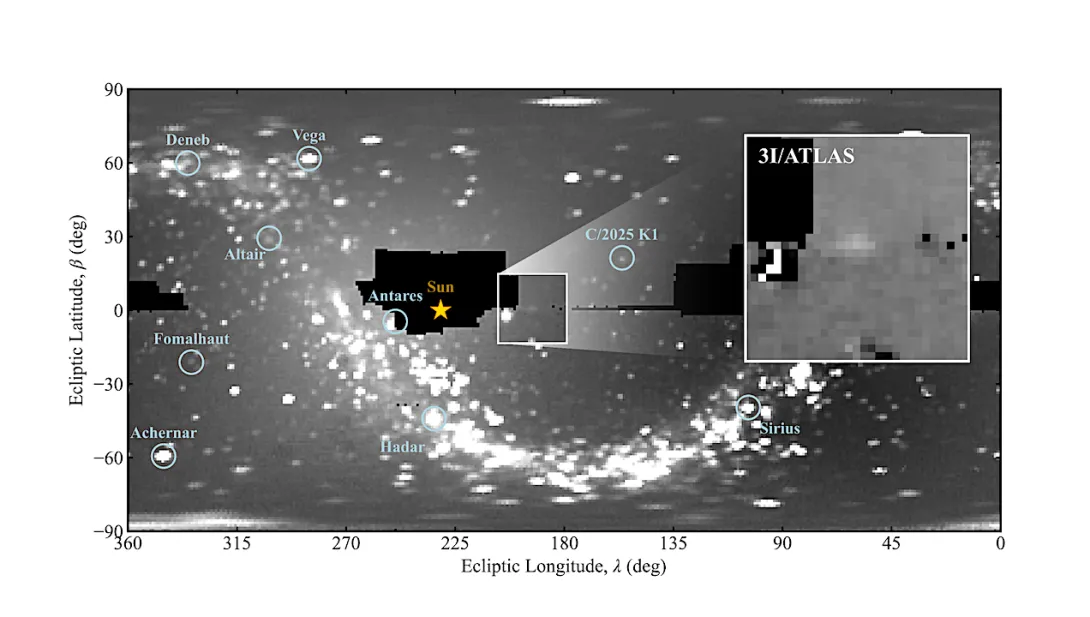
Astronomers worldwide have closely observed the object known as 3I/ATLAS during a rare and scientifically valuable celestial alignment, offering a brief window to study its motion, composition, and origin. Detected through advanced sky surveys, the object’s trajectory and timing created ideal conditions for coordinated observation across multiple observatories. Researchers say the alignment has enabled unusually precise measurements, deepening understanding of how such interstellar or fast-moving bodies behave as they pass through the solar system. The event underscores the growing role of global collaboration and data-driven astronomy in capturing fleeting cosmic phenomena.
A Rare Moment in the Night Sky
The observation of 3I/ATLAS coincided with an uncommon alignment of Earth-based telescopes and the object’s position relative to the sun. This geometry allowed astronomers to collect high-resolution data that is typically difficult to obtain for fast-moving celestial bodies.
Scientists described the alignment as short-lived, making timing critical. Missing such a window can mean waiting decades for a similar opportunity.
What Makes 3I/ATLAS Scientifically Significant
3I/ATLAS has drawn attention due to its unusual trajectory and velocity, characteristics that suggest it may not have originated within the solar system. Its movement differs from typical comets and asteroids, prompting researchers to examine whether it represents a broader class of interstellar visitors.
Early analysis indicates subtle variations in brightness and structure, offering clues about its composition and exposure to cosmic radiation over long distances.
Technology and Global Coordination at Work
The successful observation relied on a network of automated survey systems, precision tracking software, and rapid data sharing among international research teams. Modern astronomy increasingly depends on such coordination, especially when studying objects that move quickly across the sky.
Advanced imaging and spectroscopy tools allowed scientists to extract meaningful insights despite the object’s brief visibility window.
Implications for Planetary Science
Studying objects like 3I/ATLAS helps refine models of planetary formation and migration beyond the solar system. Each confirmed observation contributes to a growing dataset that informs how material is exchanged between star systems over cosmic timescales.
For researchers, these findings also help improve early detection systems, increasing the likelihood of identifying similar objects sooner in the future.
Looking Forward
Astronomers will continue analyzing data gathered during the alignment, with peer-reviewed findings expected in the coming months. As sky surveys become more sensitive, experts anticipate a rise in detections of rare and transient objects.
The observation of 3I/ATLAS serves as a reminder that the universe is dynamic and unpredictable—and that scientific readiness is essential to seize moments when the cosmos briefly reveals its secrets.
Comments