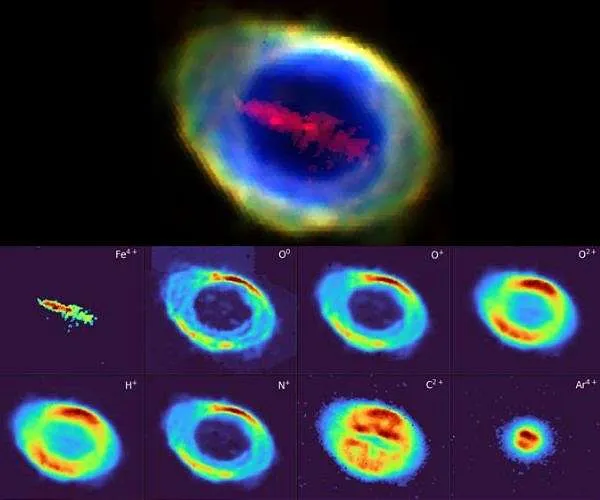
Astronomers have identified a puzzling iron-rich structure embedded deep within the Ring Nebula, one of the most extensively studied planetary nebulae in the Milky Way. The discovery challenges long-held assumptions about how dying stars shed material and distribute heavy elements into space. Detected through advanced spectroscopic analysis, the iron formation appears as a bar-like feature near the nebula’s core, raising fresh questions about stellar evolution and chemical complexity in late-stage stars. Scientists say the finding could reshape models of nebular dynamics and elemental dispersal, offering new insights into the cosmic recycling process that seeds future star systems.
A Surprising Find in a Familiar Cosmic Landmark
The Ring Nebula, located roughly 2,000 light-years from Earth, has long served as a textbook example of a planetary nebula—the glowing remains of a sun-like star nearing the end of its life cycle. Despite decades of observation, the newly detected iron structure went unnoticed until high-resolution instruments enabled more precise elemental mapping.
Researchers describe the feature as a concentrated, elongated formation rich in iron, an element typically expected to be dispersed more evenly or locked within dust grains.
How Advanced Tools Revealed the Iron Bar
The discovery was made possible through refined spectroscopic techniques capable of isolating faint chemical signatures amid the nebula’s luminous gases. By analyzing how light interacts with different elements, astronomers were able to distinguish iron emissions from surrounding materials.
This level of detail has only recently become achievable, underscoring how technological advances continue to extract new science from well-known celestial objects.
Implications for Stellar Evolution Models
Iron is forged deep within stars and is generally difficult to detect in planetary nebulae, as it often condenses into dust or remains hidden in complex chemical compounds. The presence of a distinct iron-rich structure suggests previously unaccounted-for physical processes during the star’s final evolutionary stages.
Astrophysicists are now reassessing how stellar winds, magnetic fields, or binary interactions might concentrate heavy elements in specific regions rather than dispersing them uniformly.
Rethinking the Chemistry of Nebulae
From a broader scientific perspective, the finding has implications beyond a single nebula. Planetary nebulae play a crucial role in enriching the interstellar medium with elements essential for planet formation and, ultimately, life.
If iron and other heavy elements can remain structured rather than fully dispersed, it may influence how raw materials are distributed in future star-forming regions.
What Comes Next for Researchers
Scientists plan to conduct follow-up observations using next-generation space- and ground-based telescopes to determine whether similar iron structures exist in other nebulae. Comparative studies could reveal whether the Ring Nebula is an exception or part of a broader, previously overlooked phenomenon.
As researchers refine their models, the discovery serves as a reminder that even the most familiar cosmic objects can still hold profound surprises, reshaping humanity’s understanding of how stars live—and die—in the universe.
Comments