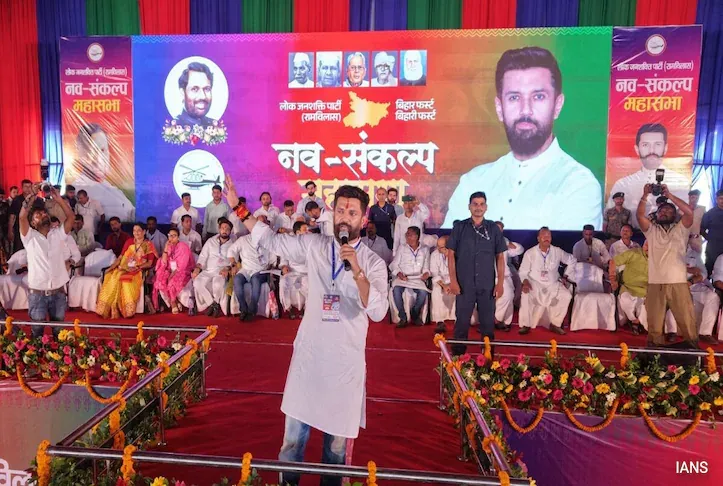
The recent killing of prominent businessman Gopal Khemka in Patna has ignited a political storm in Bihar, drawing rare public criticism from Union Minister Chirag Paswan against the state’s ruling leadership, including Chief Minister Nitish Kumar. Paswan, whose Lok Janshakti Party (Ram Vilas) is a key National Democratic Alliance (NDA) partner, condemned the deteriorating law and order situation and questioned the effectiveness of governance in Bihar. As the state heads toward crucial assembly elections later this year, the incident has intensified scrutiny on public safety and exposed tensions within the NDA coalition.
Political Repercussions of a High-Profile Crime
The fatal shooting of Gopal Khemka, a well-known businessman, outside his residence in one of Patna’s upscale neighborhoods has rattled political circles and reignited debate over the state’s internal security. What has made the incident even more politically charged is the proximity of the crime scene to the homes of influential political leaders, highlighting the brazenness of the attack.
Union Minister and LJP (Ram Vilas) chief Chirag Paswan minced no words in his response. “This is not just an isolated crime; it reflects a collapse of law and order,” Paswan stated, adding that such incidents in the capital indicate an even graver situation in rural Bihar. His remarks are significant, as they mark a break from the usual coalition solidarity maintained within the NDA.
NDA Alliance Under Strain?
Paswan’s rebuke of the Nitish Kumar-led administration is notable given his party’s current alliance with the NDA. While he has not explicitly announced any change in political alignment, the pointed criticism raises questions about whether the LJP (Ram Vilas) will reassess its position in the alliance ahead of the state elections.
“The alliance we are part of is recognized for good governance, but in Bihar, that legacy is under serious threat,” Paswan said. He called for “exemplary action” that would serve as a deterrent, signaling dissatisfaction with current law enforcement efforts.
Though the LJP is expected to remain with the NDA, internal fault lines may become more pronounced as the election season unfolds.
Investigative Response and Public Backlash
In response to the public outcry and mounting political pressure, the Bihar Police have constituted a Special Investigation Team (SIT) to probe the murder. However, opposition leaders and civil society remain skeptical about the efficacy of such measures unless followed by tangible outcomes.
Tejashwi Yadav of the Rashtriya Janata Dal (RJD) echoed Paswan’s concerns, alleging that the state machinery had utterly failed to maintain law and order. His critique, though predictable from an opposition leader, gains added weight when reflected in the statements of an NDA minister.
This bipartisan condemnation places Chief Minister Nitish Kumar in a politically vulnerable position as questions grow over his administration’s ability to ensure public safety.
Broader Implications for Governance and Public Trust
The murder has reignited a broader debate over Bihar’s governance model. Once lauded for implementing reforms that curbed lawlessness, the current administration now faces criticism reminiscent of the pre-2005 era, when the state was often portrayed as synonymous with crime and political instability.
The incident also points to an increasing perception gap between the government’s public messaging on safety and the lived realities of its citizens. The fact that a high-profile individual could be assassinated near a high-security area raises serious concerns about the capabilities and responsiveness of the police force.
As Paswan aptly put it, “If this is happening in the heart of the city, imagine the condition in the hinterlands.”
Outlook Ahead of the State Elections
With Bihar’s assembly elections on the horizon, the law and order narrative is expected to dominate campaign discourse. For the NDA, maintaining unity while addressing internal discontent will be critical. For the opposition, the situation offers a potent rallying point to target the ruling coalition.
Whether this incident catalyzes policy reform or becomes another fleeting controversy will depend on how swiftly and effectively the government acts—not just in investigating the murder, but in restoring public confidence in its ability to govern.
Comments