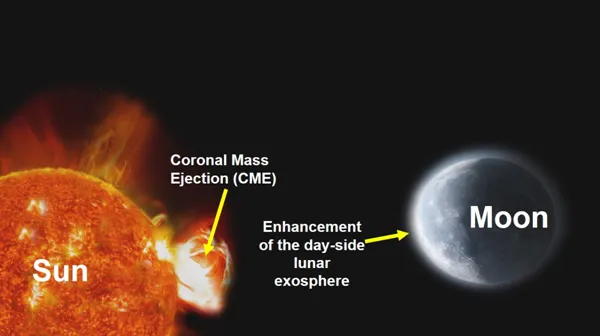
India’s Chandrayaan-2 mission has provided unprecedented observations of how Coronal Mass Ejections (CMEs) from the Sun affect the Moon’s surface and exosphere. The mission’s orbiter instruments detected charged particle interactions and transient changes in lunar surface composition during CME events, offering critical insights into space weather effects on airless celestial bodies. These findings enhance our understanding of radiation exposure, lunar dust dynamics, and the Moon’s tenuous exosphere—information vital for future crewed missions and long-term lunar exploration. Scientists believe this data could also inform protective measures for satellites and astronauts in the harsh solar environment of deep space.
Understanding Coronal Mass Ejections (CMEs)
CMEs are massive bursts of solar plasma and magnetic fields released from the Sun’s corona, traveling through space at millions of kilometers per hour. When these charged particle clouds interact with planetary bodies, they can induce electrical currents, strip surface atoms, and disturb tenuous atmospheres, such as the Moon’s exosphere. Chandrayaan-2’s observations provide direct evidence of these interactions on an airless body, filling gaps in our knowledge about solar-lunar space weather dynamics.
Chandrayaan-2’s Instrumentation and Observations
The mission’s orbiter is equipped with advanced sensors capable of detecting plasma flux, magnetic field variations, and elemental composition of the lunar surface. During recent CME events, instruments recorded temporary fluctuations in ionized particles above the Moon and subtle surface chemistry alterations. These findings are crucial for understanding how solar activity affects surface-bound resources and exospheric gases, which could influence future exploration and utilization strategies.
Implications for Lunar Exploration
Understanding CME effects is essential for the safety and success of crewed missions to the Moon. Radiation exposure from such solar events poses risks to astronauts and electronic equipment. Data from Chandrayaan-2 allows space agencies to model protective shielding and optimize landing sites and surface operations, enhancing mission planning and sustainability for long-term lunar presence.
Contributions to Space Science
Chandrayaan-2’s findings provide valuable insights for planetary scientists, space weather experts, and astrophysicists. Observing CME-induced changes on the Moon helps refine models of solar-terrestrial interactions, improves predictions for satellite operations, and contributes to broader comparative planetology studies. This knowledge is instrumental in preparing humanity for safe and sustainable exploration of the Moon and beyond.
Future Prospects
The data collected by Chandrayaan-2 will support ongoing research and influence the design of upcoming missions, including Chandrayaan-3 and international lunar projects. Enhanced understanding of CMEs’ impact will guide development of resilient spacecraft systems, safe habitat designs, and sustainable strategies for harnessing lunar resources amid the dynamic environment of deep space.
Comments