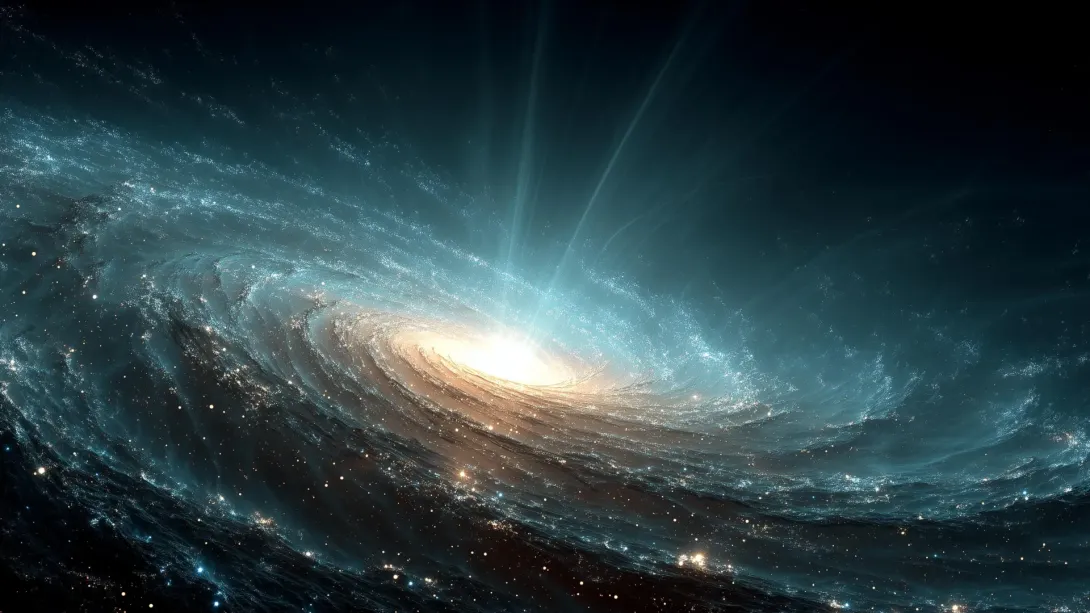
Scientists have taken a major step toward decoding the universe’s hidden architecture by creating an advanced map of matter that cannot be directly observed. This “invisible universe,” dominated by dark matter and elusive cosmic forces, shapes the formation and motion of galaxies across vast distances. By combining deep-space observations with sophisticated computational models, researchers have traced how unseen structures influence the visible cosmos. The project offers new insight into the universe’s underlying framework, improves the precision of cosmological models, and brings scientists closer to understanding the forces that govern cosmic evolution beyond what telescopes can visibly capture.
A New Way to See the Unseen
The latest map does not rely on direct imaging. Instead, it reconstructs invisible structures by studying how gravity subtly distorts light traveling from distant galaxies. These distortions, known as gravitational lensing effects, allow scientists to infer the distribution of dark matter, which accounts for the majority of the universe’s mass yet emits no light.
Dark Matter at the Center of the Model
At the core of the research is dark matter, an unknown substance believed to shape the large-scale structure of the universe. By mapping how this invisible mass bends light and influences galactic motion, scientists have produced a detailed blueprint of cosmic scaffolding. The results show dense filaments connecting galaxy clusters, reinforcing the idea that the universe is woven together by an intricate dark matter network.
Technology Powering the Breakthrough
The project draws on data collected from powerful space- and ground-based observatories, supported by high-performance computing systems. Advanced algorithms processed enormous volumes of data to convert faint gravitational signals into a coherent, three-dimensional map. This fusion of astronomy and data science marks a turning point in how cosmological research is conducted.
Implications for Cosmology and Physics
The invisible universe map has significant implications for understanding cosmic expansion, the behavior of gravity on large scales, and the nature of dark energy. By refining measurements of how matter is distributed, scientists can test competing theories of the universe’s origin and long-term fate with greater accuracy.
Rewriting Models of Cosmic Evolution
Early findings suggest subtle deviations from existing cosmological predictions, prompting fresh debate within the scientific community. These discrepancies could lead to adjustments in current models or, potentially, to entirely new physics that better explains the universe’s hidden components.
Comments