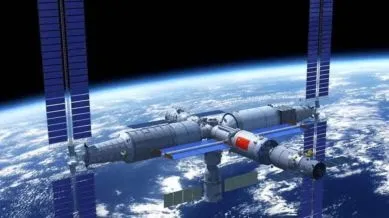
China has introduced its first artificial intelligence (AI) chatbot aboard its space station, aiming to enhance operational efficiency and support taikonauts during missions. The AI system is designed to assist with routine tasks, provide real-time information, and improve decision-making in space, reflecting China’s growing investment in integrating advanced technologies into its aerospace program. Analysts suggest that this initiative could reduce human workload, increase mission safety, and accelerate scientific research. By leveraging AI in space operations, China is positioning itself at the forefront of technological innovation, setting new benchmarks for automation and human-machine collaboration in extraterrestrial environments.
AI Chatbot Deployment on the Space Station
The newly deployed AI chatbot operates as an intelligent assistant for taikonauts, capable of answering technical queries, offering procedural guidance, and monitoring systems aboard the station. Its real-time capabilities enable astronauts to perform complex tasks with greater accuracy, reducing reliance on Earth-based support and minimizing potential operational delays.
Technological Capabilities
Equipped with natural language processing and machine learning algorithms, the chatbot can interpret commands, provide context-aware responses, and continuously improve through interaction. It can also assist in routine scientific experiments, track inventory, and predict maintenance needs, ensuring that critical systems operate seamlessly during extended missions.
Strategic Implications
Experts note that integrating AI into manned missions demonstrates China’s commitment to advancing autonomous systems in space exploration. This deployment aligns with global trends emphasizing AI-assisted space operations, offering competitive advantages in mission efficiency and safety. Furthermore, it reflects the broader goal of reducing human workload while enhancing the accuracy and speed of in-orbit decision-making.
Future Prospects
The introduction of the AI chatbot paves the way for more advanced autonomous systems in future space missions. By combining AI with robotics and sensor networks, China aims to create a fully integrated, intelligent space station environment capable of supporting long-duration human presence and complex research initiatives.
Conclusion
China’s AI chatbot represents a significant milestone in human-machine collaboration in space, demonstrating the potential of intelligent systems to transform mission operations. As AI technologies evolve, their application in space exploration is likely to expand, enhancing safety, efficiency, and scientific output, while redefining the future of extraterrestrial human activity.
Comments