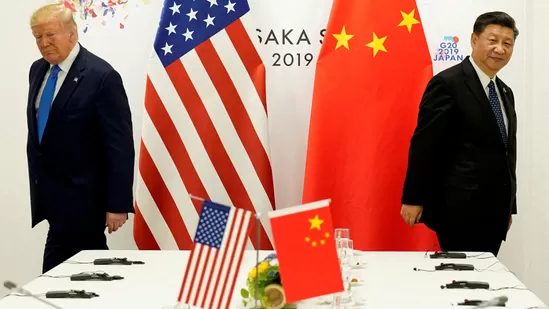
In a sharp and symbolic maneuver, China has announced immediate restrictions on the import of Hollywood films, in response to heightened U.S. tariffs on Chinese goods initiated by President Donald Trump. The National Film Administration’s decision is widely viewed as a retaliatory gesture with minimal economic cost but considerable political resonance. While the practical impact on China’s domestic film industry may be limited, the move underscores Beijing’s willingness to challenge American cultural exports in a domain that once relied heavily on Chinese audiences. This development highlights the shifting dynamics between trade policy and soft power on the global stage.
A Cultural Counterstrike to Economic Warfare
The latest salvo in the ever-evolving U.S.–China trade conflict has taken an unexpected turn—through cinema. Following the Trump administration’s decision to impose a steep 125% tariff on Chinese imports, China’s National Film Administration (NFA) swiftly retaliated by curbing the flow of Hollywood films into its domestic market. Though cloaked in the language of “market discipline” and “audience preference,” the political undertone is unmistakable. For over three decades, China has maintained a steady intake of ten Hollywood films annually. That number, while modest, has historically served as a bridge for cultural diplomacy and soft power exchange. Now, in an era of increased protectionism, even cinema has become collateral in a high-stakes geopolitical chess game.
China’s Domestic Market No Longer Needs Hollywood
The most compelling facet of this decision is not the restriction itself, but what it reveals about China’s evolving entertainment ecosystem. For years, Hollywood studios depended on the vast Chinese market to recoup the increasingly astronomical budgets of blockbuster films. However, the tide has turned. Chinese audiences are now flocking to homegrown productions. The animated feature Ne Zha 2 recently dethroned Pixar’s Inside Out 2, becoming the highest-grossing animated film in China’s history. This milestone reflects a significant shift in consumer sentiment and creative dominance. In short, China no longer needs Hollywood to sustain its box office economy. The NFA’s move, while politically charged, carries virtually no domestic risk. As Chris Fenton, author and expert on U.S.–China media relations, aptly put it, this is “a super high-profile way to make a statement of retaliation with almost zero downside for China.”
The Stock Market Implications for U.S. Studios
From an investor standpoint, the immediate concern lies in how this move impacts Hollywood’s publicly traded parent companies—such as Disney, Warner Bros. Discovery, Paramount Global, and Comcast (owner of Universal Pictures). Historically, Chinese box office receipts have accounted for 10–15% of global revenue for tentpole films. For example, Disney’s Avengers: Endgame grossed over $600 million in China alone. With access to that revenue stream now uncertain or reduced, institutional investors may begin to factor in lower international upside in their valuations of entertainment stocks. In pre-market and early trading, shares of entertainment giants reacted with caution. Disney saw a modest dip of 1.2%, while Warner Bros. Discovery slipped 0.8%, reflecting investor unease about the long-term implications of reduced global reach. Streaming platforms, however, remained largely unaffected, given their limited exposure in mainland China due to government restrictions.
Hollywood's Waning Soft Power in the East
Beyond the financial ramifications, the restriction is a clear sign that China is recalibrating its tolerance for foreign influence. For years, Hollywood was not just an entertainment exporter—it was a global megaphone for American values, narratives, and soft power. But as Beijing doubles down on cultural sovereignty, the Hollywood-to-China pipeline is increasingly being viewed as a liability rather than an asset. This isn't just about box office numbers; it's about control of the narrative. China is developing its own cinematic language, informed by domestic traditions, national identity, and political ideology. The rise of Chinese studios, actors, and production companies has further marginalized the relevance of Western cinema in its home market.
A Calculated Symbolism with Global Ripples
While the immediate financial impact on Hollywood may not be devastating, the symbolism is profound. China has chosen to push back in a domain that blends art, commerce, and ideology. Unlike rare earth metals or tech components, film imports carry no critical strategic value—yet they command immense cultural capital. This calculated restraint speaks volumes: China is prepared to target America’s soft power assets while safeguarding its own domestic industries. In doing so, it reveals a growing confidence in its ability to produce, export, and sustain cultural products that resonate globally—on its own terms.
Conclusion: The Cinema Cold War
What was once an amicable exchange of entertainment across borders has morphed into yet another battlefield in the intensifying U.S.–China standoff. As tariffs escalate and cultural gates close, the prospect of a cinematic Cold War becomes increasingly plausible. Hollywood may soon have to pivot its business model away from foreign dependency and rediscover the strength of domestic and diversified global audiences. Meanwhile, China’s signal is unmistakable: it is no longer merely a consumer of stories—it intends to become one of the most influential storytellers on the world stage. And in the realm of geopolitics, the narrative is everything.
Comments