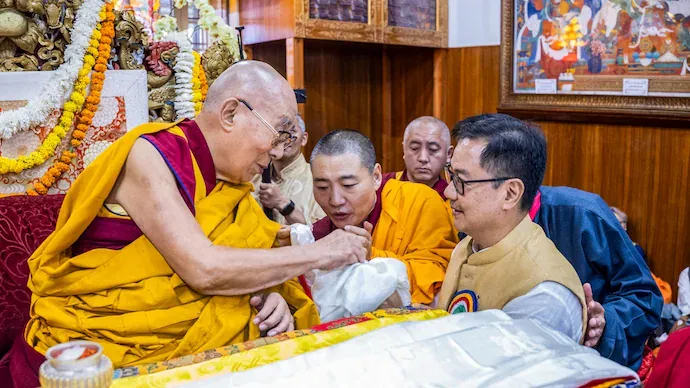
China has formally expressed strong disapproval of Prime Minister Narendra Modi’s felicitations to the Dalai Lama on his 90th birthday and the attendance of several Indian ministers at the celebrations in Dharamshala, reiterating its long-held stance on Tibet-related matters. Beijing accuses the Dalai Lama of separatist activities disguised as religious leadership and warns India against interfering in China’s internal affairs. Meanwhile, the Dalai Lama’s recent declaration affirming the continuation of his reincarnation system has further intensified diplomatic sensitivities. This episode underscores the persistent geopolitical tensions between India and China surrounding Tibet and the Dalai Lama’s status.
India-China Rift Deepens Over Dalai Lama Birthday Observances
The diplomatic friction between India and China escalated sharply after Prime Minister Narendra Modi extended public congratulations to the Dalai Lama on his 90th birthday, praising him as a global symbol of compassion and moral rectitude. Modi’s message, shared on social media platform X, was followed by the presence of high-profile Indian leaders at the Dalai Lama’s residence in Dharamshala, Himachal Pradesh, for birthday celebrations.
China promptly registered its objection through Foreign Ministry spokesperson Mao Ning, who reaffirmed Beijing’s consistent and unequivocal position on Tibet. Mao criticized India for what China perceives as a deliberate politicization of the Dalai Lama issue and warned New Delhi against undermining China’s sovereignty.
Beijing’s Position on Tibet and the Dalai Lama’s Political Role
The Chinese government categorizes the Dalai Lama as a political exile engaged in efforts to fragment China under the pretext of religious leadership. Mao Ning emphasized that the Dalai Lama's activities are fundamentally separatist in nature and that India must respect prior commitments made to China concerning Tibet (referred to as Xizang in Chinese nomenclature).
The Chinese Embassy in India also condemned the Dalai Lama’s recent announcement affirming the continuation of the reincarnation tradition, declaring that the spiritual leader lacks the authority to make decisions about the future of this religious institution. This stance aligns with Beijing’s assertion that it will control the selection process of future Dalai Lamas, a position that has consistently been a flashpoint in Sino-Indian relations.
Indian Leadership’s Stance and Regional Political Participation
Prime Minister Modi’s warm wishes highlighted the Dalai Lama’s universal appeal across faiths and his role as a beacon of compassion and patience. The involvement of Union ministers Kiren Rijiju and Rajiv Ranjan Singh, along with regional leaders such as Arunachal Pradesh’s Chief Minister Pema Khandu and Sikkim’s Sonam Lama, signals India's ongoing political and cultural support for the Tibetan spiritual leader.
This participation is particularly sensitive given the strategic significance of border states like Arunachal Pradesh and Sikkim, regions where China’s territorial claims have been a source of longstanding dispute with India.
Diplomatic Sensitivities and Bilateral Relations
Last week, China also voiced concerns over remarks by Minister Kiren Rijiju endorsing the Dalai Lama’s right to determine his own reincarnation, cautioning India to exercise restraint on Tibet-related matters to preserve the trajectory of bilateral relations.
The recent statement by the Dalai Lama regarding the continuation of the reincarnation lineage through the Gaden Phodrang Trust further complicates this delicate diplomatic terrain. Beijing’s assertion that it alone has jurisdiction over this religious succession adds another layer of tension to an already fraught relationship.
Conclusion
The celebrations of the Dalai Lama’s 90th birthday have rekindled the complex interplay of religious, cultural, and geopolitical factors that define India-China relations. While India asserts its sovereign right to honor a revered spiritual figure residing within its borders, China perceives these actions as provocations infringing upon its territorial and political sovereignty.
As the two Asian giants navigate these sensitive issues, the Dalai Lama’s status continues to be a potent symbol around which broader strategic contestations are played out, making the path toward bilateral rapprochement increasingly challenging.
Comments