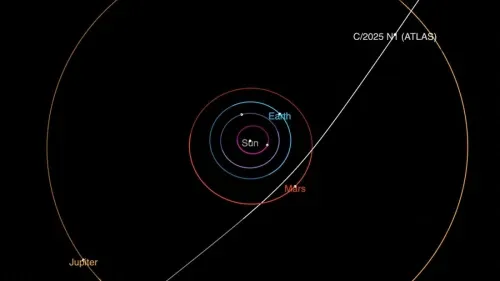
A mysterious comet originating from beyond our solar system has reignited scientific curiosity at Harvard and across the global astronomy community. The object, traveling at an extraordinary velocity and exhibiting an unusual trajectory, challenges long-held assumptions about the formation of comets and the structure of interstellar space. Researchers at Harvard’s astrophysics department are leading efforts to decode its composition, behavior, and possible origin — raising profound questions about what lies beyond the boundaries of our known cosmic neighborhood.
This rare visitor from the deep cosmos is more than just a spectacle; it could be a messenger carrying secrets from other star systems, possibly even clues to the fundamental processes that shaped our own solar system billions of years ago.
The Comet That Defies Convention
The comet — detected by ground-based observatories earlier this year — is believed to be traveling at speeds exceeding 100,000 kilometers per hour, suggesting it did not originate within the gravitational influence of our sun. Its hyperbolic trajectory confirms that it entered our solar system from interstellar space, much like the enigmatic object ‘Oumuamua discovered in 2017 and Comet Borisov that followed in 2019.
However, what distinguishes this new comet is its unusual spectral signature — an indication that its composition may differ significantly from any known comet observed before. Early data suggest the presence of complex organic compounds and frozen gases, which could reveal how planetary systems evolve in environments far different from our own.
Harvard scientists are examining how such an object could have been ejected from its home star system and what its materials might reveal about the conditions in other parts of the galaxy.
Harvard’s Research Initiative: Searching for Cosmic Clues
Under the guidance of Professor Avi Loeb and a team of astrophysicists at the Harvard-Smithsonian Center for Astrophysics, researchers are employing advanced optical spectroscopy and high-resolution imaging to study the comet’s motion and chemical composition. Their findings may determine whether this interstellar object formed naturally — or whether its properties hint at something far more unusual, such as non-natural origins or anomalies in its structure.
According to preliminary analyses, the comet’s reflectivity and acceleration are inconsistent with typical icy bodies, raising speculation that unseen forces or unique surface materials could be influencing its movement. Harvard’s research team aims to compile a detailed physical profile as the comet approaches its closest point to the sun, offering an unprecedented opportunity for real-time observation.
Implications for Understanding the Universe
If the comet’s interstellar nature is confirmed, it will represent another rare data point in humanity’s study of extrasolar material — tangible evidence from beyond our solar cradle. Each interstellar visitor provides scientists with fresh insights into the chemical diversity, dynamical interactions, and potential for life-supporting compounds elsewhere in the universe.
Astronomers believe that such comets may have played a role in spreading organic molecules across space, potentially seeding planets like Earth with the building blocks of life. The discovery also underscores how dynamic and interconnected the Milky Way truly is — with celestial debris constantly traversing vast distances between stars.
Public Fascination and Scientific Responsibility
The discovery has captured public imagination, inspiring a wave of discussions about cosmic mysteries and the possibility of other intelligent civilizations. However, Harvard researchers remain cautious, emphasizing the importance of rigorous data analysis and peer review before drawing any extraordinary conclusions.
“The universe often surprises us,” one Harvard astronomer commented. “But science requires us to separate wonder from speculation. This comet is a gift — a piece of the galaxy that has come to visit us — and our responsibility is to learn from it with precision.”
Their sentiment echoes a broader truth: scientific discovery thrives on humility, curiosity, and evidence, not sensationalism.
Looking Ahead: A New Era of Cosmic Exploration
As the comet continues its journey through the solar system before vanishing back into interstellar darkness, scientists are racing against time to gather as much information as possible. Data collected from this celestial traveler could influence future space missions, asteroid research, and even planetary defense strategies.
The event also highlights the growing role of international collaboration and advanced technology — from deep-space telescopes to AI-driven analytics — in decoding the universe’s most elusive phenomena.
Harvard’s work on this interstellar mystery is a reminder that, even in an age of rapid scientific progress, the cosmos still holds infinite unknowns waiting to be explored.
Conclusion: A Visitor from the Galactic Unknown
The arrival of this mysterious comet has once again reminded humanity of its small yet significant place in the vast expanse of space. As Harvard’s astronomers peer into the depths of the unknown, they are not merely studying a frozen ball of gas and dust — they are listening to a cosmic whisper from beyond the stars, a message that may deepen our understanding of where we come from and where we might go.
In the silent trail of a passing comet, science finds its poetry — and humankind, its enduring curiosity.
Comments