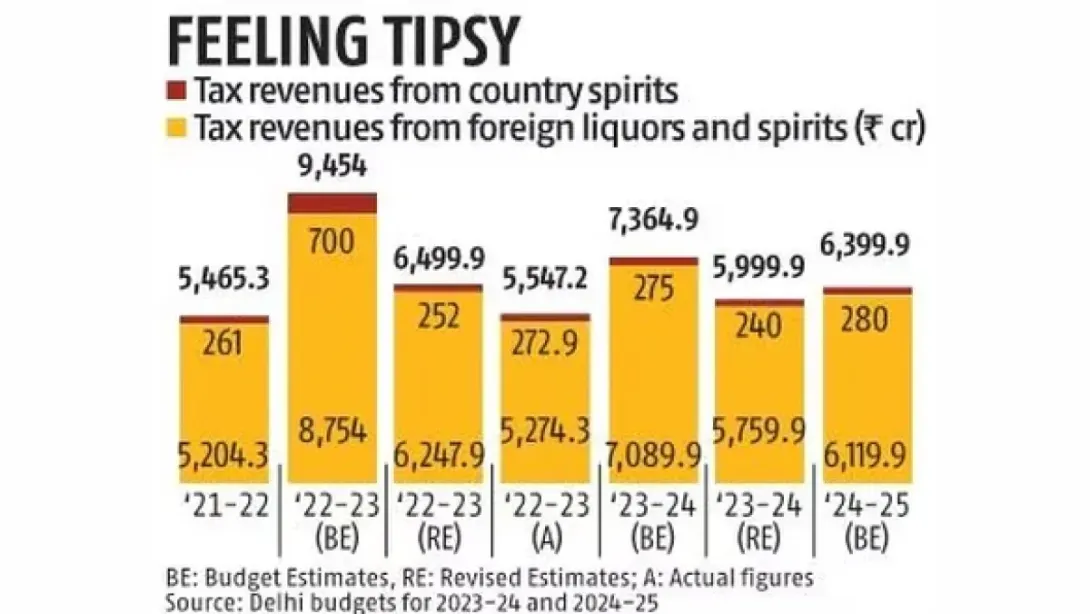
Delhi’s excise collections for the April–September half of FY26 surged by over 12 percent, reaching Rs. 4,192.86 crore, driven largely by higher liquor sales and improved enforcement measures. The growth signals healthy demand and provides momentum toward achieving the revised annual target of Rs. 6,000 crore. Excluding VAT, monthly excise receipts leapt by nearly 85 percent over the same period last year. Meanwhile, officials are preparing a new excise policy to modernize pricing, licensing, and regulatory oversight. While the festival season may create further upside, authorities will need to calibrate policy levers carefully to sustain revenue gains and ensure social responsibility.
---
Accelerated Growth in Excise Collections
Delhi’s excise revenue (inclusive of VAT) rose from Rs. 3,731.79 crore in April–September FY25 to Rs. 4,192.86 crore in the same period of FY26—a growth exceeding 12 percent. Authorities note that the current estimate may still be conservative, as VAT data is available only up to September 16. The surge, largely attributed to increased liquor consumption, has already pushed the government past the halfway mark of its revised Rs. 6,000 crore target for the full year.
The bulk of the acceleration came in the excise receipts excluding VAT, which rose sharply: from cumulative monthly receipts of Rs. 279.81 crore in FY25 to Rs. 517.26 crore in FY26—an 84.86 percent jump. On a broader base, the excise revenue (excluding VAT) also climbed, from Rs. 2,598.04 crore in FY25 to Rs. 3,043.39 crore in FY26—a 17 percent increase.
---
Drivers Behind the Uptick
1. Robust Liquor Demand and Consumption
A key driver has been sustained demand for alcoholic beverages, likely buoyed by the easing of pandemic-era restrictions, pent-up consumer demand, and seasonal and festive consumption. The excise department’s push to maintain adequate stock levels at government-run vends also appears to have enhanced reach and sales volume.
2. Sharper Enforcement and Compliance Measures
The government has reiterated instructions to its liquor-retailing bodies to streamline supply chain processes and ensure availability ahead of festival periods. By mitigating supply bottlenecks and preventing stock-outs, the administration enhances revenue upside.
3. Policy Adjustments and Revenue Target Revision
Initially pegged at Rs. 7,000 crore for FY26, the excise revenue target was later revised downward to Rs. 6,000 crore in acknowledgment of market uncertainties. Despite that, Delhi has crossed the halfway mark in collections midway through the year.
Simultaneously, a high-level committee—led by the PWD minister—is formulating a new excise policy aimed at improving transparency, adjusting margins, updating maximum retail prices (MRP), and possibly enabling private participation in aspects of the retail trade.
---
Challenges and Structural Considerations
Pricing Stagnation & Margin Pressure
Excise tax rates in Delhi have not been revised since 2014, and MRP adjustments were last made three years ago. This rigidity may squeeze margins or result in revenue loss if brand shifts or smuggling intensify.
Spillover to Neighboring Regions
Lower excise rates and MRPs in neighboring jurisdictions like Noida, Ghaziabad, Faridabad, and Gurugram encourage cross-border liquor purchases, leading to leakage of potential revenues for Delhi.
Policy Execution and Transition Risks
The proposed new excise policy faces operational and political complexities. If drafting or implementation is delayed, the existing duty regime must carry over, which may not address structural inefficiencies or evolving consumption patterns.
Volatility in Demand Patterns
Consumption of liquor tends to be sensitive to macroeconomic trends, disposable incomes, regulatory changes, and social norms. Seasonal peaks (e.g., Diwali) may amplify revenues, but any adverse shifts in consumption behavior or enforcement can quickly reverse gains.
---
Outlook: Sustaining Momentum, Calibrating Risks
With strong momentum in hand, Delhi has a plausible path toward meeting or slightly exceeding the revised excise target, particularly if festival demand remains robust. However, realizing this potential will rely heavily on policy agility, supply-side efficiency, and demand stability.
To guard gains, the following strategic imperatives are critical:
Timely implementation of the new excise policy, with provisions to revise margins, tax rates, and facilitate a more responsive licensing regime.
Dynamic monitoring of cross-border leakage, potentially via coordinated excise agreements with neighbouring states to reduce arbitrage.
Enhanced regulatory oversight to clamp down on unlicensed liquor sales, bootlegging, and evasion through periodic audits and enforcement actions.
Data-driven adjustments during lean periods—e.g., mid-year course corrections—should revenue trends deviate from projections.
Comments