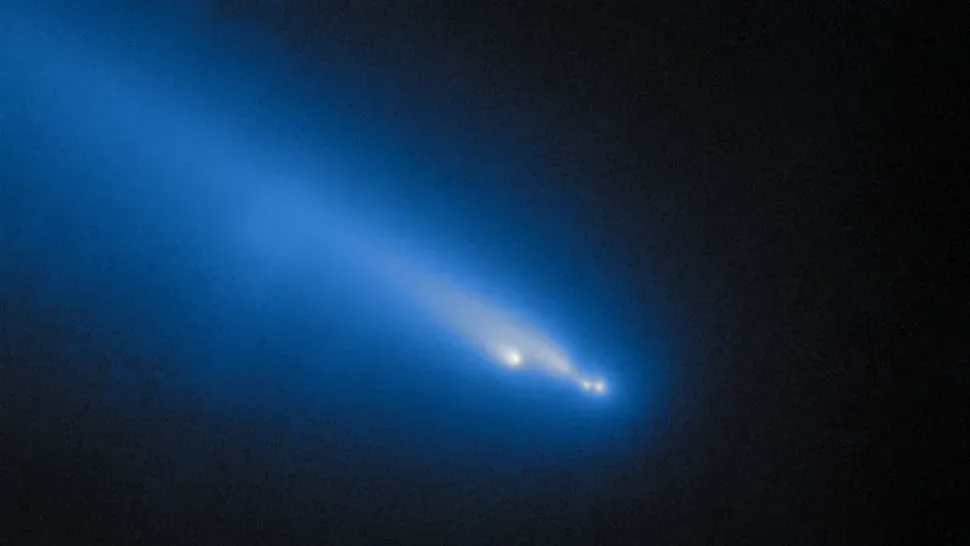
New images captured by the Gemini North telescope have revealed that comet C/2025 K1 (ATLAS) is breaking apart as it travels through the inner solar system, offering scientists a rare glimpse into the fragile nature of these ancient celestial objects. The observations show clear signs of structural collapse, with fragments and dust spreading along the comet’s trajectory. Astronomers say the disintegration likely results from thermal stress and volatile outgassing as the comet approaches the Sun. The findings provide valuable insights into comet composition, evolution, and the dynamic forces shaping small bodies in space.
Striking Observations From Gemini North
Astronomers using the Gemini North telescope in Hawaii have documented compelling evidence that comet C/2025 K1 (ATLAS) is actively crumbling. High-resolution images reveal a diffuse, elongated structure rather than a compact nucleus, suggesting that the comet’s core is fragmenting into smaller pieces.
The observations were made as the comet moved closer to the Sun, a phase during which comets often experience heightened physical stress. The data indicate that C/2025 K1 is no longer a single coherent body but a cluster of debris traveling along a shared orbital path.
Why the Comet Is Breaking Apart
Scientists attribute the comet’s disintegration to a combination of rising temperatures and internal pressure caused by sublimating ices. As frozen gases within the nucleus rapidly vaporize, they can fracture the comet from the inside, particularly if its structure is weak or porous.
Such breakups are not uncommon among dynamically young comets, which may be making their first or one of their earliest passages through the inner solar system. These objects have not previously been hardened by repeated solar encounters, making them especially vulnerable.
Scientific Value of a Rare Event
The fragmentation of comet C/2025 K1 presents a valuable research opportunity. By studying how the comet breaks apart, astronomers can better understand the mechanical strength and chemical makeup of cometary nuclei—often described as time capsules from the solar system’s formation.
Observations of debris dispersal and brightness changes also help refine models of comet behavior, improving predictions for future objects detected by global sky surveys.
Broader Implications for Planetary Science
Events like the breakup of C/2025 K1 underscore the dynamic and transient nature of small solar system bodies. They also highlight the importance of advanced ground-based observatories such as Gemini North, which can respond quickly to rapidly evolving astronomical phenomena.
As next-generation telescopes and surveys come online, scientists expect to witness more such events in unprecedented detail—deepening humanity’s understanding of how the solar system continues to evolve, fragment, and renew itself over cosmic time.
Comments