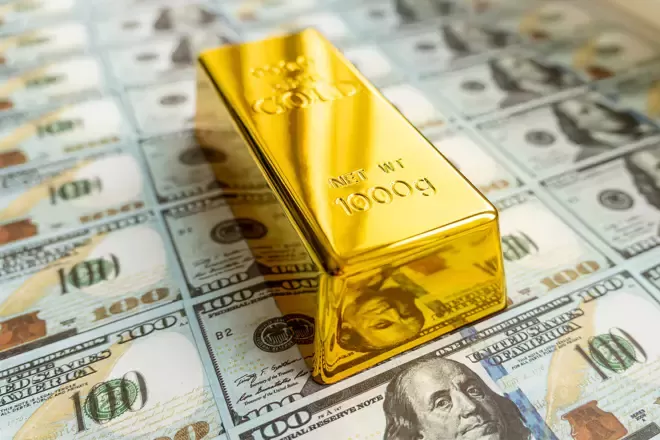
Gold prices retreated on Friday, shedding recent gains as a resurgent US Dollar offset safe-haven demand driven by escalating trade tensions. The yellow metal slipped to around Rs. 3,280 in North American trading hours, pressured by a stronger dollar that rose to nearly 99.60 on the US Dollar Index. Renewed fears of trade discord emerged after former President Trump accused China of breaching bilateral trade pacts, heightening investor caution. Meanwhile, weaker-than-expected US inflation data—particularly in the Federal Reserve’s preferred PCE gauge—added to the market’s uncertainty, although it had limited impact on monetary policy expectations for now.
Renewed Trade Discord and Dollar Resilience
The resurgence of trade tensions between Washington and Beijing cast a shadow over global financial markets. In a post on Truth.Social, former President Donald Trump claimed that China had “totally violated” existing trade agreements, stoking fears of further retaliatory measures. These comments reignited worries about global trade, typically a catalyst for safe-haven demand.
Yet, the impact on gold was muted by a concurrent rally in the US Dollar. The Dollar Index advanced to nearly 99.60, reflecting renewed investor appetite for the Greenback amid global trade uncertainty. A stronger dollar typically dampens gold demand by making it more expensive for buyers using other currencies.
Legal Challenges and Tariff Uncertainty
Adding to the market’s apprehension was the latest legal maneuver in the tariff saga. The US Court of Appeals suspended an earlier trade court ruling that had deemed most of the Trump-era tariffs illegal. This decision preserved the President’s emergency powers under the International Emergency Economic Powers Act (IEEPA), keeping tariff threats alive.
These tariffs, which Trump initially imposed on trading partners and certain commodities like fentanyl, have long been a flashpoint in global trade. The uncertainty over the permanence of these measures is weighing heavily on investor confidence, particularly in export-driven sectors.
Tepid US Inflation Data and Limited Market Impact
Meanwhile, fresh US economic data showed that core Personal Consumption Expenditures (PCE)—the Federal Reserve’s favored inflation barometer—rose by 2.5% year-over-year in April, in line with expectations but down from March’s revised figure of 2.6%. Headline PCE inflation also cooled to 2.1%, below both forecasts and the prior month’s 2.3% rate.
On a monthly basis, both the headline and core PCE rose by 0.1%, as projected. However, this moderation in inflationary pressures did little to sway market expectations for the Federal Reserve’s policy path, given the overshadowing trade uncertainties and the Fed’s focus on longer-term consumer inflation expectations.
Fed’s View and Business Sentiment
Chicago Federal Reserve Bank President Austan Goolsbee underscored the challenge for policymakers. He noted that persistent uncertainty surrounding tariff policies was dampening business investment, as companies struggle to navigate shifting trade landscapes. Goolsbee suggested that if tariffs were ultimately lifted through a negotiated deal, the Fed could consider lowering interest rates to support growth.
However, any resolution remains distant. White House trade adviser Peter Navarro reiterated the administration’s intent to maintain tariffs by “another way” if legal challenges intensify, amplifying the sense of policy unpredictability.
Conclusion: A Delicate Balancing Act for Investors
Gold’s retreat amid these complex crosscurrents underscores the delicacy of balancing safe-haven demand with a robust US Dollar and wavering inflation data. While the precious metal’s traditional appeal as a geopolitical hedge persists, its performance is increasingly shaped by the interplay of trade policy uncertainties and the dollar’s resilience.
For investors navigating this environment, the evolving rhetoric on trade, combined with legal battles and monetary policy ambiguity, will remain crucial determinants of market direction in the near term.
Comments