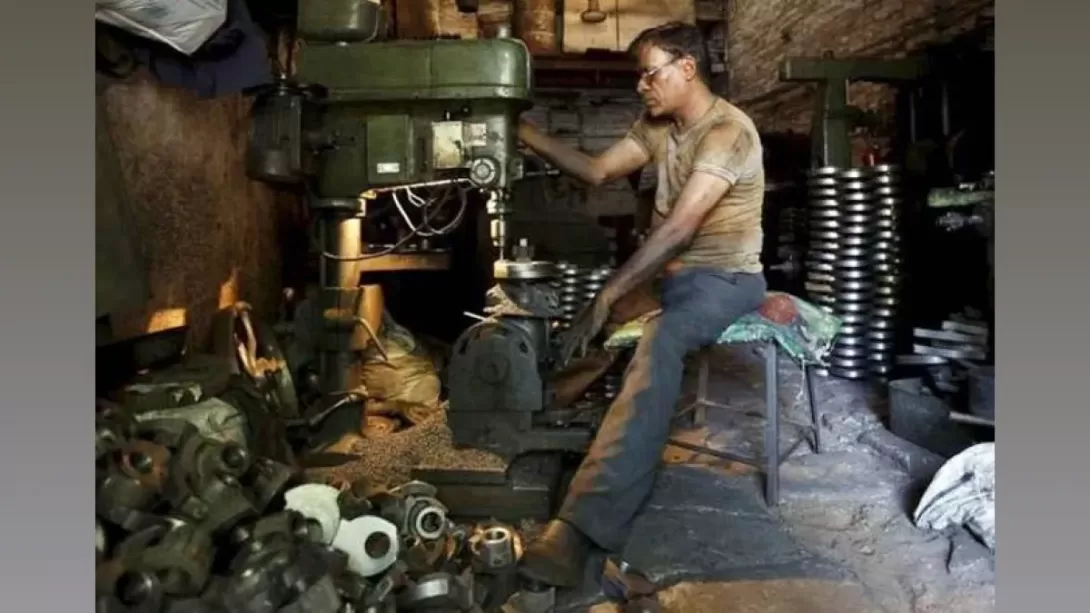
In a bid to enhance the Make in India initiative, the government has established an inter-ministerial committee to draft the framework for the proposed National Manufacturing Mission. Headed by Niti Aayog CEO B.V.R. Subrahmanyam, the committee is conducting consultations with stakeholders across sectors. The mission, announced in the Union Budget of 2025, aims to improve the ease of doing business, create a future-ready workforce, strengthen the MSME sector, and promote technological innovation. With India’s manufacturing sector contributing around 16-17% to GDP, the government is focused on expanding this share to foster global competitiveness.
Government Takes Concrete Steps Towards National Manufacturing Mission
The Indian government has taken a major step towards bolstering its manufacturing sector with the formation of an inter-ministerial committee tasked with outlining the National Manufacturing Mission. Established under the leadership of B.V.R. Subrahmanyam, the CEO of Niti Aayog, the committee’s goal is to establish a comprehensive framework for the mission, which was announced as part of the Union Budget in February 2025.
The committee is currently holding consultations with various stakeholders, including state governments and domestic industries, to ensure the mission's success across all sectors of manufacturing—ranging from small and medium enterprises (SMEs) to large-scale industries. These consultations are integral to formulating policies that will stimulate growth and enhance India’s global standing as a manufacturing hub.
Key Objectives of the National Manufacturing Mission
The National Manufacturing Mission, a crucial component of the Make in India initiative, is designed to address several critical challenges in the sector. The mission’s objectives can be broken down into five primary focus areas:
- Ease and Cost of Doing Business: Simplifying regulatory processes, reducing compliance burdens, and creating a more business-friendly environment to foster both domestic and foreign investments.
- Developing a Future-Ready Workforce: Ensuring the availability of skilled labor for emerging industries, such as automation, artificial intelligence, and renewable energy, to meet the demands of a rapidly evolving global market.
- Strengthening the MSME Sector: Recognizing the vital role that micro, small, and medium enterprises (MSMEs) play in India's economy, the mission seeks to enhance their competitiveness, improve access to credit, and provide technological support.
- Fostering Technological Advancements: Encouraging the adoption of cutting-edge technologies to improve manufacturing capabilities, reduce costs, and drive innovation across industries.
- Ensuring Quality Products: Implementing quality standards and improving product manufacturing processes to ensure India’s products meet global benchmarks, thus opening up new markets and opportunities for exports.
By addressing these key pillars, the mission aims to create a manufacturing ecosystem that is not only efficient but also competitive in the global market.
Economic Impact and Strategic Benefits
India’s manufacturing sector currently accounts for about 16-17% of the country's Gross Domestic Product (GDP). While this is a significant contribution, the government aims to substantially increase this share through the National Manufacturing Mission. The enhanced focus on this sector aligns with India’s broader economic goals of job creation, export expansion, and reduced dependency on imports.
An industry expert has pointed out that the mission will likely increase India's competitiveness on the global stage. By fostering innovation, improving efficiency, and integrating domestic manufacturing into global value chains, the country could witness a transformation in its industrial landscape, positioning itself as a globally competitive manufacturing hub.
Furthermore, by aligning the mission with the digital transformation of industries and the future of work, the government intends to ensure that India remains at the forefront of the next industrial revolution. A workforce skilled in high-tech manufacturing processes will be key to sustaining this transformation.
Stakeholder Consultations: A Key to Success
The consultations being carried out by the inter-ministerial committee are central to the development of the mission’s framework. These discussions are focused on understanding the unique challenges faced by different segments of the industry, including MSMEs, large corporations, and state governments. The inputs garnered from these consultations will help craft policies that are practical, inclusive, and conducive to fostering growth in the sector.
The committee's approach emphasizes collaboration between the government, industry, and various state-level entities. This is essential for building an ecosystem where all stakeholders feel empowered and engaged in the mission’s execution.
The Path Ahead
As the National Manufacturing Mission continues to take shape, India’s ambition to be a global leader in manufacturing is becoming clearer. The government's commitment to policy support, governance, and the creation of a robust monitoring framework will ensure that the mission remains on track and responsive to the evolving needs of the industry.
With a focus on strengthening both the technological backbone and the human capital necessary for modern manufacturing, the National Manufacturing Mission is poised to have far-reaching effects on India’s industrial capabilities. If executed successfully, it could mark a new era of growth for the Indian manufacturing sector, enhancing its contribution to GDP, boosting exports, and creating millions of jobs.
The government’s efforts to reshape India's manufacturing landscape have the potential to not only enhance domestic production but also make India a key player in global manufacturing supply chains. The National Manufacturing Mission, therefore, represents a transformative step towards realizing India's economic aspirations for the future.
Comments