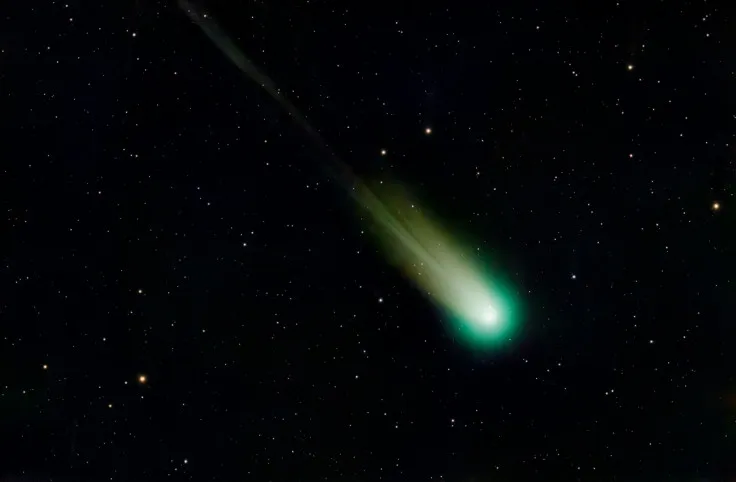
A Harvard scientist has shed new light on 3I/ATLAS, the third known interstellar object to enter our solar system, marking a significant milestone in modern astronomy. The celestial body, believed to originate from beyond our planetary neighborhood, is offering researchers rare opportunities to study material formed in distant star systems. The scientist’s analysis emphasizes the object’s unusual trajectory, chemical composition, and the potential clues it carries about the nature of planetary formation outside the Milky Way’s familiar regions. As astronomers race to observe the fast-moving visitor, the findings may reshape current theories about cosmic evolution and interstellar travel.
A Rare Arrival From Beyond Our Solar System
The detection of 3I/ATLAS represents one of the most remarkable astronomical events of the decade, following the sightings of 1I/ʻOumuamua and 2I/Borisov. Unlike common comets born within the solar system, 3I/ATLAS entered with a hyperbolic trajectory—strong evidence that it originated from another star. Such objects are exceedingly rare, and each arrival provides scientists with invaluable data about distant cosmic environments that cannot be observed directly.
According to the Harvard researcher, the object’s entry angle and high velocity reflect conditions far different from those influencing solar system bodies, suggesting that 3I/ATLAS may have been ejected during early planetary formation in another stellar neighborhood.
Chemical Composition Offers Clues to Alien Worlds
Preliminary spectral analyses hint at features not typically seen in native comets. The Harvard scientist notes that the composition—particularly the ratios of volatile gases—may indicate a colder, more chaotic birthplace. Such findings can help astronomers assess whether planetary systems across the galaxy share chemical commonalities with our own or follow entirely different evolutionary paths.
Understanding this composition also improves modeling for interstellar debris, enhancing predictions of how often such objects may pass near Earth and what information they might carry from their home systems.
Shifting Theories on Interstellar Dynamics
The unique behavior of 3I/ATLAS is encouraging scientists to reevaluate long-standing assumptions about the frequency and nature of interstellar objects. The Harvard expert suggests that previous models underestimated the number of small bodies capable of escaping their original systems.
If such visitors prove more common than once believed, it could reshape theories about how planetary systems interact, exchange matter, and influence each other’s development. This has significant implications for understanding cosmic migration, stellar evolution, and the distribution of organic compounds throughout the galaxy.
Implications for Future Research and Exploration
The arrival of 3I/ATLAS underscores the need for improved detection technology and rapid-response observation strategies. As interstellar objects move at extraordinary speeds, astronomers have narrow windows in which to collect data.
The Harvard scientist argues that investment in next-generation telescopes and automated tracking systems is essential to ensure that future interstellar visitors—especially potentially larger or more anomalous objects—are studied in real time. Such advancements could open pathways for space missions designed to intercept or analyze interstellar material directly.
Comments