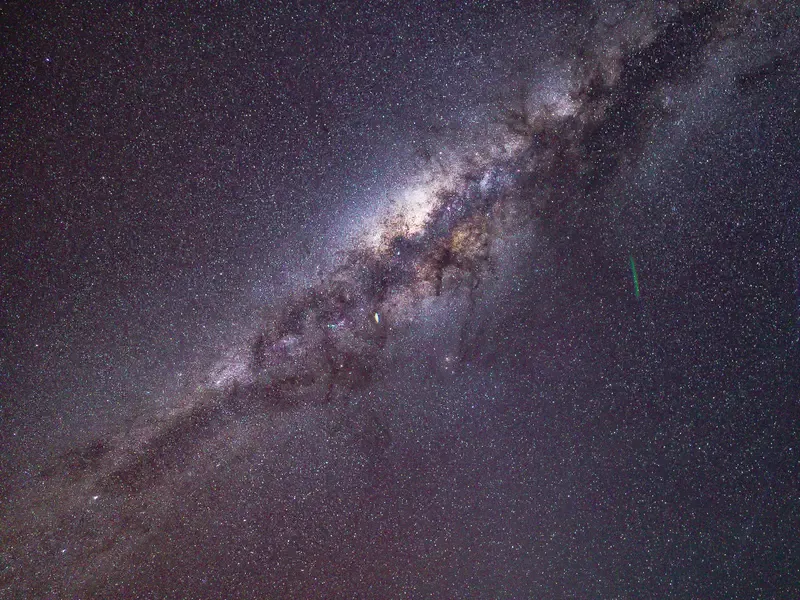
A groundbreaking astrophysical study has reignited the scientific debate surrounding dark matter—an elusive substance believed to make up nearly 85% of the universe’s mass. Researchers now suggest that dark matter may be far more concentrated within the Milky Way than previously assumed, potentially concealed in dense, invisible structures that influence galactic motion. The findings could reshape current models of cosmic evolution and provide a clearer understanding of how galaxies form, move, and maintain their spiral arms. If confirmed, this discovery would mark one of the most significant breakthroughs in modern cosmology and particle physics.
Unveiling the Mystery of Dark Matter
Dark matter remains one of the most profound enigmas in physics. Unlike ordinary matter, it does not emit, absorb, or reflect light, making it invisible to telescopes. Its presence is inferred only through gravitational effects on visible objects such as stars, gas clouds, and entire galaxies.
The new study, led by a team of international astronomers, proposes that dark matter within the Milky Way may not be evenly distributed, as many previous models have suggested. Instead, it may form clumps or streams—dense zones that subtly alter the motion of stars and planetary systems. These hidden concentrations could explain discrepancies in the galaxy’s rotation curve, where outer stars orbit faster than gravitational laws would otherwise predict.
Revisiting Galactic Models
Traditional models have treated dark matter as a smooth “halo” surrounding galaxies. However, recent computational simulations suggest a more complex reality. The researchers combined high-resolution data from the Gaia space observatory with advanced cosmological modeling to map the Milky Way’s mass distribution.
Their findings indicate localized variations in gravitational strength—signs that dark matter may cluster within the galactic disk itself, rather than existing solely in a diffuse halo. This refined mapping could help resolve long-standing inconsistencies between theoretical predictions and observed star movements.
According to the study, these dark-matter-rich regions may contain up to 10% more mass than previously estimated, with the central bulge of the Milky Way acting as a gravitational anchor for these hidden structures.
Technological Advances Driving Discovery
The precision of this analysis owes much to recent advances in astronomical technology. The Gaia mission, operated by the European Space Agency, has provided the most detailed 3D map of the Milky Way to date, tracking over 1.5 billion stars. Complementing this, data from the Very Large Telescope (VLT) in Chile and the Atacama Cosmology Telescope (ACT) helped identify subtle distortions in light caused by gravitational lensing—a phenomenon directly linked to dark matter’s invisible pull.
These combined datasets enabled scientists to construct a more nuanced gravitational model, revealing that the galaxy’s visible mass alone cannot explain its rotational velocity. The evidence points to substantial “hidden mass” embedded within the Milky Way’s spiral arms and surrounding disk.
Implications for Cosmology and Physics
If validated, these findings could challenge several aspects of the Lambda-CDM model, the prevailing cosmological framework describing dark matter and dark energy. A more concentrated dark matter distribution may indicate that its particles interact in ways not yet accounted for in current physics.
This could also provide indirect support for competing theories—such as self-interacting dark matter (SIDM) or fuzzy dark matter, where the particles are extremely light and wave-like. Understanding these interactions could open pathways to reconciling dark matter with quantum mechanics, potentially transforming fundamental physics.
Moreover, these insights may influence how scientists interpret gravitational waves, galactic collisions, and even the future trajectory of our own solar system within the Milky Way.
Economic and Strategic Dimensions of Space Research
Beyond scientific curiosity, the hunt for dark matter has significant economic and strategic dimensions. Governments and private enterprises are investing billions of rupees in deep-space observation and high-energy particle research.
For instance, the upcoming International Dark Matter Observatory (IDMO), funded by a consortium of research institutions, represents a Rs. 4,000-crore initiative designed to probe dark matter interactions through ultra-sensitive detectors placed deep underground. Similarly, private aerospace companies are now exploring how cosmic research could translate into advanced materials science, quantum computing, and next-generation energy storage technologies.
The potential commercial and defense applications of such breakthroughs—from advanced sensors to gravitational navigation systems—underscore why understanding dark matter is not only a scientific imperative but also an economic one.
Global Collaboration and Future Outlook
This latest study is part of a growing international effort to decode the cosmic puzzle. Observatories in India, Japan, Europe, and the United States are now coordinating data-sharing agreements to accelerate research into dark matter and dark energy.
Next-generation telescopes, such as the Square Kilometre Array (SKA) in Australia and South Africa, and India’s Thirty Meter Telescope (TMT) partnership, are expected to deliver even higher-resolution insights into galactic dynamics within the next decade.
If dark matter is indeed embedded within the Milky Way’s structure, upcoming missions may be able to detect its influence directly—through gravitational lensing, cosmic ray deflection, or subatomic interactions detectable by Earth-based instruments.
Conclusion
The possibility that dark matter lies hidden within the Milky Way’s own boundaries reshapes how humanity perceives its place in the cosmos. It suggests that the universe’s most mysterious ingredient is not some distant phenomenon but an invisible force woven into the very fabric of our galaxy.
As scientific tools evolve and theoretical models adapt, this discovery may bring physicists one step closer to unlocking the universe’s most enduring secret: the true nature of matter itself. In doing so, it may redefine not just astrophysics, but humanity’s understanding of existence on a cosmic scale.
Comments