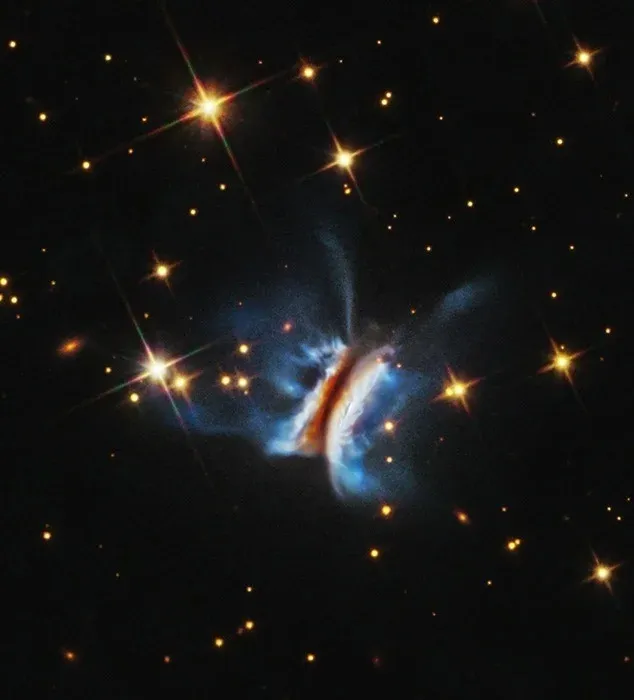
NASA’s Hubble Space Telescope has captured unprecedented images of the largest known planet-forming disk, shedding light on the early stages of planetary system formation. The expansive protoplanetary disk, encircling a young star, measures several hundred astronomical units in diameter, dwarfing our own Solar System. High-resolution imaging reveals intricate structures, including gaps, rings, and potential planet-forming regions. Astrophysicists highlight that these observations provide a unique window into the processes governing planetary accretion, disk evolution, and material distribution. The findings are expected to refine theoretical models, guide future observational campaigns, and deepen our understanding of how diverse planetary systems emerge across the galaxy.
Discovery and Imaging
Hubble’s latest observations employed advanced instruments to capture detailed structures within the protoplanetary disk. The images reveal an intricate network of rings and gaps, indicative of active planet formation processes.
Scientists note that such high-resolution data allow for precise measurement of disk size, composition, and density variations, providing critical empirical input for computational models of planetary evolution.
Disk Composition and Structure
Spectroscopic analysis indicates that the disk contains a mixture of gas, dust, and organic compounds—essential ingredients for planet formation. Regions of concentrated material suggest potential locations where protoplanets may be coalescing, while gaps likely indicate the presence of nascent planetary bodies shaping the disk.
Understanding these structures helps astronomers infer the timeline, efficiency, and dynamics of planetary accretion in different stellar environments.
Implications for Planetary Science
The discovery of such a massive disk challenges existing paradigms regarding disk evolution and planetary system architecture. It suggests that large-scale disks may be more common than previously thought, offering new insights into the diversity of exoplanetary systems.
Astrophysicists emphasize that studying extreme cases like this disk refines our understanding of how factors such as stellar mass, angular momentum, and disk composition influence planet formation.
Future Observational Prospects
The findings will guide follow-up studies using next-generation observatories such as the James Webb Space Telescope and ground-based interferometers. Targeted observations may reveal the presence of forming planets, temperature gradients, and chemical distributions, providing a more comprehensive picture of planetary genesis.
International collaboration among observatories will be critical in tracking disk evolution over time and comparing it with other protoplanetary systems.
Broader Significance
By imaging the largest known planet-forming disk, Hubble offers a tangible view of the processes that lead to the birth of planetary systems. These observations not only enhance scientific knowledge but also inspire curiosity about the formation of worlds beyond our own.
Comments