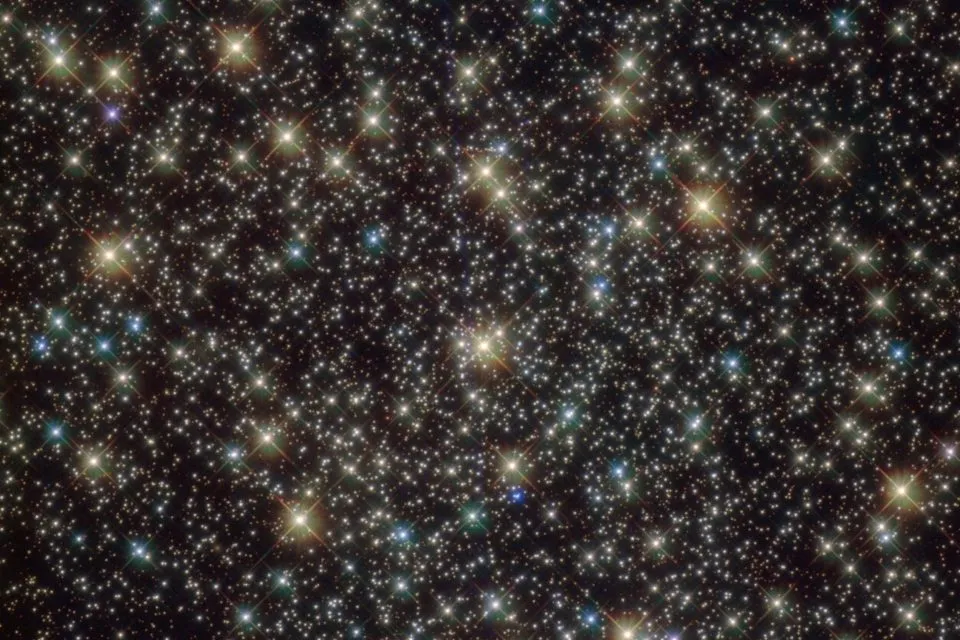
The Hubble Space Telescope has delivered fresh insights into one of astronomy’s most enduring puzzles: blue straggler stars. These anomalously young-looking stars, found in ancient star clusters, have long challenged conventional models of stellar aging. New observations and data analysis from Hubble provide compelling evidence about how these stars form and evolve, reshaping scientific understanding of stellar lifecycles. Beyond pure science, the findings underscore the enduring value of legacy space assets like Hubble, whose discoveries continue to generate high intellectual and economic returns. The research strengthens astrophysics’ foundational theories while guiding future investments in next-generation space telescopes.
A Persistent Stellar Paradox
Blue straggler stars stand out in old star clusters because they appear hotter, brighter, and younger than their surrounding stellar populations. According to classical stellar evolution, such stars should not exist in environments formed billions of years ago.
For decades, astronomers have debated whether blue stragglers are the result of stellar collisions or mass transfer between binary stars. Hubble’s precision imaging and ultraviolet capabilities have now provided the clearest observational evidence yet to address this question.
Hubble’s Observational Breakthrough
Using long-term observations of dense globular clusters, Hubble tracked the distribution, motion, and composition of blue straggler stars with unprecedented accuracy. The data reveal distinct subpopulations, strongly suggesting that more than one formation mechanism is at work.
In crowded cluster cores, stellar mergers appear to dominate, while in less dense regions, mass exchange between binary companions plays a greater role. This dual-path explanation reconciles years of conflicting theories.
Implications for Stellar Evolution Models
The findings carry significant implications for how scientists model star cluster evolution and energy dynamics. Blue stragglers influence cluster brightness, mass distribution, and long-term stability—factors critical to understanding how galaxies evolve over cosmic time.
Refined models based on Hubble’s data will improve the accuracy of simulations used across astrophysics, from predicting star formation rates to interpreting deep-space observations from newer observatories.
Strategic Value of Legacy Space Assets
Hubble’s continued scientific output highlights the economic and strategic wisdom of maintaining long-term space infrastructure. Despite being operational for more than three decades, the telescope remains a cornerstone of discovery, delivering returns that far exceed its original investment.
For policymakers and space agencies, the results reinforce the case for sustained funding of both legacy missions and future platforms such as the James Webb Space Telescope and upcoming observatories.
Looking Ahead
As astronomy enters an era of data-rich exploration, Hubble’s work on blue straggler stars serves as a reminder that transformative discoveries often emerge from sustained observation rather than short-term missions. By resolving a long-standing stellar mystery, Hubble not only advances science but also strengthens the broader case for patient, well-funded exploration of the universe.
Comments