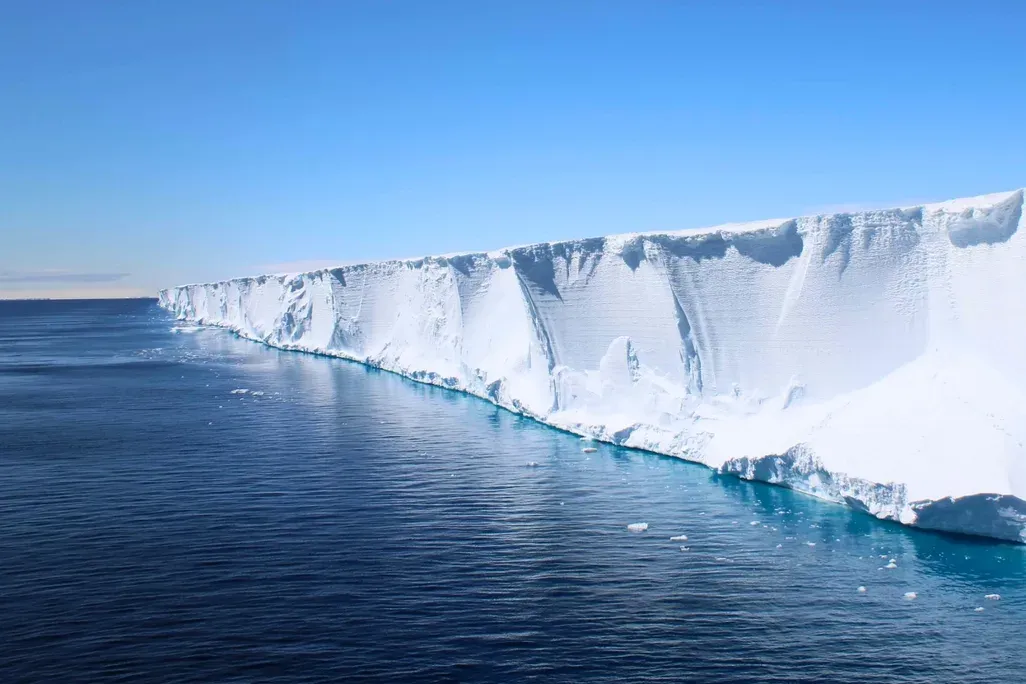
A colossal iceberg has detached from the Antarctic coastline, exposing an enormous and unexpected natural formation beneath its frozen base — a sprawling mega-nest believed to have been constructed by an immense colony of fish. The iceberg’s separation, while part of a recurring natural cycle, has drawn global attention for the remarkable ecological discovery that followed. Scientists studying satellite imagery and on-site data have described the find as one of the largest known breeding grounds beneath the Southern Ocean’s ice shelves. The revelation underscores the intricate link between climate dynamics, marine ecosystems, and the fragile balance sustaining life in polar regions.
A Colossal Break from the Frozen Continent
Antarctica’s latest geological event has sparked both scientific intrigue and environmental concern. The massive iceberg, estimated to span hundreds of square kilometers, calved from the edge of the Filchner-Ronne Ice Shelf in what researchers describe as a “clean break” — a natural process where sections of ice detach due to internal stress and oceanic currents. While such calving events occur periodically, this particular separation drew attention for what it revealed below: a vast, previously hidden ecosystem preserved beneath layers of ancient ice.
Satellite data first captured the detachment, showing the iceberg drifting into the Weddell Sea. As the shelf receded, oceanographers detected an unusually structured seabed below, leading to the discovery of a gigantic nest-like formation stretching across several kilometers.
The Hidden Mega-Nest Beneath the Ice
Upon further investigation, scientists determined that the newly exposed seabed contained millions of circular mounds — each roughly 75 centimeters in diameter — believed to be nesting sites created by Antarctic icefish. Early estimates suggest the colony could encompass over 60 million nests, forming one of the largest reproductive aggregations ever recorded in marine history.
The nests, found at depths of around 500 meters, were each carefully built with pebbles and guarded by adult fish. The sheer density of this underwater nursery astonished researchers, who had never observed such a massive and organized breeding ground in such extreme conditions.
This extraordinary discovery sheds light on the hidden complexity of Antarctic marine ecosystems and the biological resilience of species that thrive beneath the ice, far from sunlight and warmth.
Climate Dynamics and Ecological Implications
While the calving event that revealed the nests is part of Antarctica’s natural ice cycle, scientists caution that increasing ocean temperatures and changing wind patterns may be accelerating such phenomena. As glaciers thin and ice shelves weaken, the frequency of large-scale calving events could rise — altering habitats and reshaping underwater ecosystems.
The revelation of this mega-nest also raises questions about how future environmental changes could affect breeding populations. The icefish depend on stable, cold conditions to reproduce; any disruption to water temperature or ocean chemistry could threaten their survival and, by extension, the delicate food chain that supports larger Antarctic predators.
Experts emphasize that the find presents both an opportunity and a warning — an opportunity to study an untouched ecological system, and a warning of how climate shifts can expose fragile worlds previously insulated from human observation.
A Window into an Untouched World
The discovery beneath the iceberg is not only a scientific milestone but also a reminder of the vast mysteries hidden under the planet’s frozen surfaces. It highlights how much of Earth’s biodiversity remains unseen, concealed beneath layers of ice that are now, due to environmental change, slowly revealing their secrets.
Marine biologists are now deploying remote-operated vehicles and sensor-equipped probes to study the area further. The goal is to understand the evolutionary adaptations that allow such species to flourish in subzero waters and to monitor how the region evolves as ice cover diminishes.
Preserving the Polar Frontier
The unveiling of the Antarctic mega-nest adds a new dimension to global conservation efforts. It reinforces the importance of designating marine protected areas to safeguard fragile ecosystems exposed by melting ice. The discovery also underscores the urgency of climate action — a reminder that every shift in Earth’s temperature reverberates through even the most isolated corners of the planet.
In revealing one of nature’s hidden wonders, the drifting iceberg has also exposed humanity’s challenge: to protect a world still rich with mystery, yet perilously vulnerable to change.
Comments