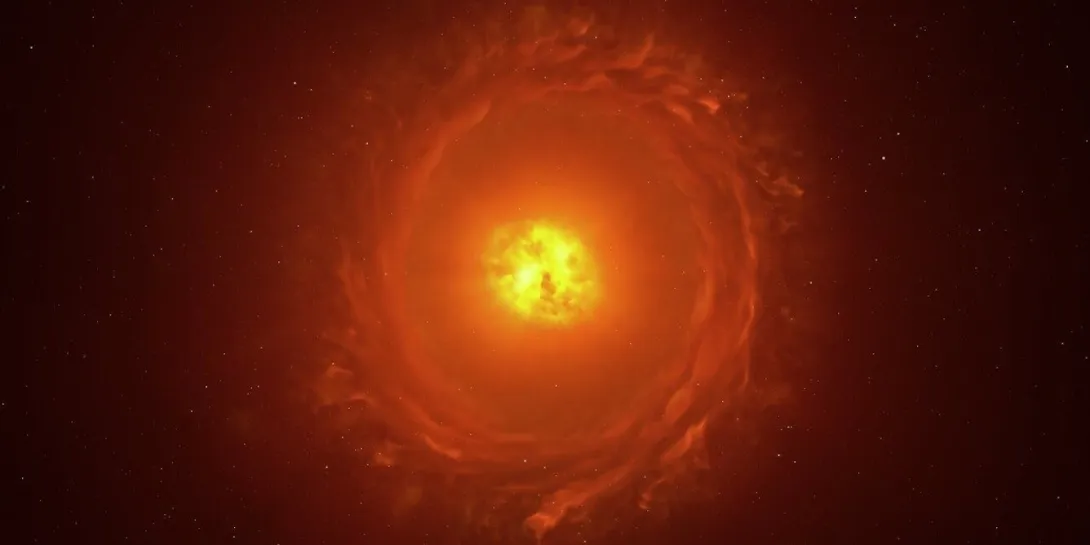
Astronomers are closely monitoring WOH G64, one of the largest known red supergiant stars, amid growing scientific discussion about its potential transition into a supernova. Located in the Large Magellanic Cloud, the star has exhibited unusual dimming and structural irregularities that have intensified research interest. While experts caution that stellar explosions are inherently unpredictable, the possibility of a supernova offers a rare observational opportunity. Beyond scientific curiosity, such cosmic events provide critical data for astrophysics, influence interstellar chemistry and underscore the expanding commercial and institutional investments shaping modern astronomical research and space science infrastructure.
A Giant Star Under Scrutiny
The star WOH G64 ranks among the most massive and luminous red supergiants identified to date. Situated in the Large Magellanic Cloud, approximately 160,000 light-years from Earth, WOH G64 has long intrigued astronomers for its immense size and thick circumstellar dust envelope.
Recent observations indicate irregular brightness fluctuations and complex mass-loss patterns. Such characteristics are commonly associated with late-stage stellar evolution, fueling speculation that the star could eventually culminate in a supernova explosion.
However, researchers emphasize that “eventually” in cosmic terms may still span thousands of years.
Understanding the Supernova Process
A supernova occurs when a massive star exhausts its nuclear fuel, leading to a catastrophic core collapse and a powerful explosion. These events briefly outshine entire galaxies and disperse heavy elements—such as iron and nickel—into surrounding space.
If WOH G64 were to explode, it would provide a rare opportunity to observe a supernova in a neighboring galaxy with modern instrumentation. Contemporary telescopes can capture electromagnetic radiation across multiple wavelengths, offering insights into stellar interiors and explosion dynamics.
Such data contribute to refining models of stellar lifecycles and galactic evolution.
Scientific and Technological Implications
The monitoring of WOH G64 reflects broader advancements in observational astronomy. Ground-based observatories and space telescopes now deliver high-resolution imaging and spectroscopy, enabling researchers to detect subtle stellar changes.
Institutions including NASA collaborate with international research networks to maintain continuous sky surveys. Automated detection systems powered by advanced algorithms have significantly improved early identification of transient astronomical events.
A confirmed supernova would trigger coordinated global observation campaigns, generating vast datasets for astrophysicists.
Economic Dimensions of Modern Astronomy
While supernovae are fundamentally scientific phenomena, the infrastructure supporting their study represents a substantial economic ecosystem. Public funding for space research supports aerospace manufacturing, data analytics and academic institutions worldwide.
Astrophysical discoveries also drive technological spillovers. Innovations in imaging sensors, signal processing and computational modeling often find commercial applications in telecommunications, medical diagnostics and defense systems.
The sustained investment in astronomical research underscores how pure science frequently catalyzes downstream economic value.
Managing Public Expectations
Speculation surrounding a potential supernova often captures public imagination. However, astronomers caution against assuming imminence. Stellar behavior, particularly among red supergiants, can remain volatile for extended periods without culminating in an explosion.
Importantly, even if WOH G64 were to undergo a supernova, its vast distance from Earth ensures no direct threat to the planet. The event would manifest as a brilliant point of light in the sky, not a hazard.
Transparent communication remains central to balancing public enthusiasm with scientific realism.
A Window Into Cosmic Evolution
Whether WOH G64 explodes in the near astronomical future or continues its prolonged decline, its observation enriches humanity’s understanding of stellar life cycles. Massive stars serve as cosmic forges, creating the elements essential to planetary systems and life itself.
The continued monitoring of WOH G64 exemplifies the intersection of curiosity, technology and investment shaping twenty-first-century astronomy. In watching a distant giant approach the twilight of its existence, scientists gain a clearer view of the processes that have shaped the universe—and, ultimately, our own origins.
Comments