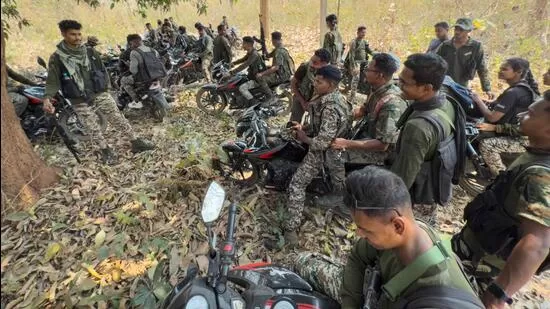
While national headlines were preoccupied with Operation Sindoor, a more expansive and intense security maneuver quietly unfolded in the heart of India’s Maoist belt—Operation Kagar. Launched on April 21 and spanning the rugged Karreguttalu hill ranges that bridge Telangana and Chhattisgarh, this high-stakes offensive was one of the largest anti-Maoist campaigns in recent history. With an unprecedented mobilization of 10,000 security personnel, the mission targeted an estimated 400 Maoists, including key insurgent leaders. Officially concluded on May 11, Operation Kagar marks a significant strategic push by the Indian state to reclaim territory long dominated by insurgent forces.
A Coordinated Multi-Force Offensive
Operation Kagar represented a rare convergence of elite Indian security units. The Central Reserve Police Force (CRPF), its elite CoBRA (Commando Battalion for Resolute Action) unit, Telangana’s Greyhounds, Chhattisgarh’s District Reserve Guards, and other state police forces were deployed in unison. Each unit brought specialized skills to navigate the treacherous terrain and counter the guerrilla tactics of Maoist combatants.
The area of operation—288 square kilometers across the Karreguttalu hills—was identified through actionable intelligence, suggesting that approximately 400 Maoists, including high-ranking leaders, were encamped deep within the forest. This intelligence prompted the central government to authorize what was internally dubbed the “largest-ever anti-Naxal operation.”
Strategic Intent and Political Oversight
The scale and scope of Operation Kagar were not only tactical but also symbolic. With Home Minister Amit Shah closely monitoring the progress and terming it the "biggest operation to date," it served as a declaration of renewed political will to confront long-standing internal security threats.
CRPF Director General G.P. Singh's decision to personally camp in the conflict zone underscored the operation’s importance. His presence on the ground demonstrated a hands-on approach to command and control, ensuring that coordination among units remained seamless despite the geographical and operational complexities.
Operational Challenges and Terrain Dynamics
The Karreguttalu region, often referred to in operational circles as the “Black Forest,” poses significant logistical and tactical hurdles. Dense vegetation, undulating topography, and the presence of fortified Maoist hideouts have historically made this area a fortress for insurgents. Unlike conventional urban warfare, anti-insurgency efforts in these zones demand a nuanced blend of intelligence, endurance, and ground-level coordination.
The forested enclave also serves as a strategic corridor linking Maoist activities across state lines. By targeting this vital zone, Operation Kagar aimed not just to neutralize insurgents, but to dismantle their command infrastructure and disrupt supply routes.
Outcomes and Implications for National Security
Although the government has not released detailed figures on casualties or captures, the operation’s extended duration—spanning nearly three weeks—suggests a sustained engagement with insurgents. More importantly, its symbolic success lies in establishing state authority in a region historically under parallel governance by Maoist factions.
Operation Kagar sets a precedent for future counterinsurgency measures, emphasizing scale, coordination, and intelligence-led action. It also signals a policy shift: from containment to proactive dismantling of insurgent networks in India’s Red Corridor.
Conclusion: A Template for Future Engagements
While Operation Kagar may not have garnered the headlines it deserved, its significance is far-reaching. As India continues to grapple with internal security threats, this operation serves as a template for high-impact, intelligence-driven missions. The quiet execution of such a massive deployment without media fanfare reflects both operational maturity and a strategic recalibration in New Delhi’s approach to insurgency.
In the shadows of the Karreguttalu hills, India has redrawn the map of state control—quietly, decisively, and with resolve.
Comments