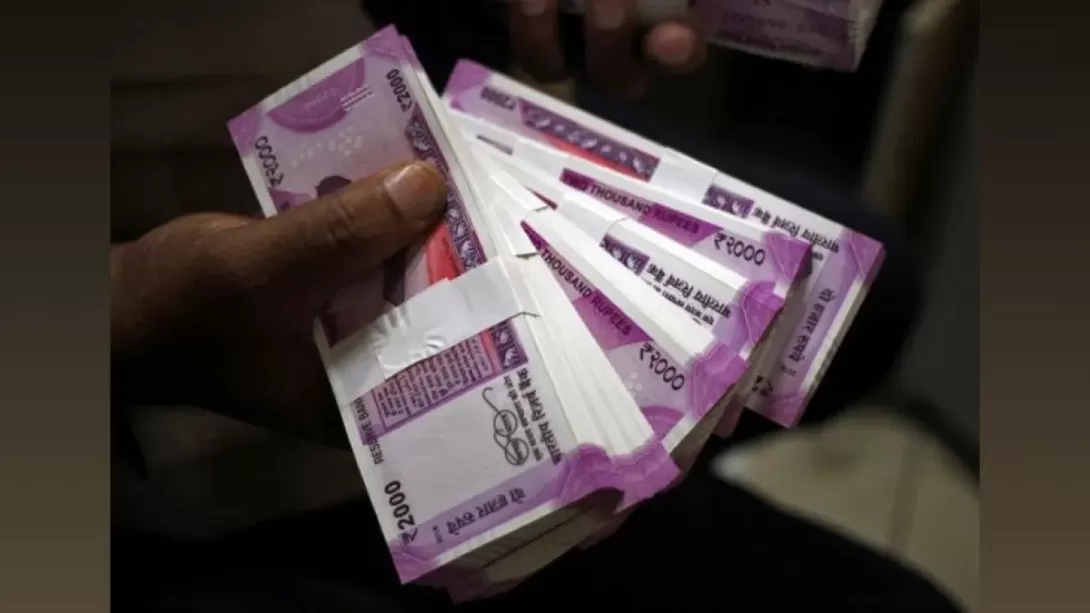
The Indian Rupee continues to struggle against the US Dollar, extending its losing streak for the fourth consecutive session, closing at Rs. 86.71. The ongoing global trade tensions, notably between the US and China, combined with domestic challenges such as foreign fund outflows and tepid sentiment in the equity markets, have placed significant pressure on the currency. Meanwhile, the Reserve Bank of India (RBI) has made a move to stimulate the economy by reducing the key interest rate, but analysts warn that the road ahead remains uncertain as investor caution persists amidst rising global tariffs.
Rupee’s Persistent Decline Amid Global Economic Turbulence
The Indian Rupee continued its downward trajectory, settling at Rs. 86.71 against the US Dollar, marking a 45-paise drop. This marks the fourth consecutive session of depreciation, a trend driven by various global and domestic factors. Rising tariff tensions, particularly between the US and China, along with continued foreign institutional investor (FII) outflows, have significantly dampened investor sentiment. Despite a sharp decline in crude oil prices, which typically places downward pressure on the Rupee, the Indian currency remains under considerable stress. Forex analysts attribute this to weak domestic markets and ongoing uncertainty in the global economic environment, leading to heightened volatility.
Impact of US-China Trade War on Global Sentiment
The broader global market is grappling with an escalating trade conflict between the US and China. The US recently imposed an additional 50% tariff on Chinese imports, exacerbating concerns over global economic slowdown. As a result, market sentiment has turned more cautious, with investors increasingly risk-averse. This has contributed to the Indian Rupee’s steep declines, which, in turn, reflects the dented global market sentiment. As foreign funds exit the market and uncertainty grows, the Rupee faces additional challenges. Anuj Choudhary, Research Analyst at Mirae Asset Sharekhan, noted the effect of the weak domestic markets and FII outflows on the currency, despite the cushioning effect of a declining US Dollar and falling oil prices.
RBI Cuts Interest Rates to Boost Economic Activity
In an attempt to counter the negative economic impact, the Reserve Bank of India (RBI) reduced its key repo rate by 25 basis points, bringing it down to 6%. This move, which marks the second consecutive rate cut, aims to make financing cheaper and stimulate economic activity. However, despite the rate reduction, concerns remain about inflationary pressures and the impact of tariff-induced volatility on India’s broader economic outlook. The RBI’s monetary policy committee also revised its growth projection for FY26 down to 6.5% from the previous estimate of 6.7%, signaling caution in the face of persistent global uncertainties. During a press conference, RBI Governor Sanjay Malhotra clarified that the central bank does not directly target a specific level for the Rupee. Instead, the RBI intervenes only in cases of excessive or disruptive volatility, aiming to maintain stability rather than manage the currency at a predefined value.
Volatility in the Stock Market Amid Currency Weakness
The negative sentiment in the forex market has spilled over into the Indian equity markets. After a slight recovery on Tuesday, the stock market benchmarks closed significantly lower on Wednesday. The 30-share BSE Sensex dropped 379.93 points, or 0.51%, to settle at 73,847.15, while the Nifty fell 136.70 points, or 0.61%, closing at 22,399.15. Earlier in the week, the Sensex and Nifty had faced even sharper declines, with the indices falling more than 5% on Monday before recovering slightly by the end of the session. This volatility highlights the fragility of the market amidst growing uncertainties and weakening investor confidence.
Foreign Institutional Investors (FII) Pullback
Another critical factor contributing to the Rupee's weakness is the significant outflow of foreign capital. On Tuesday alone, foreign institutional investors (FII) offloaded equities worth Rs. 4,994.24 crore, according to exchange data. This is part of a broader trend where FIIs have been reducing their exposure to the Indian stock market, driven by global uncertainties, economic slowdown fears, and concerns over the ongoing trade war.The lack of confidence in the domestic market, exacerbated by the global trade war and tariff hikes, has led to a net outflow of foreign capital, which further weakens the currency. This dynamic is compounded by the lackluster performance in India’s equity markets, making the country less attractive to international investors.
Outlook for the Indian Rupee and Stock Market
The USD-INR spot price is expected to trade in a range of Rs. 86.30 to Rs. 86.90, as indicated by analysts. Despite the relief provided by falling oil prices and a weaker dollar, the Indian Rupee remains vulnerable to the ongoing global volatility and domestic economic challenges. Investors are advised to exercise caution, particularly in the short term, as the markets continue to respond to external shocks, such as the US-China tariff situation, and internal pressures like the slowdown in foreign capital inflows. While the RBI’s interest rate cuts are aimed at stimulating economic activity, these measures alone may not be sufficient to counterbalance the negative forces at play. For the Rupee to stabilize and the stock market to regain momentum, global economic tensions need to ease, and investor confidence must be restored in the Indian economy.
Conclusion
In conclusion, the Indian Rupee is facing significant challenges amid global tariff tensions, foreign fund outflows, and weak domestic sentiment. While the RBI’s monetary policy adjustments and the fall in oil prices offer some relief, the broader market remains volatile. Foreign investors have pulled back, and the Indian stock market is reflecting the uncertainty that looms over the global economy. The road ahead for the Rupee and Indian equities remains uncertain, with analysts forecasting a cautious outlook in the short to medium term. For the Indian economy to regain stability, a comprehensive approach, including stronger foreign investments and global trade resolution, will be essential.
Comments