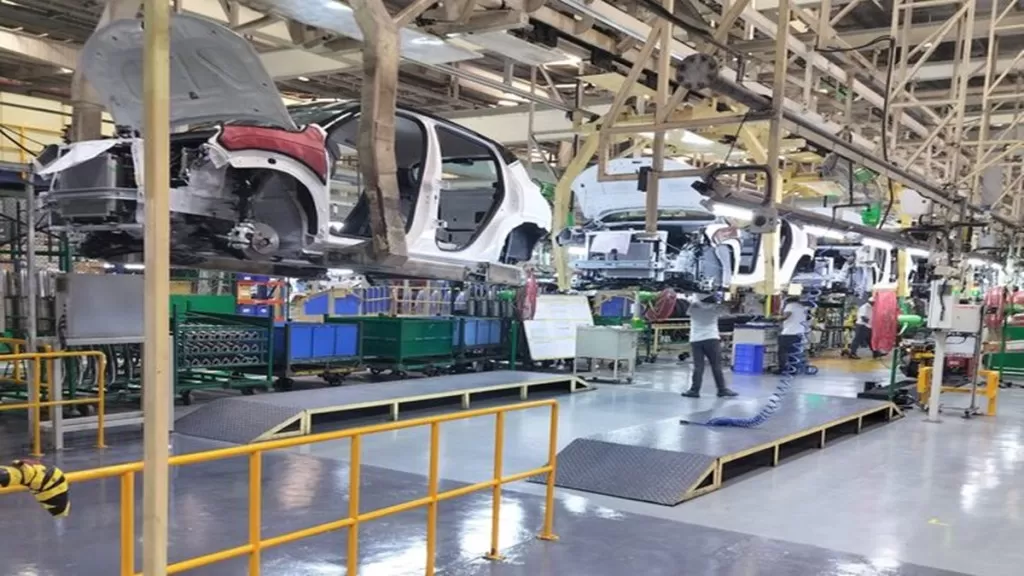
India’s industrial activity moderated sharply in February 2025, with factory output growing at a subdued pace of 2.9%—the slowest in six months—amid sector-wide deceleration and a high base effect. The Index of Industrial Production (IIP) data, released by the National Statistics Office (NSO), reflects a broad-based softening in manufacturing and mining, while electricity generation remained the only area of modest growth. As macroeconomic headwinds persist and domestic demand recalibrates, this data signals a momentary pause in the country’s post-pandemic industrial momentum, prompting economists and market participants to re-evaluate short-term expectations for economic recovery.
Manufacturing Momentum Stalls
The manufacturing sector, which constitutes nearly 78% of the IIP, experienced a marked slowdown, expanding by just 2.9% in February compared to 5.8% in January. This decline also trails the 4.9% growth witnessed in February of the previous year. Analysts attribute this cooling to multiple factors: waning post-festive demand, slower inventory restocking, and a recalibration in export orders. The manufacturing deceleration is especially noteworthy given the government's continued push for self-reliance through schemes such as Production-Linked Incentives (PLIs). While long-term fundamentals remain intact, short-term pressures suggest that India’s industrial engine may need more than policy momentum to sustain growth.
Mining Sector Fades Into the Background
Mining activity, often a bellwether of upstream economic strength, posted only 1.6% growth in February—down sharply from 4.4% in January and significantly lower than the 8.1% seen a year earlier. The decline signals a slowdown in raw material demand, especially from core sectors like steel, cement, and power. Unfavorable weather, logistical disruptions, and a cooling global commodities cycle may have contributed to the subdued performance. For listed mining and metals companies, this softening has translated into mixed investor sentiment, with shares witnessing mild corrections in anticipation of muted quarterly earnings.
Electricity Generation: A Silver Lining
In an otherwise lukewarm industrial print, electricity output stood out with a 3.6% increase in February, improving upon the 2.4% growth recorded in January. However, the figure still pales in comparison to the 7.6% expansion seen in February 2024. The rise in power demand reflects urban consumption and infrastructure-related upticks, even as the overall energy sector continues to grapple with transition challenges related to green energy integration. Electric utilities and transmission companies saw a moderate uptick in investor interest following the data, as the segment demonstrates a degree of stability and counter-cyclicality in the face of manufacturing and mining volatility.
Investor Reaction and Market Implications
While factory output numbers rarely drive markets in isolation, February’s data has triggered caution among institutional investors and portfolio managers. Equities in the industrials and materials space showed mild weakness in the trading sessions following the NSO release, as markets priced in a potential soft patch in domestic production. However, the overall market reaction has been restrained, largely due to expectations that the slowdown is cyclical rather than structural. Several brokerage houses maintain overweight positions on capital goods and infrastructure-related plays, betting on continued public sector capex and resilient private consumption to cushion the industrial slowdown.
Outlook: Temporary Blip or Early Signal?
Economists remain divided on whether the February IIP data reflects a short-lived anomaly or an early warning of deeper malaise in the industrial sector. The consensus view suggests that while the high base effect skews the headline number, underlying dynamics—such as global demand weakness and domestic investment hesitancy—should not be ignored. For policymakers, this moderation may serve as a reminder that macroeconomic resilience cannot be taken for granted. With global growth expected to remain uneven and inflationary pressures still lingering, India’s industrial landscape will require agile fiscal support, efficient execution of infrastructure projects, and a sustained push toward manufacturing competitiveness.
Conclusion
India’s factory output deceleration in February is a signal worth watching, though not yet a red flag. With both manufacturing and mining losing steam and electricity showing only marginal gains, the latest IIP reading serves as a reality check amid the country's ambitious growth narratives. Markets, for now, appear to be absorbing the news with guarded optimism, anticipating policy responses and future data prints to provide clearer direction. In the broader scheme, India’s industrial engine may be momentarily idling—but the road ahead still offers room for acceleration.
Comments