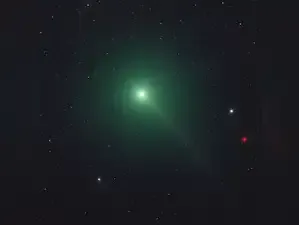
Astronomers worldwide are closely monitoring 3I/ATLAS, an interstellar comet that has entered our solar system from beyond, providing a rare opportunity to study extrasolar material firsthand. First detected by the Asteroid Terrestrial-impact Last Alert System (ATLAS), the comet exhibits unusual trajectories and chemical compositions, signaling its origin from a distant star system. Researchers emphasize that analyzing 3I/ATLAS could reveal crucial insights into the formation and evolution of planetary systems, offering a comparative perspective on our own solar system. Its highly eccentric orbit, dynamic behavior, and distinctive emissions make it a focal point for both astronomical research and public fascination.
Discovery and Observation
- Initial Detection: 3I/ATLAS was first observed by the ATLAS survey in late 2023, quickly identified as interstellar due to its hyperbolic orbit.
- Trajectory Analysis: The comet’s high-speed passage and trajectory confirm it is not gravitationally bound to the Sun, differentiating it from ordinary comets.
- Observation Methods: Ground-based telescopes and space observatories are using spectroscopy, photometry, and imaging to track its composition, brightness variations, and tail dynamics.
Astronomers note that continuous monitoring is essential for understanding material diversity in extrasolar objects.
Composition and Unique Features
Studies reveal that 3I/ATLAS exhibits distinct chemical signatures unlike those typically found in solar system comets:
- Organic Molecules: Presence of complex carbon-based compounds suggests the comet may carry building blocks for life.
- Isotopic Ratios: Deviations in isotopic compositions, particularly of hydrogen and nitrogen, hint at formation under different stellar environments.
- Activity Levels: Observed outgassing patterns indicate volatile-rich ices, contributing to the comet’s bright and extended tail.
These properties make 3I/ATLAS a rare laboratory for comparative planetology.
Scientific Significance
- Understanding Planetary Formation: The comet offers a unique lens into how other star systems assemble planetary and small-body materials.
- Exobiology Insights: Organic molecules present in the comet could inform theories about prebiotic chemistry in the galaxy.
- Solar System Comparisons: Studying its structure and composition allows scientists to contrast formation processes across different stellar environments.
Experts predict that 3I/ATLAS will influence decades of astronomical research, potentially reshaping models of interstellar object migration.
Global Collaborative Efforts
Observatories and space agencies are joining forces to maximize observational coverage:
- Ground-Based Networks: Facilities across North America, Europe, and Asia are conducting continuous tracking.
- Space Telescopes: Instruments like the Hubble Space Telescope and James Webb Space Telescope provide high-resolution spectroscopy and imaging.
- Citizen Science: Amateur astronomers are contributing data, amplifying coverage and real-time monitoring.
This international collaboration underscores the global fascination and scientific value of interstellar visitors.
Future Prospects
- Orbital Predictions: 3I/ATLAS will continue moving outward from the Sun, limiting observation opportunities to the next few months.
- Sample-Return Missions: While challenging, proposals for intercept missions could eventually allow direct analysis of extrasolar material.
- Model Refinement: Data from 3I/ATLAS will inform computational models of comet formation, interstellar travel, and chemical diversity.
As the comet departs, it leaves behind a wealth of knowledge that bridges solar and interstellar science.
Comments