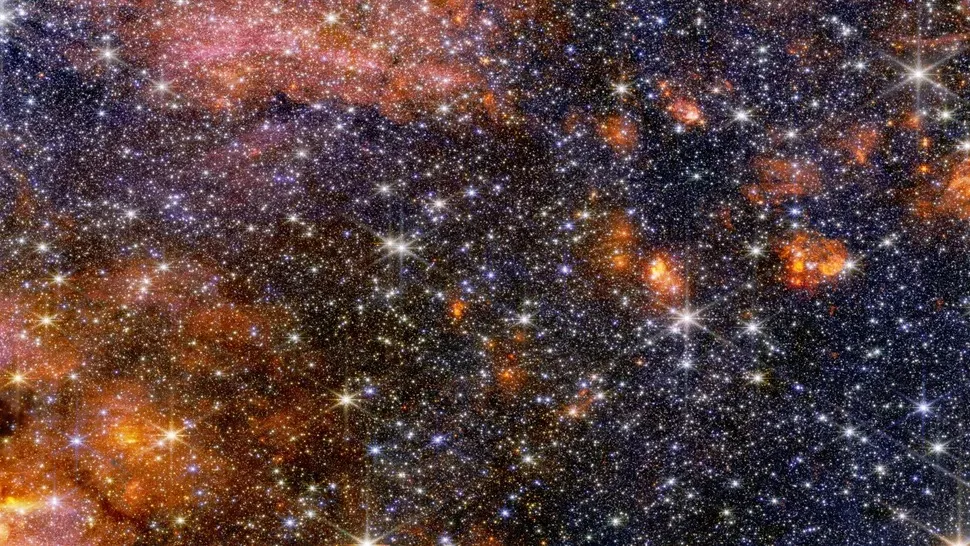
NASA’s James Webb Space Telescope (JWST) has captured unprecedented images of Sagittarius B2, one of the Milky Way’s most massive molecular clouds. Located near the galactic center, this stellar nursery contains the raw materials for star formation, including complex organic molecules. The high-resolution infrared imagery from JWST reveals intricate structures, dense gas filaments, and embedded protostars, offering scientists a deeper understanding of the processes driving stellar birth. These observations not only enhance knowledge of our galaxy’s formation but also provide critical insights into the chemical pathways that may influence planet formation and the potential for prebiotic chemistry in emerging solar systems.
Sagittarius B2: A Stellar Nursery
Sagittarius B2, situated approximately 26,500 light-years from Earth, has long fascinated astronomers due to its immense mass—several million times that of our Sun—and its richness in complex organic molecules. These molecules, including alcohols, aldehydes, and prebiotic compounds, are key ingredients in the chemistry that can lead to life. JWST’s infrared capabilities allow scientists to penetrate the dense dust and gas that obscure this region from optical telescopes, revealing its internal structure in remarkable detail.
JWST’s Infrared Advantage
The James Webb Space Telescope operates primarily in the infrared spectrum, making it ideal for studying cold, dusty regions like Sagittarius B2. Its powerful instruments can detect faint heat signatures from protostars and intricate filaments of gas, enabling astronomers to trace the early stages of star formation. This level of detail allows researchers to map molecular distributions, measure temperatures, and understand the dynamics of the cloud, shedding light on the processes that govern stellar evolution.
Implications for Astronomy and Astrobiology
By revealing the complexity of molecular clouds, JWST provides crucial data on how stars and planetary systems form. Understanding the chemical environment of regions like Sagittarius B2 helps scientists model the formation of planets and the potential emergence of life elsewhere in the galaxy. Observations of prebiotic molecules offer a window into the early chemical conditions that may have influenced the development of life on Earth and potentially other planetary systems.
Conclusion
The James Webb Space Telescope’s observations of Sagittarius B2 mark a milestone in the study of star formation and galactic chemistry. By capturing the intricate details of this massive molecular cloud, JWST not only advances our understanding of stellar nurseries but also enriches the broader quest to comprehend the origins of planets, molecules, and life itself. Continued observations promise to unveil even deeper secrets of our galaxy’s most enigmatic regions.
Comments