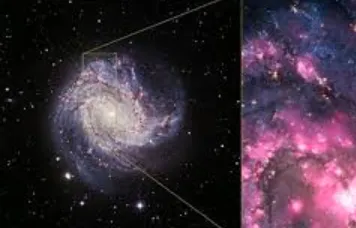
The James Webb Space Telescope (JWST) has identified MoM-z14, the most distant galaxy ever detected, offering an unprecedented glimpse into the universe’s earliest chapter. Observed as it existed just a few hundred million years after the Big Bang, the galaxy challenges existing models of how quickly stars and galaxies formed. The discovery underscores JWST’s transformative impact on cosmology, enabling astronomers to probe deeper into space and further back in time than ever before. Beyond its scientific significance, the finding reinforces the value of long-term investment in advanced space infrastructure that continues to deliver high-impact returns.
A New Benchmark in Cosmic Distance
MoM-z14 now holds the record as the farthest known galaxy, surpassing previous observations enabled by earlier space telescopes. Its extreme distance means the light detected by JWST has traveled for more than 13 billion years, effectively allowing scientists to observe the universe in its infancy.
Such discoveries are rare and technically demanding, requiring extraordinary sensitivity and resolution—capabilities that distinguish JWST from all prior observatories.
What MoM-z14 Reveals About the Early Universe
Initial analysis suggests that MoM-z14 is more chemically evolved and luminous than expected for a galaxy formed so soon after the Big Bang. This finding raises important questions about the pace of early star formation and the efficiency of galaxy assembly during cosmic dawn.
Astrophysicists note that the presence of heavier elements implies that multiple generations of stars may have already lived and died, compressing timelines previously thought to span hundreds of millions of additional years.
James Webb’s Expanding Scientific Reach
JWST was designed to study the infrared universe, allowing it to see through cosmic dust and detect faint, redshifted light from the earliest galaxies. The detection of MoM-z14 highlights the telescope’s ability to exceed its original mission parameters.
From a strategic perspective, the observatory’s performance strengthens the scientific and economic case for flagship missions that deliver decades of discovery across multiple research disciplines.
Implications for Cosmology and Research Investment
The discovery is expected to influence future theoretical models and guide upcoming observational campaigns. Each new data point from galaxies like MoM-z14 helps refine understanding of dark matter distribution, star formation efficiency and the evolution of large-scale cosmic structures.
For policymakers and funding agencies, such breakthroughs validate the significant capital invested in space science, demonstrating how advanced research infrastructure generates long-term intellectual and technological dividends.
Global Collaboration Behind the Discovery
JWST is a collaborative effort involving NASA, the European Space Agency and the Canadian Space Agency. The identification of MoM-z14 reflects the effectiveness of international partnerships in tackling complex scientific challenges that exceed the capacity of any single nation.
These collaborations also promote data sharing and global participation in frontier research, amplifying the impact of each discovery.
Conclusion
The detection of MoM-z14 by the James Webb Space Telescope marks a defining moment in modern astronomy. By pushing observational boundaries to the edge of the observable universe, JWST is reshaping humanity’s understanding of cosmic origins. As more data emerge, MoM-z14 is likely to become a cornerstone in the study of early galaxy formation—proof that sustained investment in scientific ambition continues to unlock the universe’s deepest secrets.
Comments