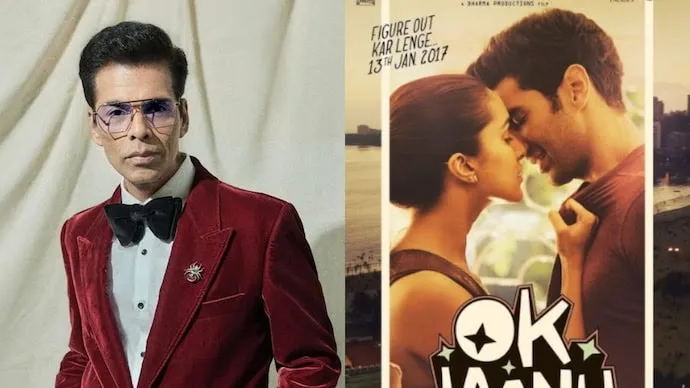
Renowned filmmaker and producer Karan Johar has openly admitted that he anticipated the commercial underperformance of Ok Jaanu, the 2017 romantic drama starring Shraddha Kapoor and Aditya Roy Kapur. Despite being a remake of Mani Ratnam’s acclaimed Tamil film O Kadhal Kanmani, the Hindi version failed to connect with audiences. Johar, known for his instinctive grasp of cinematic appeal, said he sensed the remake lacked the emotional resonance and cultural texture that made the original a success. His remarks offer a rare behind-the-scenes insight into how even seasoned producers grapple with the unpredictable nature of the box office.
A Misjudged Bet on a Remake
Karan Johar, a seasoned stalwart of the Hindi film industry, has never shied away from introspection. Recently, he spoke candidly about one of the few miscalculations in his otherwise polished career—backing Ok Jaanu, a Hindi adaptation of the 2015 Tamil romantic hit O Kadhal Kanmani. Despite the pedigree of the original and the young star power of Shraddha Kapoor and Aditya Roy Kapur, the film failed to resonate with Hindi-speaking audiences.
According to Johar, the decision to greenlight Ok Jaanu was fraught with doubt even at the outset. “I knew this wasn’t the right move,” he admitted. His reservations stemmed from the cultural nuances embedded in the original script—elements that, in his view, did not translate effectively into the Hindi remake.
The Challenge of Cultural Transference
Johar’s commentary sheds light on a recurring dilemma in Indian cinema: the complexity of remaking regional hits for a national audience. While O Kadhal Kanmani was praised for its urban realism, contemporary themes, and nuanced character arcs, those subtleties appeared diluted in Ok Jaanu’s glossy packaging.
The central theme of live-in relationships—a topic still approached cautiously in mainstream Hindi narratives—did not generate the anticipated engagement. Johar, reflecting on this misfire, suggested that the soul of the story was lost in translation. "It looked beautiful, but it didn’t feel authentic," he observed.
Casting Chemistry and Narrative Disconnect
While Shraddha Kapoor and Aditya Roy Kapur had previously delivered a hit in Aashiqui 2, their on-screen pairing in Ok Jaanu lacked the raw emotional charge that the narrative demanded. Critics and audiences alike noted a lack of chemistry, and the storytelling—despite being technically polished—felt emotionally hollow.
Johar acknowledged that casting decisions are often a gamble. In this case, the star value was not enough to carry a narrative that required deeper connection and understated performance.
The Broader Lesson: Gut Over Formula
This instance adds to the growing discourse in Bollywood about the limitations of formulaic thinking. Johar’s reflection is a nod to the importance of instinct over conventional logic. “I should have listened to my gut,” he said, reiterating that cinematic success is rarely guaranteed by the strength of a concept alone. Execution, cultural context, and emotional fidelity play equally crucial roles.
The admission is not just an evaluation of a single film, but an invitation to the industry to reexamine how remakes are approached. Faithful reproduction without meaningful adaptation can often result in emotional dissonance, something Ok Jaanu inadvertently exemplified.
A Mark of Maturity, Not Regret
For a producer of Johar’s stature, publicly acknowledging a project’s failure is an act of transparency and professional maturity. It serves as a valuable lesson for emerging filmmakers and producers who might mistake surface-level aesthetics for substantive storytelling.
Despite the commercial hiccup, Johar remains one of the most insightful voices in Indian cinema—capable of turning even a misstep into a moment of introspection and learning.
Conclusion
In a business as unpredictable as cinema, not every project will be a hit. What separates the enduring from the ephemeral is the ability to learn, pivot, and evolve. Karan Johar’s frank take on Ok Jaanu is a reminder that even the most established names are constantly recalibrating their creative compass—and sometimes, the most powerful move is admitting when something simply didn’t work.
Comments