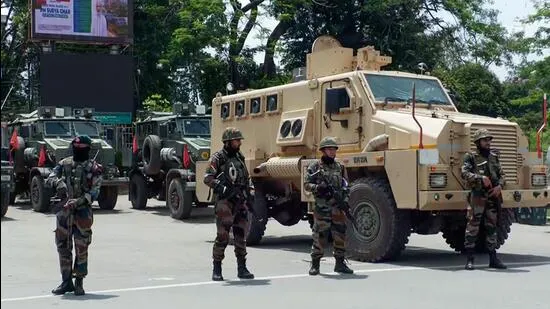
In a renewed effort to ease tensions in Manipur, the Union Home Ministry and representatives of Kuki-Zo insurgent groups have reached an initial understanding to relocate seven designated camps away from Meitei-dominated areas. This development stems from the 2008 Suspension of Operations (SoO) agreement, which governs ceasefire protocols for 25 insurgent factions. While discussions did not extend the SoO pact itself, they focused on revising ground rules, restoring key highways, and enhancing security. The talks unfold against the backdrop of a year-long ethnic conflict that has claimed over 250 lives and displaced thousands, underscoring the urgency of political resolution and humanitarian response.
Context: Ethnic Fault Lines and a Broken Accord
The conflict in Manipur, one of India's most volatile northeastern states, has been driven by simmering tensions between the Meitei and Kuki-Zo communities. The Meiteis, who dominate the Imphal valley, and the Kukis, who inhabit the surrounding hills, have been embroiled in violent clashes since May 2023. These confrontations have not only resulted in tragic human costs—approximately 250 dead and thousands displaced—but have also paralyzed the state’s transportation and governance.
A significant element in the backdrop is the 2008 Suspension of Operations (SoO) agreement, a tripartite arrangement between the central government, Manipur state authorities, and 25 Kuki-Zo insurgent groups. Under the pact, approximately 2,200 cadres were confined to 14 designated camps, receiving stipends and demobilization support. However, the agreement’s efficacy has been under scrutiny, particularly after the Manipur government withdrew from it in February 2023, rendering its enforcement ambiguous.
Recent Developments: Relocating Camps and Revising Ground Rules
The second round of talks, held earlier this week, did not deliberate on extending the overall SoO pact. Instead, both parties agreed to relocate seven Kuki-Zo camps situated near Meitei-dominated regions to tribal areas, a move aimed at de-escalating flashpoints and reducing proximity-driven clashes.
According to a senior official involved in the talks, new camp locations are yet to be finalized but will be restricted to tribal-dominated zones. This spatial separation is being seen as a stopgap to restore some degree of calm, pending a broader political resolution.
Additionally, the insurgent groups submitted fresh proposals concerning security arrangements, while central officials emphasized two critical conditions: the return of looted weapons and the restoration of national highways, particularly the Imphal–Jiribam–Silchar and Dimapur–Imphal–Moreh corridors—lifelines that have remained blocked since the eruption of violence.
Political Reactions: Deepening Rift Over the SoO Pact
The SoO framework has now become a lightning rod in the state’s political landscape. On one side, Kuki representatives continue to push for a Union Territory with a legislative assembly, evolving from their earlier demand for an autonomous council. On the other, several Meitei political figures, including Rajya Sabha MP Leishemba Sanajaoba and BJP spokesperson Michael Lamjathang Haokip, have called for the abrogation of the pact altogether, citing it as a root cause of unrest and an ineffective containment tool.
Sanajaoba, echoing widespread Meitei sentiment, questioned the logic of entering into agreements with armed groups that were not actively rebelling against the Indian Union, attributing the crisis to “missteps” by the previous Congress-led administration, which formalized the pact.
Governance in Limbo: Camp Stipends Suspended, Highways Blocked
Adding to the crisis is the administrative deadlock. Stipends of Rs. 6,000 per month, earlier paid to each camp-bound insurgent under the SoO agreement, have reportedly been suspended since May 2023, compounding tensions in the camps.
Meanwhile, the blockade of key transportation routes has crippled the movement of essential supplies, creating de facto territorial separations between Meitei and Kuki strongholds. Both communities have entrenched themselves along ethnically aligned zones, erecting roadblocks and checkpoints that mirror a fractured civil landscape.
Strategic and Humanitarian Imperatives
The evolving peace talks are as much about strategic recalibration as they are about humanitarian urgency. Relocating camps to tribal areas may prevent localized violence, but it does little to address the deeper structural grievances, including identity politics, land ownership, and demands for autonomy.
For peace to be sustainable, the Union government will need to mediate a political consensus that ensures equitable governance, secures disarmament, and rebuilds inter-community trust. The current emphasis on restoring road connectivity and recovering looted arms is a functional necessity, but these measures must converge with a long-term political roadmap to stabilize Manipur.
Conclusion: A Step Forward, But a Long Road Ahead
The decision to relocate Kuki-Zo camps marks an incremental but critical development in the complex matrix of Manipur’s conflict resolution. It reflects a pragmatic acknowledgment that proximity between armed groups and civilian populations poses a persistent risk. However, camp closures and highway reopenings alone will not heal a divided state.
The road to reconciliation demands more than logistical adjustments—it requires political will, transparent dialogue, and a reimagining of the social contract between the state and its people. Without these, the ghosts of violence will continue to loom over Manipur’s fragile peace.
Comments