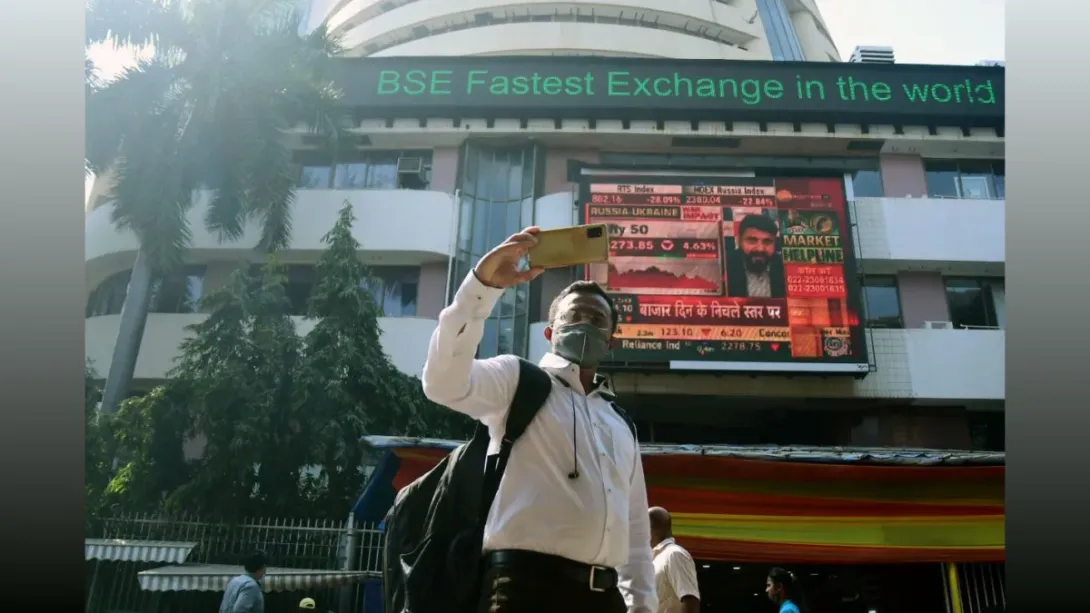
Indian equity benchmarks witnessed a volatile session as heavy selling pressure in Bajaj Finance and persistent foreign fund withdrawals dragged the markets lower. Despite strong quarterly earnings, Bajaj Finance’s shares plunged sharply after the company revised its growth guidance and hinted at potential stress in certain loan segments. Concurrently, foreign institutional investors (FIIs) extended their selling streak, offloading equities worth over Rs. 4,100 crore, triggering widespread caution. The combined impact of stock-specific weakness and sustained capital outflows has injected short-term uncertainty into an otherwise resilient domestic market.
Bajaj Finance Faces Market Scrutiny
Shares of Bajaj Finance declined nearly 7 percent, making it one of the biggest drags on the benchmark indices. The non-banking financial major, often viewed as a bellwether for India’s consumer credit cycle, reported a 23 percent year-on-year rise in consolidated net profit to Rs. 4,948 crore for the September quarter. Net interest income climbed 22 percent to Rs. 10,785 crore, driven by higher loan volumes and stable yields.
However, the upbeat numbers failed to lift investor sentiment. Market participants were more concerned about the company’s forward guidance. Bajaj Finance lowered its full-year loan book growth outlook to 22–23 percent, compared with earlier projections of 24–25 percent. The management cited moderation in demand across MSME and two-wheeler segments as a key reason for the revision.
Adding to concerns, gross non-performing assets (NPAs) rose to 1.24 percent from 1.06 percent a year earlier, while net NPAs increased to 0.60 percent from 0.46 percent. This uptick in bad loans prompted analysts to question the quality of incremental lending and the sustainability of high growth in riskier segments.
Investor Reaction and Market Implications
The stock’s steep correction underscores a shift in investor focus—from short-term profitability to the durability of future earnings. Several brokerages revised their target prices downward, highlighting concerns around asset quality, rising funding costs, and subdued net interest margins.
Market analysts note that Bajaj Finance’s valuations had already priced in aggressive growth expectations, leaving limited room for disappointment. The company’s cautious commentary therefore triggered a wave of profit-taking, exacerbated by weak global cues and sustained foreign outflows.
Foreign Funds Continue to Withdraw
Simultaneously, foreign institutional investors sold shares worth Rs. 4,114.85 crore, extending their selling streak amid heightened global uncertainty. By contrast, domestic institutional investors (DIIs) were net buyers, pumping in Rs. 5,805.26 crore, helping cushion the fall.
Analysts attribute the persistent FII outflows to a combination of factors—firm U.S. Treasury yields, elevated oil prices, and a strengthening dollar—that have made emerging markets less attractive in the near term. Moreover, concerns over valuations in select Indian large-cap stocks, coupled with global risk aversion, have kept foreign investors on the sidelines.
The rupee’s relative stability and robust domestic inflows into mutual funds have mitigated the impact, but market participants warn that sustained foreign selling could create near-term volatility, particularly in sectors with high foreign ownership such as financials, IT, and consumer goods.
Broader Market Performance
The benchmark BSE Sensex slipped 259 points, or 0.31 percent, to close at 83,275, while the NSE Nifty 50 declined 81 points to 25,332. The broader market showed mixed trends, with midcap indices witnessing mild pressure and smallcap stocks showing resilience, supported by retail and domestic institutional participation.
Financials, IT, and energy stocks were among the major laggards, while select FMCG and pharma names saw defensive buying. Bajaj Finance alone contributed nearly a quarter of the Sensex’s total decline for the day, underscoring its weight in the index.
Outlook: Correction or Consolidation?
Market strategists remain divided on whether the current downturn marks the start of a broader correction or a short-term consolidation phase. Some analysts argue that the sell-off in Bajaj Finance reflects stock-specific overvaluation rather than a systemic risk, while others warn that slowing credit growth could dampen earnings momentum across the financial sector.
Meanwhile, persistent FII withdrawals highlight the global disconnect—India’s strong economic fundamentals are counterbalanced by global monetary tightening and capital allocation shifts. However, experts note that robust domestic liquidity, stable macroeconomic indicators, and upcoming festive demand could offer downside protection in the medium term.
Conclusion
The latest sell-off serves as a reminder that even fundamentally strong companies are not immune to market corrections when valuations stretch and investor expectations peak. Bajaj Finance’s sharp decline, compounded by sustained foreign fund outflows, underscores the delicate balance between optimism and caution in a high-valued market.
While short-term volatility may persist, India’s long-term growth story remains intact. The coming weeks will test whether domestic inflows and policy stability can offset foreign selling pressure and restore investor confidence in the country’s financial markets.
Comments