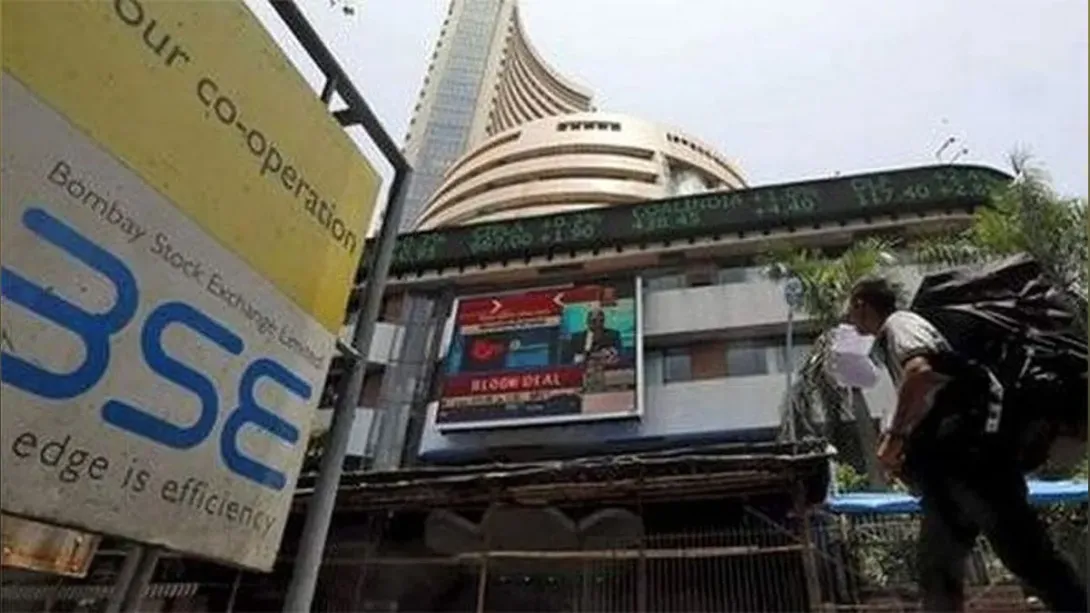
Indian equity markets saw a sharp correction on Monday, with benchmark indices Sensex and Nifty each falling over 1%, driven by renewed geopolitical unrest in the Middle East. The drop followed reports of U.S. military action targeting three major nuclear facilities in Iran, escalating concerns of a broader regional conflict. Despite the sharp dip, analysts suggested the market impact may be temporary, citing historical patterns of resilience even under geopolitical threats. Key technology stocks bore the brunt of the selling, while select defensive counters saw gains. Global markets offered mixed cues as oil prices inched upward amid the turmoil.
Equity Indices Recoil as Tensions Escalate
The Bombay Stock Exchange’s 30-share Sensex plunged 931.41 points, or 1.13%, closing at 81,476.76. Meanwhile, the National Stock Exchange’s Nifty 50 fell 287.55 points, or 1.14%, ending the session at 24,824.85. The sell-off was largely attributed to escalating Middle East tensions, following U.S. airstrikes on Iranian nuclear facilities—Fordow, Natanz, and Isfahan.
These attacks, marking a direct intervention in the Israel-Iran conflict, jolted investor sentiment globally, raising concerns over energy supply disruptions and further regional destabilization.
Geopolitics and Market Sentiment: The Hormuz Factor
Despite the sharp drop in equities, some market observers maintained a cautiously optimistic outlook. V K Vijayakumar, Chief Investment Strategist at Geojit Financial Services, noted that while the threat of closure of the Strait of Hormuz—through which nearly a fifth of global oil trade passes—remains a concern, history suggests such threats have rarely materialized into an actual blockade.
"While the developments in West Asia have worsened, the market’s reaction could be short-lived if the situation stabilizes soon," Vijayakumar said, offering context to the market’s knee-jerk reaction.
Sectoral Performance: Tech Stocks Take the Hit
Technology and IT companies were among the top losers on the Sensex. Infosys, HCL Technologies, Tata Consultancy Services, and Wipro all declined sharply, reflecting heightened global risk aversion typically associated with geopolitical tensions.
Other major laggards included infrastructure heavyweight Larsen & Toubro, Mahindra & Mahindra, and Hindustan Unilever.
Conversely, select stocks like Trent, Bharat Electronics, Adani Ports, and Bajaj Finance managed to stay in positive territory, buoyed by defensive positioning and underlying sectoral resilience.
Global Market Signals and Crude Oil Movement
Asian equity markets presented a mixed picture. While Japan’s Nikkei 225 and South Korea’s Kospi registered losses, Chinese indices—the Shanghai Composite and Hong Kong’s Hang Seng—recorded marginal gains. U.S. markets had closed mostly lower on Friday, adding to the cautious global sentiment.
In commodities, Brent crude rose 0.78% to USD 77.61 per barrel, amid fears of possible supply disruptions due to the flare-up in West Asia. For an energy-import-reliant economy like India, such price movements remain a critical macroeconomic variable.
Investor Activity and Broader Implications
Despite the downturn, foreign portfolio investors (FPIs) remained net buyers on Friday, with inflows totaling Rs. 7,940.70 crore. This suggests a degree of confidence in India's underlying economic fundamentals, even as near-term risks mount.
The volatility follows a robust performance at the end of last week, when the Sensex had surged 1,046.30 points (1.29%) and the Nifty added 319.15 points (1.29%). Monday’s pullback thus appears to be a geopolitics-driven correction rather than a reversal of market momentum.
Conclusion: Short-Term Jitters, Long-Term Fundamentals
While geopolitical developments, particularly in oil-sensitive regions, remain a persistent risk for emerging markets like India, the structural macroeconomic outlook remains intact. India's diversified energy import strategy, strong domestic consumption, and robust institutional participation continue to anchor investor confidence.
Nevertheless, market participants are advised to brace for continued volatility as developments unfold in the Middle East, with oil prices, foreign flows, and global risk appetite serving as key variables to monitor in the near term.
Comments