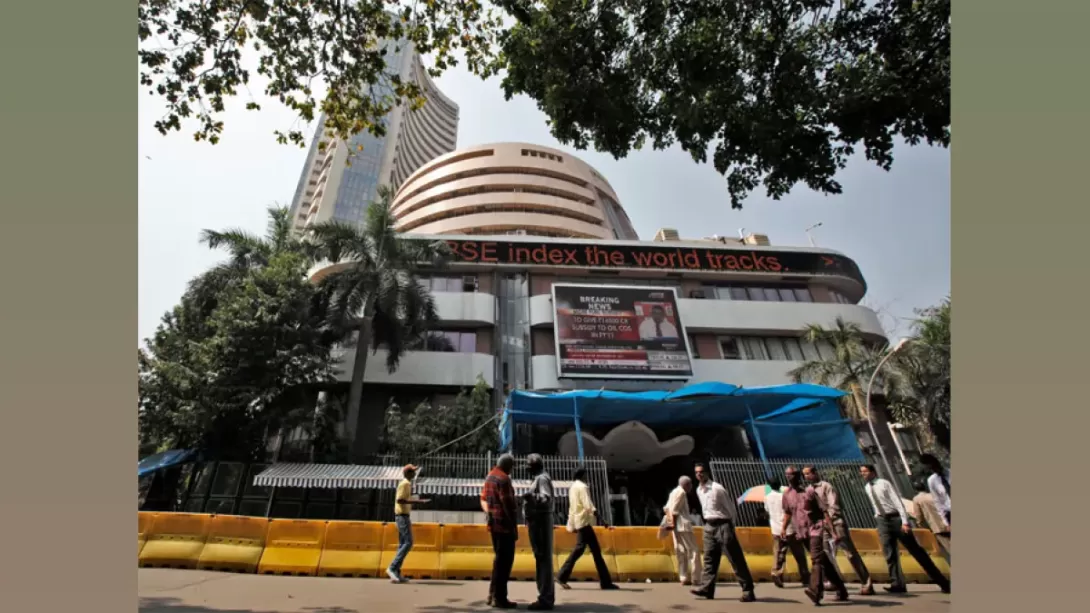
Indian equity benchmarks Sensex and Nifty saw a robust surge in early Friday trade after the Reserve Bank of India (RBI) delivered a larger-than-anticipated 50 basis point reduction in the repo rate, lowering it to a three-year low of 5.5%. The move comes as a response to economic growth slowing to a four-year low of 6.5% in FY25. Key rate-sensitive sectors including real estate, banking, and auto led the market rebound. The central bank maintained its GDP projection but lowered inflation expectations to 3.7%, citing a favorable monsoon outlook and subdued global oil prices.
Central Bank Surprises with Aggressive Policy Easing
In an assertive policy decision aimed at rejuvenating the domestic economy, the Reserve Bank of India slashed the benchmark repo rate by 50 basis points—doubling the widely anticipated 25 basis point cut. The move reduces the policy rate to 5.5%, its lowest point in three years, underscoring the central bank’s commitment to maintaining liquidity and stimulating credit flow.
RBI Governor Sanjay Malhotra stated that the Monetary Policy Committee's (MPC) decision was made following a comprehensive evaluation of macroeconomic trends and global financial developments. Despite the rate cut, the central bank retained its GDP growth forecast at 6.5% for FY25, suggesting confidence in India’s medium-term economic prospects.
Markets Respond with Optimism
The capital markets responded positively to the policy shift. The BSE Sensex surged 591.94 points to reach 82,033.98, while the NSE Nifty climbed 205.2 points, closing at 24,956.10 in morning trade. The upbeat sentiment was driven primarily by gains in rate-sensitive segments.
The BSE Realty Index led the rally with a 2.80% gain, followed by the Auto Index (1.14%) and the Bankex (0.98%). Among notable gainers were Bajaj Finance, Axis Bank, Maruti Suzuki, Kotak Mahindra Bank, IndusInd Bank, SBI, Bajaj Finserv, and HDFC Bank. Conversely, shares of Sun Pharma, Infosys, Nestlé India, and HCL Technologies ended in the red.
Inflation Outlook Revised Amid Stable Commodity Trends
In an important recalibration, the RBI revised its inflation forecast downward from 4% to 3.7% for FY25. This shift reflects optimism about food price stability and an anticipated normal monsoon season, which could help ease agricultural inflation. Global oil benchmarks, such as Brent crude, also remain subdued, trading at USD 65.16 per barrel, offering additional relief on the inflation front.
These projections provide the central bank with policy room to maneuver should further easing be required without threatening macroeconomic stability.
Commentary: Balancing Growth and Inflation Risks
Market analysts welcomed the RBI’s bold action as a strategic and forward-looking move. Umeshkumar Mehta, Chief Investment Officer at SAMCO Mutual Fund, remarked that the decision to front-load the rate cut reflects a "pro-growth" stance, especially against the backdrop of declining inflation. He also emphasized that the shift in the policy stance from "accommodative" to "neutral" allows greater flexibility for the central bank to navigate future uncertainties, including potential geopolitical risks.
This is the third consecutive rate reduction by the RBI in 2025, reinforcing its responsiveness to both domestic challenges and global economic turbulence.
Global Context and Institutional Activity
Asian markets displayed a mixed pattern, with South Korea’s Kospi and Japan’s Nikkei 225 trading higher, while China’s SSE Composite Index and Hong Kong’s Hang Seng showed marginal losses. On Wall Street, U.S. equity markets closed lower on Thursday, reflecting investor caution ahead of key economic data releases.
Foreign Institutional Investors (FIIs), however, remained net sellers in Indian equities, offloading shares worth Rs. 208.47 crore on Thursday, according to stock exchange data. This contrasts with the buoyant sentiment seen in domestic markets, hinting at cautious foreign investor positioning amid global macroeconomic uncertainty.
Concluding Outlook
The RBI’s unexpected rate cut has injected fresh momentum into the Indian markets, reinforcing the central bank’s commitment to reviving domestic demand and maintaining financial stability. With inflation under control and the prospect of a strong monsoon, the policy environment appears conducive to sustained growth in the second half of FY25.
While external headwinds persist, particularly from global markets and commodity prices, India’s proactive monetary stance positions it well to navigate uncertainties. The coming months will be crucial in determining whether this strategic easing translates into broader economic recovery and investor confidence.
Comments