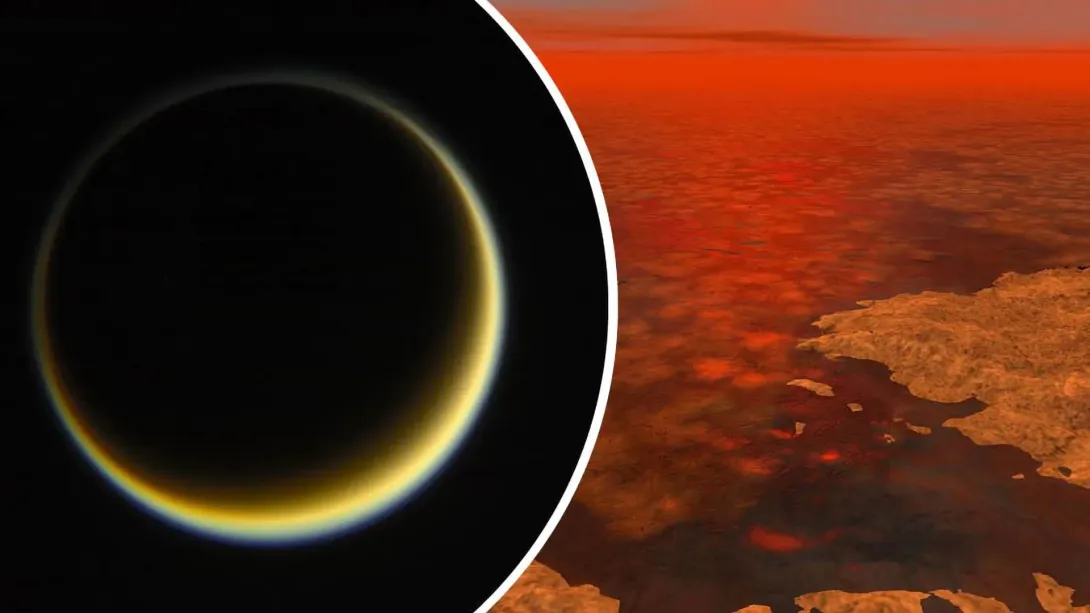
In a remarkable planetary discovery, NASA and Sweden’s Chalmers University of Technology have identified hydrogen cyanide (HCN) crystals on Titan, Saturn’s largest moon. Using cutting-edge radio telescopes and infrared spectroscopy, researchers found solid-state HCN formations in Titan’s upper atmosphere—marking the first confirmed evidence of such crystalline compounds beyond Earth. This finding provides critical insight into Titan’s complex chemistry and its potential as a prebiotic environment. Scientists believe that the moon’s cold, nitrogen-rich atmosphere could host chemical reactions resembling those that preceded life on early Earth, thereby redefining the search for extraterrestrial habitability in the outer solar system.
Discovery of a Cosmic Chemical Puzzle
Titan, larger than the planet Mercury, has long fascinated scientists due to its dense, nitrogen-dominated atmosphere and methane lakes. Recent observations by NASA’s James Webb Space Telescope (JWST) and radio analysis conducted by Chalmers University’s Onsala Space Observatory have now detected distinct spectral signatures of hydrogen cyanide (HCN) crystals.
HCN, a molecule composed of hydrogen, carbon, and nitrogen, is considered one of the building blocks of life’s chemistry. The research team found that under Titan’s extremely cold conditions—around minus 179°C—HCN condenses into solid crystals, forming aerosols that drift within the moon’s stratosphere. These microscopic ice-like particles play a key role in Titan’s atmospheric processes and may even catalyze reactions leading to more complex organic molecules.
Dr. Linda Karlsson, lead researcher at Chalmers University, noted that “the crystalline hydrogen cyanide detected on Titan demonstrates a remarkable chemical pathway that mirrors the earliest stages of organic synthesis once theorized for primordial Earth.”
How the Discovery Was Made
The team utilized a combination of infrared spectrometry from JWST and millimeter-wave radio observations from the Atacama Large Millimeter/submillimeter Array (ALMA) in Chile. These advanced instruments captured the distinctive absorption patterns corresponding to frozen HCN particles high in Titan’s atmosphere.
The data revealed strong signatures around the 3.2-micron wavelength, consistent with crystalline hydrogen cyanide rather than gaseous or amorphous forms. This finding confirms earlier, inconclusive detections made by the Cassini–Huygens mission between 2004 and 2017.
By cross-referencing temperature gradients and spectral variations, scientists determined that the HCN crystals likely form during Titan’s seasonal cooling cycles—particularly near the poles where atmospheric density peaks.
Chemical and Astrobiological Implications
The discovery of solid HCN on Titan holds profound implications for the field of astrochemistry and the ongoing search for life beyond Earth. Hydrogen cyanide is a reactive molecule that can combine with other compounds to form amino acids and nucleobases—the essential ingredients of life as we know it.
Titan’s unique environment, rich in methane and nitrogen but devoid of liquid water on the surface, creates a natural laboratory for studying prebiotic chemistry in conditions distinct from Earth’s. When exposed to ultraviolet radiation and cosmic rays, HCN can participate in a cascade of reactions leading to complex organic polymers known as tholins—the substances responsible for Titan’s orange haze.
According to NASA researchers, these tholins may accumulate on Titan’s icy surface and interact with potential subsurface water reservoirs, forming a dynamic chemical system that mimics the early stages of biogenesis.
Relevance to Planetary Science and Future Missions
This discovery is expected to significantly influence NASA’s upcoming Dragonfly mission, scheduled for launch in 2028. Dragonfly—a rotorcraft lander—will explore Titan’s surface to analyze organic compounds and assess its potential for supporting life’s chemistry.
Understanding how HCN crystals form and evolve in Titan’s atmosphere can help mission scientists identify landing sites rich in prebiotic material. The findings also provide new calibration data for Dragonfly’s onboard spectrometers, allowing for more accurate chemical detection once the spacecraft arrives.
The study further enhances the scientific rationale for continued investment in outer solar system exploration. The estimated mission cost of Rs. 35,000 crore underscores NASA’s growing commitment to understanding the building blocks of life in diverse planetary environments.
Economic and Strategic Dimensions of Space Research
Beyond the scientific implications, the discovery reflects the broader economic and strategic significance of space collaboration. The partnership between NASA and Chalmers University underscores the value of international cooperation in deep-space research.
For Sweden, participation in such groundbreaking projects elevates its profile within the European Space Agency (ESA) framework, fostering high-value innovation in remote sensing, cryogenics, and data analytics. For NASA, the collaboration complements its strategy of outsourcing specialized research to global partners, ensuring cost efficiency while maintaining scientific leadership.
The global space economy, now valued at over Rs. 45 lakh crore (USD 550 billion), is increasingly driven by such interdisciplinary projects that merge planetary science, advanced engineering, and artificial intelligence in data interpretation.
A New Window Into the Origins of Life
Titan continues to stand out as one of the most Earth-like worlds in the solar system, with lakes, clouds, and an active atmosphere. The discovery of crystalline hydrogen cyanide adds yet another layer of intrigue, suggesting that complex organic chemistry is not unique to our planet.
The revelation that Titan hosts stable, life-forming compounds in its skies reinforces a growing hypothesis: life’s chemistry may be widespread, even if life itself remains rare. Each molecule detected brings scientists closer to answering the timeless question of whether biology could arise elsewhere under different conditions.
Conclusion
The detection of hydrogen cyanide crystals on Titan marks a milestone in planetary science—bridging the gap between chemistry and cosmology. It demonstrates how international collaboration, advanced technology, and persistent inquiry can reveal the hidden architecture of alien worlds.
As Dr. Karlsson aptly summarized, “Titan offers us a mirror into our past and a glimpse into what might exist elsewhere. Its chemistry is both alien and familiar—a reminder that the universe may be teeming with the ingredients of life, waiting for the right conditions to ignite.”
For NASA, Chalmers University, and the global scientific community, this is not merely a discovery—it is an invitation to reimagine life’s possibilities across the cosmos.
Comments