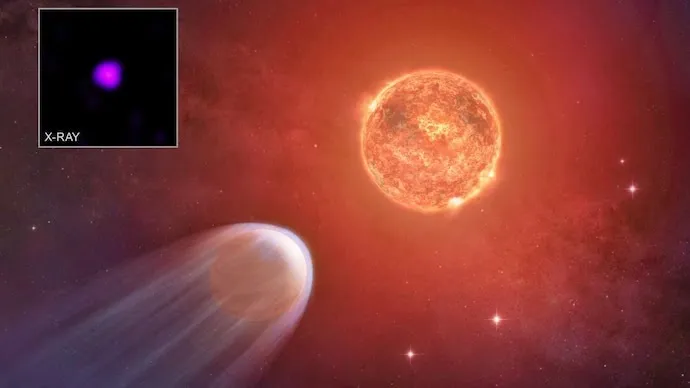
In a groundbreaking astronomical observation, NASA has identified a young exoplanet that is rapidly shrinking as its atmosphere appears to be evaporating. The discovery offers a rare glimpse into the turbulent early stages of planetary evolution, raising profound questions about the formation, longevity, and survivability of newborn worlds in extreme conditions. Scientists suggest that the planet, still in its infancy, is losing its gaseous envelope due to intense radiation from its nearby host star. This development marks a significant step forward in understanding how planetary systems evolve—and sometimes unravel—under the pressures of their stellar environments.
---
A Planet in Peril: Key Discovery Insights
Astronomers using NASA’s space-based observational assets have tracked a distant exoplanet—classified as a “baby planet”—that is undergoing a dramatic and unusual transformation. Situated relatively close to its host star, the planet is believed to be just a few million years old, a blink in cosmic terms.
What makes this celestial body remarkable is the rate at which it is shedding its atmosphere. The phenomenon, described as atmospheric evaporation or “melting,” is being triggered by intense ultraviolet and X-ray radiation emitted by the parent star. This radiation heats the upper layers of the planet’s atmosphere, causing particles to escape into space.
---
The Science Behind Atmospheric Loss
Planets form in disks of gas and dust surrounding young stars. During their early stages, many exoplanets have thick, volatile-rich atmospheres composed of hydrogen and helium. However, when a planet orbits too close to its star, these gases can be stripped away.
In this case, the baby planet is experiencing such extreme stellar radiation that its atmospheric gases are not merely drifting off but are being violently ejected into space. Observational data show a stream of atmospheric material extending from the planet, forming a visible tail not unlike that of a comet.
Such a process can ultimately change the planet’s classification—transforming it from a gas-dominated body to a rocky core, akin to Mercury or Mars.
---
Implications for Planetary Evolution
This discovery is critical for scientists trying to understand the broader narrative of planetary evolution. The fact that a planet can lose a significant portion of its atmosphere so early in its lifecycle indicates that planetary systems may be more fragile and dynamic than previously thought.
It also helps refine existing models of planet formation, particularly for so-called “hot Jupiters” and “super-Earths” found in other solar systems. If a planet can lose its atmosphere in such a short timeframe, it could explain why we observe such diversity in exoplanet sizes and compositions.
---
Future Research and Observation Plans
The findings open new avenues for future astronomical missions. NASA’s James Webb Space Telescope, for instance, may provide even more detailed insights into the chemical composition of the escaping gases, helping scientists determine the precise mechanisms driving atmospheric loss.
Moreover, researchers are now keen to identify other young exoplanets showing similar signs of instability. Tracking how atmospheres evolve—or evaporate—could offer answers to one of astronomy’s oldest questions: What makes a planet capable of sustaining life?
---
A Fragile Window into the Cosmos
The sight of a planet losing its atmosphere in real-time offers a sobering reminder of the volatility of space. While planets may seem permanent from our Earth-bound perspective, the universe is constantly reshaping and erasing its creations.
NASA’s detection of this shrinking baby planet underscores the fragile balance required for planetary survival and reinforces the idea that our own solar system is an exception, not the rule. In a universe defined by change, even the birth of a planet can begin with a loss.
Comments