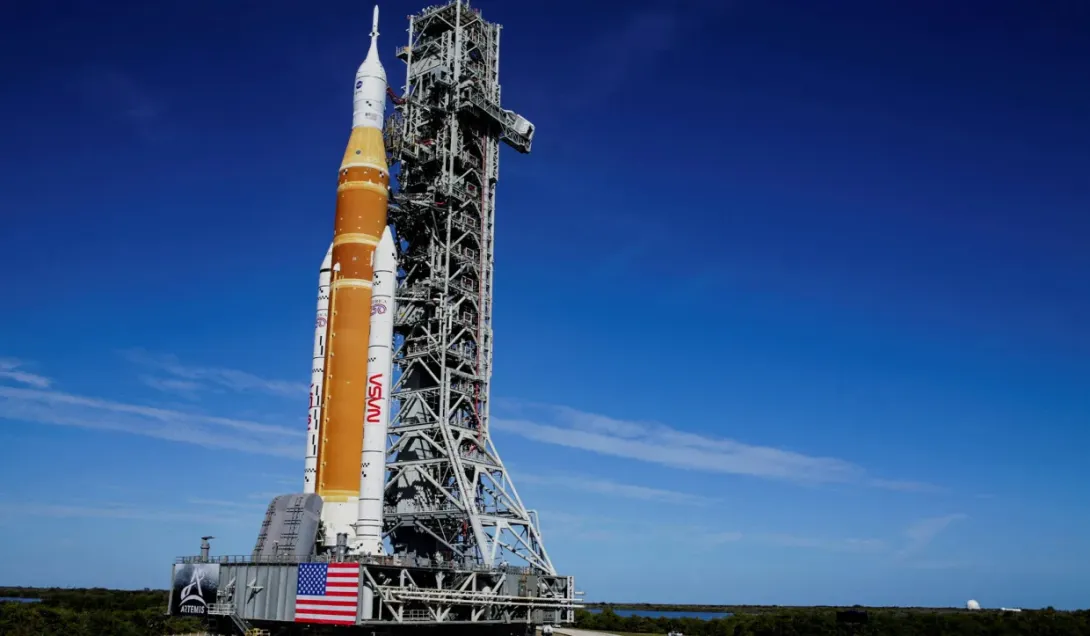
The United States space agency NASA has made significant progress on Artemis II, the first crewed mission under its ambitious Artemis program. Artemis II is designed to send astronauts around the Moon, marking a critical step toward sustained lunar exploration and future missions to Mars. The mission represents a strategic blend of technological readiness, international collaboration, and long-term economic investment in space infrastructure. Officials say the program not only advances scientific discovery but also strengthens aerospace supply chains, workforce development, and America’s leadership in the rapidly evolving global space economy.
Mission Overview and Objectives
Artemis II will carry a crew of astronauts aboard the Orion spacecraft on a multi-day journey around the Moon, without landing on its surface. The primary objective is to rigorously test life-support systems, navigation, and spacecraft performance in deep-space conditions before attempting a crewed lunar landing.
NASA officials describe the mission as a bridge between uncrewed test flights and future lunar surface operations, ensuring mission safety and operational reliability.
Technological and Economic Significance
The Artemis program is supported by substantial public investment and a broad network of private contractors. From propulsion systems to advanced materials, Artemis II reflects years of research, development, and capital deployment.
Analysts note that such missions generate economic spillovers across the aerospace sector, boosting innovation, high-skilled employment, and supplier ecosystems while reinforcing U.S. competitiveness in space technology.
International Collaboration and Strategic Impact
Artemis II also underscores growing international cooperation, with allied space agencies contributing technology, research, and future mission planning. This collaborative model is seen as essential for managing costs and sharing expertise in long-duration space exploration.
Strategically, the mission strengthens NASA’s role in shaping global norms around lunar exploration, resource utilization, and space governance.
Timeline and Readiness
NASA has indicated that Artemis II preparations are advancing steadily, with system testing, astronaut training, and safety reviews underway. While schedules remain subject to technical validation, officials emphasize that mission readiness—not speed—remains the guiding principle.
The agency has reiterated its commitment to transparency and rigorous testing following lessons learned from earlier Artemis missions.
Outlook
Artemis II represents more than a single spaceflight; it is a cornerstone of NASA’s long-term vision for human exploration beyond low Earth orbit. As preparations continue, the mission is expected to play a defining role in shaping the future of space exploration, commercial participation, and humanity’s return to the Moon.
Comments