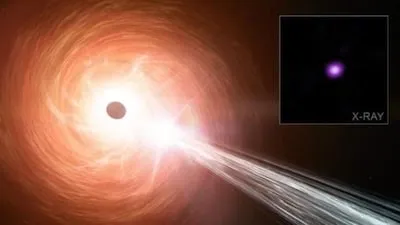
NASA’s Chandra X-ray Observatory has identified a supermassive black hole undergoing an unprecedented growth phase, offering critical insights into the evolution of galaxies and cosmic structures. The black hole, located billions of light-years away, is accreting matter at extraordinary rates, emitting intense X-rays detectable across vast cosmic distances. This discovery provides a rare opportunity to study the dynamics of extreme astrophysical phenomena, including energy output, accretion mechanics, and interactions with surrounding interstellar material. Understanding such rapidly growing black holes helps astronomers refine models of galaxy formation, supermassive black hole evolution, and the role these cosmic giants play in shaping the universe.
Discovery and Observation
Chandra’s high-resolution X-ray imaging revealed the black hole’s exceptional growth, allowing astronomers to measure its accretion rate and energy emissions accurately. The observations indicate that this black hole is absorbing surrounding gas and dust at an extraordinary pace, shedding light on mechanisms driving rapid mass accumulation in the early universe.
Implications for Galaxy Evolution
Supermassive black holes exert significant influence over their host galaxies, regulating star formation and galactic dynamics. Studying one in an accelerated growth phase enables researchers to understand the feedback processes that govern galaxy evolution. The energy output from the accretion process can heat surrounding gas, potentially suppressing or triggering star formation depending on environmental conditions.
Accretion Mechanics and X-Ray Emissions
The black hole’s extreme growth is accompanied by intense X-ray radiation, a byproduct of matter heating up as it spirals into the event horizon. Analysis of these X-ray signatures provides critical data on the physical conditions near the black hole, including temperature, density, and magnetic field interactions. Such observations are vital for refining theoretical models of black hole physics.
Significance for Cosmology
Rapidly growing supermassive black holes serve as natural laboratories for understanding the universe’s early epochs. Their study informs models of cosmic structure formation, dark matter distribution, and the interplay between black holes and their galactic environments. This discovery adds to the growing body of evidence that supermassive black holes can influence the evolution of entire galaxies on cosmological timescales.
Conclusion
NASA’s detection of a rapidly growing supermassive black hole underscores the importance of X-ray astronomy in uncovering extreme cosmic phenomena. Observing such a system in real-time provides invaluable insights into black hole accretion, energy feedback mechanisms, and galaxy evolution. As research progresses, these findings will continue to deepen our understanding of the most enigmatic and powerful objects in the universe, offering a rare glimpse into the forces that shape cosmic history.
Comments