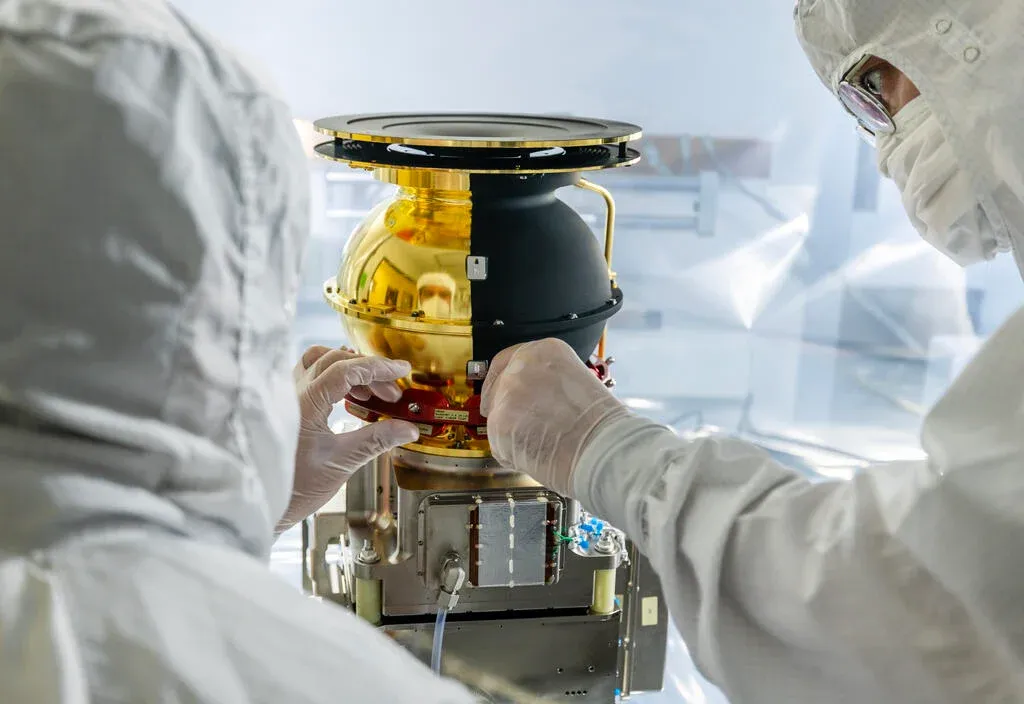
NASA’s Interstellar Mapping and Acceleration Probe, known as IMAP, has achieved a critical early milestone by successfully collecting its first-light data from space. The initial observations confirm that the spacecraft’s instruments are functioning as designed, validating years of engineering, testing, and scientific planning. IMAP’s mission is to study the heliosphere—the vast magnetic bubble created by the solar wind—and its interaction with interstellar space. Scientists say the early data will help refine models of cosmic particle acceleration and space weather dynamics, with implications for satellite safety, astronaut health, and long-term space exploration strategies.
A Major Milestone for a Flagship Science Mission
The successful acquisition of first-light data represents a defining moment for NASA’s IMAP mission. First light, a term used to describe the initial operational observations of a space instrument, confirms that the spacecraft’s sensors are correctly aligned, calibrated, and capable of collecting usable scientific information.
Mission officials described the early results as a strong indication that IMAP is on track to meet its primary scientific objectives. The data will now undergo detailed validation before being integrated into broader research workflows.
Understanding the Heliosphere’s Hidden Dynamics
IMAP is designed to provide the most detailed maps yet of energetic particles that originate both within and beyond the solar system. By measuring how charged particles are accelerated and distributed, the mission aims to deepen understanding of the heliosphere’s structure and its role as a protective shield against harmful cosmic radiation.
Researchers note that this region plays a crucial role in moderating space weather, which can disrupt communication networks, navigation systems, and power infrastructure on Earth.
Implications for Space Weather and Exploration
Beyond pure scientific discovery, IMAP’s findings are expected to carry practical benefits. Improved models of particle acceleration and solar wind behavior can enhance forecasting tools used to protect satellites and astronauts from radiation exposure.
As human and commercial activity in space accelerates, reliable space weather prediction is increasingly viewed as a strategic necessity rather than a purely academic pursuit.
A Testament to Collaborative Science and Engineering
The mission reflects years of collaboration between NASA centers, academic institutions, and international partners. Analysts point out that IMAP exemplifies how long-term investment in foundational science can yield insights with wide-ranging applications, from national security to commercial space operations.
The successful first-light phase also reinforces confidence in NASA’s project management approach amid rising expectations for cost discipline and scientific return.
Comments