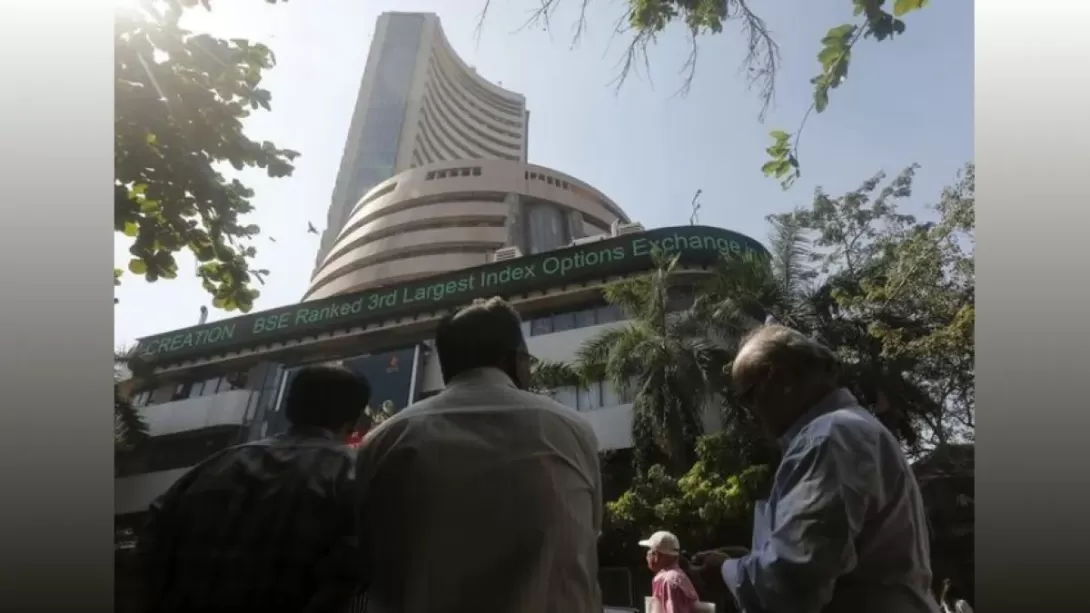
India's stock market has been navigating turbulent waters in recent weeks, with benchmark indices Sensex and Nifty facing declines as global trade tensions escalate. A fresh wave of tariffs imposed by the US has created uncertainty, which, coupled with a series of RBI rate cuts aimed at stimulating the economy, has left the market under pressure. Despite efforts by the Reserve Bank of India to provide economic support, investor sentiment remains subdued as recessionary risks loom. This article explores the current market trends, the RBI's actions, and their implications on India's financial landscape.
Global Trade Tensions Weigh on Indian Equities
The Indian stock market faced significant losses on Wednesday as the benchmark BSE Sensex and NSE Nifty indices closed lower, reflecting broader concerns stemming from escalating global trade tensions. The Sensex dropped by 379.93 points (0.51%), closing at 73,847.15, while the Nifty declined by 136.70 points (0.61%), finishing at 22,399.15. Throughout the day, both indices saw sharp intraday dips, with the Sensex touching a low of 73,673.06, and the Nifty slipping to 22,353.25. These losses were largely attributed to a fresh round of US tariffs, particularly a 104% levy on Chinese imports, which escalated the trade war between the US and China. The ripple effects were felt across global markets, with Asian stocks also taking a hit, leading to a synchronized decline in Indian equities.
The Reserve Bank of India's Response to Economic Pressures
In an attempt to shield the domestic economy from the external shocks of trade disruptions, the Reserve Bank of India (RBI) cut its repo rate by 25 basis points to 6% for the second consecutive time. This rate cut comes after a similar reduction in February, marking the first instance of back-to-back rate cuts since May 2020. In addition, the RBI signaled a more accommodative policy stance, suggesting that further rate cuts could be on the horizon. RBI Governor Sanjay Malhotra, in his address, emphasized that the central bank's decision was aimed at fostering economic growth amid mounting global risks. However, despite the easing measures, market sentiment remained largely unchanged. Analysts observed that the ongoing global recessionary concerns and heightened trade tensions had more influence on investor behavior than domestic rate cuts.
Impact of Tariffs on Market Sentiment
The broader market sentiment took a substantial hit following the imposition of additional US tariffs on Indian goods. A 26% levy was enforced on Indian exports to the US, significantly increasing costs for Indian exporters and adding pressure to the already fragile domestic economy. As a result, key Indian stocks across various sectors—such as State Bank of India, Tech Mahindra, Tata Steel, and Infosys—witnessed substantial losses. Despite these challenges, a few stocks managed to buck the trend. Companies like Nestle, Hindustan Unilever, Titan, and ITC posted gains, driven by their strong fundamentals and relative immunity to the external trade disruptions.
RBI's Economic Growth and Inflation Projections
In its latest policy review, the RBI revised its growth forecast for the Indian economy downward, adjusting its estimate for fiscal year 2025-26 to 6.5%, down from an earlier projection of 6.7%. This revision reflects the ongoing pressure from external factors, including the global trade conflict and slower-than-expected recovery in certain domestic sectors. On the inflation front, the RBI has revised its forecast to 4%, a slight reduction from its earlier projection of 4.2%. This is within the central bank's target range of 2-6%, offering some reassurance that inflationary pressures are being contained, even amid the uncertainty in global markets.
Foreign Institutional Investors (FIIs) Retreat
Investor confidence was further tested as Foreign Institutional Investors (FIIs) pulled out a significant amount of capital from the Indian stock market. On Tuesday, FIIs offloaded equities worth Rs. 4,994.24 crore, according to exchange data. This withdrawal from Indian equities reflects the broader global risk aversion as investors seek safer havens in times of heightened uncertainty. The outflows from the equity markets have compounded the negative sentiment in the short term, placing further pressure on the indices.
Global Markets and Oil Prices: A Broader Context
The global economic landscape continues to be dominated by uncertainty. In Asia, Tokyo's Nikkei 225 index and South Korea's Kospi settled lower, mirroring the global risk-off sentiment. Conversely, Chinese and Hong Kong stocks managed modest gains, as did European markets, which also faced sharp declines. On the commodities front, oil prices have witnessed volatility. Brent crude dropped 4.23% to USD 60.16 per barrel, following concerns over global demand amid the trade disruptions. This decline in oil prices may offer some relief to Indian markets, particularly for import-dependent sectors, though it remains to be seen how this will affect the overall market trajectory in the coming weeks.
Conclusion: A Cautious Outlook for the Indian Stock Market
As trade tensions continue to escalate and global recessionary risks mount, India's stock market faces a challenging environment. While the RBI's rate cuts and accommodative stance offer some support to the domestic economy, broader market sentiment remains subdued. The imposition of additional tariffs by the US, coupled with rising inflationary pressures and a retreat by foreign investors, has left the market vulnerable. Investors are urged to remain cautious and consider diversifying their portfolios in response to these uncertainties. The unfolding global scenario suggests that volatility will remain a dominant feature of the market, making it crucial for investors to stay informed and prepared for potential shifts in market dynamics.
Comments