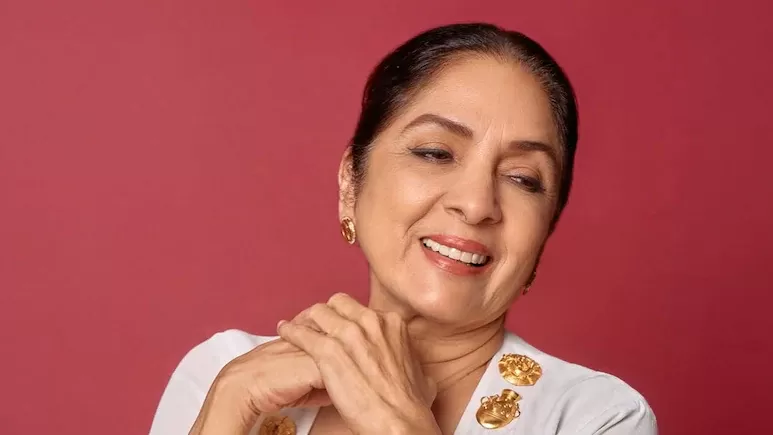
Veteran actor Neena Gupta marked her 66th birthday not with a quiet celebration, but by commanding attention at the trailer launch of her upcoming film Metro In Dino. Joined by an ensemble cast including Pankaj Tripathi, Anupam Kher, and Konkona Sen Sharma, Gupta’s sartorial choice—a bold ‘biscuit bra’ layered over a white kaftan from House of Masaba—ignited spirited conversation across social media. Applauded by many for challenging ageist fashion norms, her appearance underscored the growing cultural shift around aging, self-expression, and female autonomy in India’s public sphere.
A Celebration Beyond the Conventional
Turning 66, Neena Gupta chose work over rest—attending the high-profile trailer launch of Metro In Dino, directed by Anurag Basu. Rather than a private gathering, her birthday became a public moment of celebration, complete with cake, co-stars, and cameras. Cast members Aditya Roy Kapur, Sara Ali Khan, Konkona Sen Sharma, and Pankaj Tripathi were among those who joined the festivities, underscoring Gupta’s continued relevance in a multigenerational industry.
It was a moment that quietly dismantled prevailing narratives around aging in Bollywood, where roles for older women remain limited, and visibility often declines with age.
A Bold Fashion Statement with Cultural Roots
What truly set the tone of the event, however, was Gupta’s unapologetic fashion choice. Wearing a white Rann Kaftan paired with a gold-toned 'biscuit bra' featuring miniature charms, the ensemble came from House of Masaba, the label helmed by her daughter, designer Masaba Gupta. Far from being just a stylistic decision, the outfit symbolized the convergence of heritage, individuality, and defiance against prescriptive norms surrounding age-appropriate dressing.
In a media landscape often quick to criticize women for stepping outside traditional molds, Gupta’s confidence acted as a sartorial counter-narrative. Her look was not just an aesthetic experiment—it was a statement on visibility, aging, and freedom.
Social Media Reactions: Applause, Reflection, and Pushback
Online responses to Gupta’s look were immediate and polarized—though largely supportive. While some questioned whether her choice was “appropriate for her age,” the overwhelming sentiment was one of admiration for her confidence and individuality.
One social media user summed up the spirit of the moment: “It’s about her living life on her own terms by wearing what she likes.” Others echoed this view, framing Gupta’s appearance as emblematic of a broader cultural awakening where older women assert their right to visibility, beauty, and agency.
Critics were met with responses pointing to deep-seated biases: “We always associate age with dressing. But what’s more important is how you carry yourself,” wrote one commenter, emphasizing elegance over conformity.
Another post spoke directly to the intergenerational gap: “It’s most likely the younger ones who just wish they could look half as stunning… even at their own age.”
Contextualizing the Fashion Moment: Age and Agency in Indian Cinema
Gupta’s appearance, while widely discussed, is part of a larger evolution within Indian cinema and public life—where older women are reclaiming space not just on screen, but in the cultural imagination. From her candid autobiography to her on-screen performances, Neena Gupta has consistently challenged the tropes assigned to aging women.
By embracing bold fashion, she joins a growing global movement of older celebrities who are pushing back against invisibility. This shift is particularly significant in the Indian context, where social expectations around womanhood, modesty, and aging remain deeply entrenched.
Her choice of attire can thus be read as a multi-layered act of self-expression: a nod to generational artistry (via Masaba), a statement of bodily autonomy, and a rejection of reductive societal expectations.
Conclusion: More Than a Look—A Legacy in the Making
Neena Gupta’s birthday celebration was more than a media moment—it was a cultural statement. As she stood in the spotlight, cutting cake among co-stars and fielding flashbulbs, she symbolized not just an accomplished actor promoting her film, but a woman refusing to let age dictate relevance or self-presentation.
In a society where women are frequently told to shrink themselves with time, Gupta’s presence felt expansive—an embodiment of confidence, individuality, and artistic continuity across generations. Her message was clear: aging is not an erasure, but an evolution.
Comments