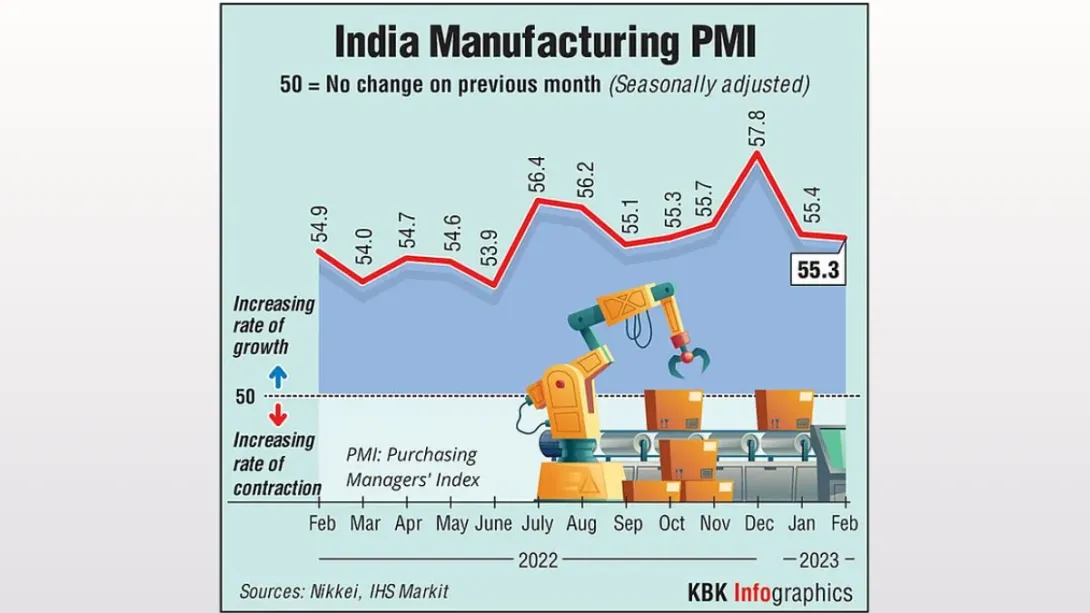
India’s manufacturing activity strengthened in October, with the Purchasing Managers’ Index (PMI) rising to a multi-month high, underscoring the resilience of industrial demand and improved supply-chain efficiency under the Goods and Services Tax (GST) regime. The latest data indicates robust factory output, higher new orders, and sustained job creation across key manufacturing hubs. Analysts attribute this expansion to festive demand, improved logistics, and the steady normalization of input costs. The GST system, now firmly entrenched in India’s manufacturing ecosystem, has helped streamline operations and foster interstate trade efficiency, bolstering business confidence amid a challenging global economic environment.
Manufacturing Activity Accelerates in October
India’s manufacturing sector displayed renewed momentum in October as output and new orders grew at a healthy pace, supported by improved domestic demand and enhanced business confidence. The S&P Global India Manufacturing Purchasing Managers’ Index (PMI) rose to 55.5 in October, up from 55.0 in September, indicating stronger expansion across the sector.
A PMI reading above 50 signals growth, while below 50 indicates contraction. The consistent reading above the 50 mark for over two years reflects the sector’s steady resilience despite global headwinds, including elevated interest rates and muted export demand in key international markets.
Survey respondents highlighted increased production volumes, stronger client orders, and rising input purchases—suggesting manufacturers are gearing up for sustained demand through the festive quarter.
GST System Boosts Efficiency and Supply-Chain Integration
A key factor behind October’s manufacturing uptrend has been the ongoing efficiency gains from the Goods and Services Tax (GST) framework. Since its introduction, the GST has simplified interstate commerce, reduced logistics delays, and fostered a unified national market for manufacturers.
Industry leaders report that smoother tax compliance and faster input credit adjustments have contributed to more predictable cash flows and better working capital management. These operational efficiencies have been particularly beneficial for small and medium enterprises (SMEs), enabling them to compete more effectively with larger manufacturers.
Experts note that the GST system has also encouraged supply-chain integration across states, facilitating timely inventory movement and reducing redundant taxation, which previously hampered production schedules.
Demand Resilience and Employment Gains
The PMI survey pointed to robust domestic demand as a key driver of manufacturing expansion. Consumer goods producers, buoyed by festive spending and a rebound in discretionary purchases, reported strong sales momentum. Intermediate goods manufacturers also benefited from a steady increase in industrial activity and infrastructure investments.
Encouragingly, employment levels rose for the eighth consecutive month, signaling confidence among manufacturers in sustained business activity. “Firms are hiring at a consistent pace to meet production commitments and prepare for continued demand in the months ahead,” noted a senior economist familiar with the data.
Inflationary pressures also appeared manageable, as input costs rose only marginally compared to earlier quarters. This allowed companies to maintain competitive pricing while preserving profit margins.
Export Orders and Global Challenges
While domestic demand remained robust, export orders saw only modest growth, reflecting a sluggish recovery in global trade. The slowdown in Europe and parts of Asia, along with persistent geopolitical tensions, continued to weigh on India’s external demand outlook.
However, India’s diversified manufacturing base—spanning automotive, pharmaceuticals, and electronics—helped offset some of the global softness. Analysts believe that ongoing government initiatives, such as the Production-Linked Incentive (PLI) schemes and infrastructure investments, will gradually strengthen export competitiveness and attract foreign investment into manufacturing clusters.
Outlook: Manufacturing Momentum Set to Continue
Looking ahead, industry observers maintain an optimistic outlook for India’s manufacturing sector. Stable inflation, a favorable policy environment, and rising domestic consumption are expected to sustain growth in the coming quarters. The PMI data reinforces expectations that manufacturing will remain a key pillar of India’s economic expansion, contributing meaningfully to GDP growth in the second half of the fiscal year.
“The combination of steady demand, supply-chain efficiencies under GST, and improving business confidence creates a strong foundation for continued industrial recovery,” said a Mumbai-based analyst. “If global conditions stabilize, India’s manufacturing could enter a sustained growth cycle.”
Conclusion: A Stronger Industrial Backbone
The October PMI reading not only highlights India’s manufacturing resilience but also underscores the tangible benefits of systemic tax reforms like the GST. By harmonizing interstate trade and boosting operational efficiency, the GST has evolved into a key enabler of industrial growth.
As the manufacturing sector continues to gain traction, supported by sound macroeconomic fundamentals and policy stability, India’s position as a global production hub appears increasingly credible. The coming months will likely see manufacturers leveraging this momentum to expand capacity, deepen export capabilities, and strengthen the country’s industrial backbone.
Comments