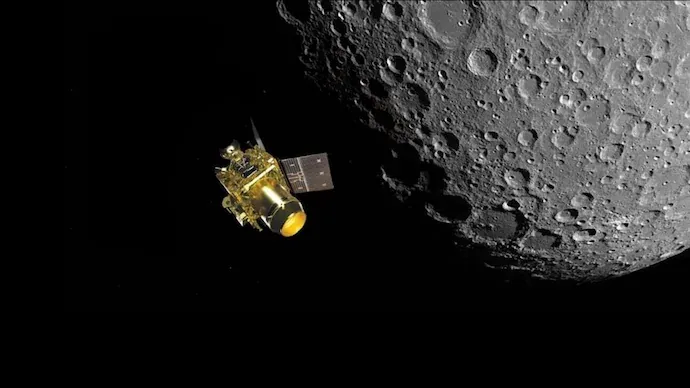
India’s Chandrayaan-2 mission continues to make significant contributions to lunar science, even years after its launch. The orbiter, equipped with advanced payloads, has delivered new data revealing crucial details about the Moon’s polar regions—areas of immense scientific interest due to their potential water ice deposits. According to the Indian Space Research Organisation (ISRO), the latest findings offer refined insights into the surface composition, temperature variations, and mineral distribution across the lunar poles. These discoveries not only deepen understanding of the Moon’s evolution but also strengthen India’s role in global space research and future interplanetary exploration initiatives.
Chandrayaan-2’s Ongoing Legacy
Launched in July 2019, Chandrayaan-2 was India’s second lunar exploration mission, designed to expand upon the discoveries of Chandrayaan-1. Although the lander, Vikram, lost communication during its descent, the orbiter has remained fully operational and continues to transmit valuable scientific data.
With its suite of eight sophisticated instruments, the orbiter has been studying the Moon’s surface characteristics, exosphere, and mineral composition. The latest analyses from ISRO’s research teams have focused on the lunar polar regions—an area of particular interest for its permanently shadowed craters that may harbor frozen water.
ISRO scientists highlight that these ongoing observations are pivotal for future lunar missions, including Chandrayaan-3 and collaborative international programs focused on sustained lunar habitation.
Mapping the Moon’s Polar Terrain
The data collected by Chandrayaan-2’s Dual Frequency Synthetic Aperture Radar (DFSAR) has allowed researchers to examine the Moon’s polar terrain with unprecedented precision. The radar imagery has identified distinct dielectric properties of the surface materials, offering clues about subsurface water ice.
In addition, the Terrain Mapping Camera-2 (TMC-2) and the Imaging Infrared Spectrometer (IIRS) have contributed detailed 3D models of the polar topography. These findings are crucial in understanding the Moon’s geological processes and in identifying stable sites for potential future landings.
Preliminary results indicate temperature variations ranging from minus 200°C in shadowed craters to relatively warmer sunlit areas. Such data points are vital in assessing the environmental challenges for human or robotic presence on the lunar surface.
Scientific Breakthroughs and Global Collaboration
Chandrayaan-2’s new polar observations complement existing lunar datasets from missions by NASA, JAXA, and ESA. Scientists have emphasized that India’s mission offers unique high-resolution mapping capabilities, especially in the southern hemisphere of the Moon, which remains relatively unexplored.
The orbiter’s data has also been shared with the international scientific community through ISRO’s open-access policy, fostering collaborative studies in planetary geology and space weathering. Researchers are now combining Chandrayaan-2’s findings with those from NASA’s Lunar Reconnaissance Orbiter (LRO) to validate the presence and distribution of water molecules in polar regions.
These cross-agency studies enhance global understanding of lunar resources, potentially guiding future missions aimed at in-situ resource utilization — a key step toward sustainable lunar exploration.
Strengthening India’s Position in Space Science
The continuous success of Chandrayaan-2’s orbiter underscores India’s growing technological and analytical capabilities in planetary exploration. It demonstrates ISRO’s resilience in transforming setbacks into long-term achievements.
With Chandrayaan-3’s historic lunar landing earlier this year, India became the first nation to reach the Moon’s south pole. The complementary findings from Chandrayaan-2’s orbiter have further enriched this success, providing scientific depth and continuity to India’s lunar exploration program.
ISRO has announced that several instruments onboard the orbiter are performing beyond their designed mission life, ensuring sustained contributions to global lunar science.
Future Implications for Lunar Exploration
The findings from Chandrayaan-2’s orbiter hold immense significance for the next generation of lunar missions. Insights into the Moon’s polar geology and ice distribution are crucial for planning future crewed missions and establishing long-term lunar bases.
The potential presence of frozen water, which can be used to produce oxygen and fuel, has transformed the Moon’s poles into focal points for future exploration. As nations gear up for renewed interest in lunar colonization, India’s contributions through Chandrayaan-2’s continued data transmission reaffirm its role as a vital participant in global space exploration.
Conclusion
Chandrayaan-2’s orbiter continues to write a remarkable chapter in India’s space history. Its ongoing observations of the Moon’s polar regions have expanded the world’s understanding of lunar resources, surface dynamics, and potential habitability. Beyond its scientific accomplishments, the mission stands as a testament to India’s technological prowess, determination, and growing influence in international space research.
Comments