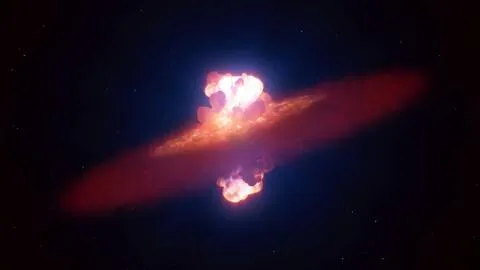
Astronomers have captured a spectacular cosmic event as a dying star, located nearly 22 million light-years from Earth, exploded into a brilliant supernova. The phenomenon marks the dramatic end of a star’s life cycle and offers scientists a rare opportunity to study the mechanics behind such powerful celestial outbursts. Supernovae not only illuminate distant galaxies but also contribute to the universe’s chemical evolution, dispersing essential elements across space. The latest discovery provides fresh insights into stellar behavior while reinforcing the importance of continuous sky monitoring. This extraordinary event is expected to serve as a critical data point for future astronomical research.
A Rare and Powerful Celestial Event
The transformation of a massive star into a supernova is among the most energetic processes known in the universe. When a star reaches the end of its fuel supply, gravitational forces destabilize its core, triggering a catastrophic collapse that results in a massive explosion. The newly observed supernova, situated about 22 million light-years away, is bright enough to be detected by ground-based observatories, offering astronomers an ideal window to analyze its composition and evolution.
Such events are invaluable for understanding the life cycles of stars, the distribution of matter in space, and the physics governing stellar explosions.
Why This Supernova Matters to Science
Supernovae play a fundamental role in shaping galaxies. They enrich the cosmos with heavy elements—such as iron, calcium, and oxygen—that are essential to the formation of planets and, ultimately, life. The explosion observed at this distant location offers researchers a chance to study these materials in real time as they expand outward from the blast.
Early observations indicate that the explosion’s brightness and structure align with known patterns of stellar collapse, but astronomers expect deeper analysis to reveal subtle variations that could refine existing theoretical models.
A Boost for Astronomical Research
The scientific community views each supernova discovery as a natural laboratory. With this event occurring relatively close—on a cosmic scale—it allows telescopes to capture high-resolution data across wavelengths, from visible light to radio emissions. Such comprehensive monitoring helps researchers evaluate how quickly the star’s remnants expand and interact with surrounding cosmic dust.
In addition, these observations aid in calibrating distance measurements across galaxies, supporting broader cosmological studies such as evaluating the universe’s rate of expansion.
The Bigger Picture: The Universe in Motion
While supernovae appear infrequently, they shape the universe more profoundly than their rarity suggests. Each explosion releases tremendous energy, briefly outshining entire galaxies before fading into stellar remnants like neutron stars or black holes.
This newly observed supernova serves as a reminder that the universe is a dynamic, ever-changing arena. For astronomers and space enthusiasts alike, these events deepen our understanding of cosmic origins while revealing the countless mysteries that still await discovery.
Comments