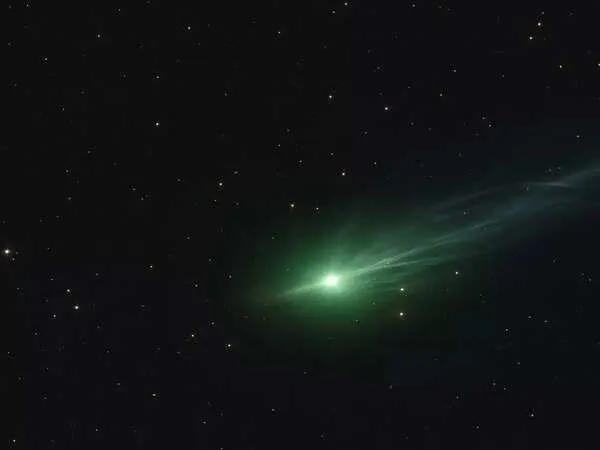
NASA is preparing to publish high-resolution images of the interstellar comet 3I/ATLAS, captured by the HiRISE camera on its Mars Reconnaissance Orbiter, after months of delay. The comet, which follows a hyperbolic trajectory and is only the third known object from beyond our solar system, has intrigued scientists with its anomalous features. Some researchers, including Harvard astrophysicist Avi Loeb, have criticized the hold-up, suggesting bureaucratic inertia may be at play. The images are expected to offer unprecedented clarity on the comet’s nucleus, structure, and unusual “anti-tail,” deepening scientific understanding of this rare cosmic visitor.
---
The Delay and Rising Pressure
NASA’s long-anticipated high-resolution images of 3I/ATLAS have become a focal point of controversy. Critics argue that a bureaucratic bottleneck—exacerbated by a recent government shutdown—has delayed the release of key data. According to reports, internal communications on the HiRISE mission website explicitly note that the images are being held as “NASA-wide news” during the pause in agency communications.
Harvard scientist Avi Loeb, known for his provocative views on interstellar objects, has publicly urged NASA to make the data available, arguing that the images may help resolve lingering questions about the comet’s nature.
---
What HiRISE Captured
The Mars Reconnaissance Orbiter’s HiRISE (High Resolution Imaging Science Experiment) was pointed at 3I/ATLAS as the comet made a close pass to Mars in early October 2025. The images are believed to offer a side-on view of the comet’s nucleus and its enigmatic “anti-tail”—a dusty feature oriented unusually toward the Sun rather than away, which defies conventional comet behavior.
If published, these images could represent the sharpest, most detailed visuals ever obtained of this interstellar body—surpassing even the views provided by the Hubble Space Telescope in July 2025.
---
Scientific Significance of 3I/ATLAS
Comet 3I/ATLAS is only the third known interstellar visitor confirmed to pass through our solar system. Its hyperbolic trajectory clearly indicates an origin beyond our Sun’s gravitational domain.
Observations by Hubble earlier this year revealed a teardrop-shaped cloud of dust emanating from its icy nucleus. Moreover, infrared spectroscopy using the James Webb Space Telescope has shown that 3I/ATLAS’s coma is unusually rich in carbon dioxide, relative to water — a rare composition that could suggest it formed in a very different environment than typical comets.
This unusual chemical fingerprint, along with its atypical tail orientation and non-gravitational acceleration, has sparked fierce debate in the astrophysics community about whether 3I/ATLAS is purely a natural comet or something more exotic.
---
Global Interest and International Observations
The fascination with 3I/ATLAS extends beyond NASA. China’s Tianwen-1 Mars orbiter also managed to capture images of the comet during its Mars flyby, using its high-resolution camera to contribute to a growing international dataset.
On Earth, observatories are racing to characterize the comet’s behavior. The Transiting Exoplanet Survey Satellite (TESS) reportedly recorded early photometric data suggesting distant activity as the comet approached the inner solar system.
These complementary efforts underscore the global ambition to decode the nature of this rare interstellar visitor.
---
Implications and What to Expect Next
If NASA releases the HiRISE images soon, scientists will gain one of their most powerful tools yet to probe 3I/ATLAS’s structure, dynamics, and composition. Such clarity could help validate or refute theories regarding its odd tail, chemical makeup, and origin.
A transparent and timely release could also strengthen public trust in space science, especially among communities that have raised concerns about withheld data. Meanwhile, the debate surrounding 3I/ATLAS adds urgency to ongoing discussions about interstellar missions, planetary defense, and the fundamentals of cometary science.
As the agency moves toward publication, the spotlight will be firmly on what these images reveal—and whether they can unravel one of the most profound cosmic mysteries of our time.
Comments