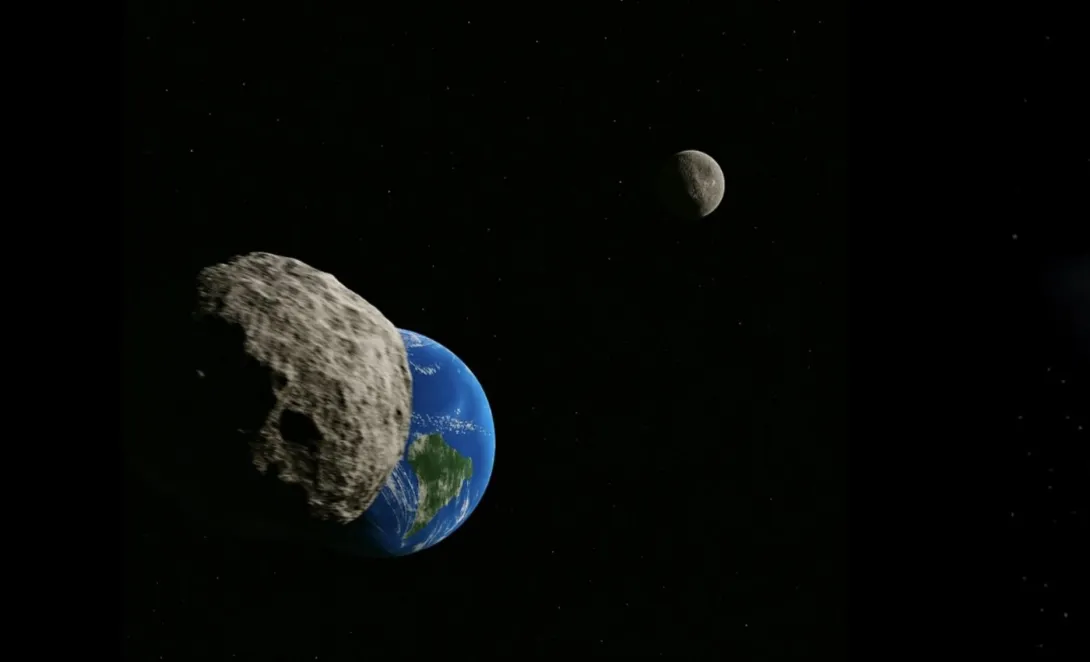
NASA has confirmed the presence of a newly identified “mini moon,” a small celestial body that has been temporarily captured by Earth’s gravity and is expected to accompany the planet for the next 50 years. Unlike Earth’s permanent natural satellite, this object is significantly smaller and follows an unusual, looping orbit influenced by both Earth’s pull and the Sun’s gravitational force. The discovery offers scientists an important opportunity to study near-Earth objects, orbital mechanics, and potential planetary defense strategies. Its stable presence over several decades will allow long-term monitoring, modeling, and exploration of how such bodies interact with Earth’s gravitational environment.
A Rare Gravitational Capture
NASA’s confirmation highlights a phenomenon that occurs infrequently: a small object becoming trapped within Earth’s gravitational field for an extended period. This newly classified “mini moon” is believed to be only a few meters in size, yet large enough to reflect measurable sunlight back to Earth-based observatories. Its capture is the result of a delicate gravitational interplay, where the object slowed sufficiently in its trajectory to be drawn into a temporary orbit rather than passing by the planet.
Scientists emphasize that such occurrences help improve understanding of how near-Earth objects behave and how frequently they approach or interact with Earth.
Unusual Orbital Path Predicted to Last Five Decades
Unlike the Moon’s stable and predictable orbit, the mini moon traces a more complex pattern. Its path resembles an elongated loop around Earth, influenced heavily by solar gravity. This trajectory is neither permanent nor entirely closed, but NASA’s calculations show it is stable enough to remain near Earth for approximately 50 years.
Researchers note that its orbit may shift slightly over time due to gravitational perturbations and solar radiation pressure, yet the prediction of multi-decade stability makes this discovery particularly valuable for long-term study.
Scientific Value for Future Research
The presence of this object opens several avenues for scientific investigation. Astronomers can analyze its composition using reflected light to determine whether it is a natural asteroid fragment or possibly a remnant of human-made space hardware. Understanding its physical characteristics can also improve classification techniques for other near-Earth objects.
Additionally, its long-term presence serves as a natural laboratory for testing models of orbital capture and escape — data that could enhance planetary defense research, including the monitoring of potential Earth-crossing objects.
Opportunities for Exploration and Monitoring
Because the mini moon will remain nearby for decades, it may eventually become a target for future research missions or robotic flybys. Its size and proximity offer a relatively low-risk environment for testing navigation systems, proximity operations, and sampling technologies.
Observatories around the world are expected to track the mini moon regularly, gathering continuous data that will be used to study its evolution and refine predictions of its exit from Earth’s orbit.
A Fascinating Addition to Earth’s Neighborhood
While temporary moons occasionally appear around Earth, few remain for more than a year or two. The exceptional longevity of this newly detected mini moon’s orbit places it in rare company, making it an object of both scientific interest and public curiosity.
Its presence underscores the dynamic nature of the space surrounding our planet and reminds us that Earth’s gravitational influence extends far beyond what is visible in the night sky.
Comments