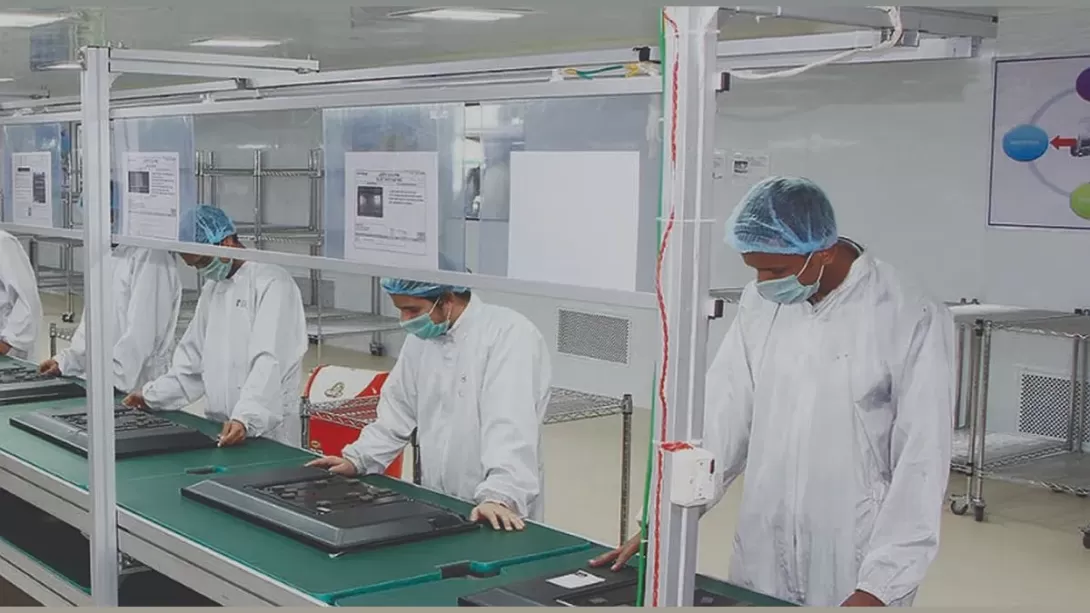
Dixon Technologies is expanding its footprint into the electronics component manufacturing sector, capitalizing on India's growing industrial capabilities. The company is set to leverage government-backed incentives, aiming to produce components initially for in-house use and later for global exports. CEO Atul Lal emphasized the company’s plans to manufacture key components such as display modules, camera modules, and lithium-ion batteries. With government initiatives such as the Rs 23,000 crore Electronics Component Manufacturing Scheme (ECMS) backing this transition, Dixon is positioning itself to become a global player, complementing its existing smartphone and laptop manufacturing operations.
Dixon Technologies Embarks on New Growth Path with Electronics Component Manufacturing
Dixon Technologies, a leader in electronics manufacturing services, is set to expand its operations into the production of electronics components. This move marks a significant step in the company’s growth strategy and aligns with the Indian government’s push to make India a key player in the global electronics supply chain. CEO Atul Lal outlined the company’s plans to develop components for its own use initially, with an eye toward exporting these components once capacity and quality standards are firmly established.
The new initiative will see Dixon venturing into categories like display modules, camera modules, mechanical enclosures, and lithium-ion batteries—sectors where it sees potential for competitive advantage both in India and globally. By entering this space, Dixon aims to integrate itself into the global value chain, making Indian-made components globally competitive and contributing to the nation’s ambition to become a hub for electronics manufacturing.
Government Incentive Scheme to Accelerate Growth
This expansion is supported by the government’s Rs 23,000 crore Electronics Component Manufacturing Scheme (ECMS), aimed at fostering domestic manufacturing capabilities for non-semiconductor electronic components. Under this scheme, the government is incentivizing companies like Dixon to invest in setting up high-quality manufacturing facilities. The scheme promises to create over 91,600 direct jobs and attract significant investment in the sector, with estimates suggesting a total investment of Rs 59,350 crore.
The ECMS aligns with the government’s broader initiative to boost electronics manufacturing, a sector that has become a focal point of India’s economic strategy. With the approval of this scheme, companies now have the resources and incentives to invest in cutting-edge technologies and scale up their operations, which, in turn, will help reduce dependency on imports and improve the country’s export capacity.
Dixon’s Strategic Shift: From Captive to Global Production
Atul Lal emphasized that the first phase of Dixon’s component manufacturing would focus on meeting the company’s internal needs, such as supplying components for the smartphones and laptops it manufactures for brands like Motorola, Xiaomi, and HP. However, the company is looking beyond just captive usage. Lal expressed confidence that Dixon’s products would eventually be competitive on the global stage, enabling the company to participate in international supply chains. This strategic move will likely open new revenue streams, as the global demand for high-quality electronics components continues to grow.
The company’s existing agreements with brands like Vivo to expand manufacturing facilities further solidify its reputation in the electronics space. By diversifying into components, Dixon aims to capitalize on its established manufacturing expertise and expand its reach into new markets.
Industry Response to the Scheme and Quality Standards
The ECMS has received positive feedback from various industry stakeholders, though some challenges remain. The government has specified that companies applying for the scheme must have a design house and maintain a six Sigma quality standard for their products. While many companies, including Dixon, are prepared to meet these requirements, some smaller enterprises in the sector may struggle with the high quality standards set by the government.
Lal, who also serves as the President of the Electronics Component Manufacturers Association (ELCINA), welcomed the government’s focus on quality and the requirement for design houses. These measures are seen as a way to elevate the Indian electronics manufacturing sector to global standards. However, industry experts note that for micro, small, and medium enterprises (MSMEs), which dominate the electronics component space, achieving six Sigma standards could present a challenge.
Long-Term Outlook: Value Addition and Sustainable Growth
Industry bodies such as the India Electronics and Semiconductor Association (IESA) and the India Cellular and Electronics Association (ICEA) have lauded the government’s push for electronics component manufacturing, seeing it as an opportunity to increase value addition and enhance the sustainability of India’s electronics manufacturing sector. Pankaj Mohindroo, Chairman of ICEA, pointed out that while financial analysts may view the sector as offering low returns in the short term, the long-term benefits will be significant. By focusing on value addition, India can reduce its reliance on imports and build a self-sustaining manufacturing ecosystem that can compete on the global stage.
Conclusion: Dixon Technologies on Track for Global Competitiveness
Dixon Technologies is positioning itself for a pivotal role in India’s ambitious electronics manufacturing ecosystem. By expanding into the component manufacturing sector, the company is tapping into a growing market, bolstered by the government’s strategic incentives. While challenges such as the six Sigma quality standard may pose hurdles for smaller players, Dixon’s experience and expertise place it in a strong position to meet these demands.
In the long run, Dixon’s expansion into electronics components could prove to be a transformative move, both for the company and the broader Indian manufacturing landscape. As India seeks to become a global leader in electronics, Dixon Technologies’ investments are likely to play a key role in driving this transformation, paving the way for sustainable growth and greater self-sufficiency in the sector.
Comments