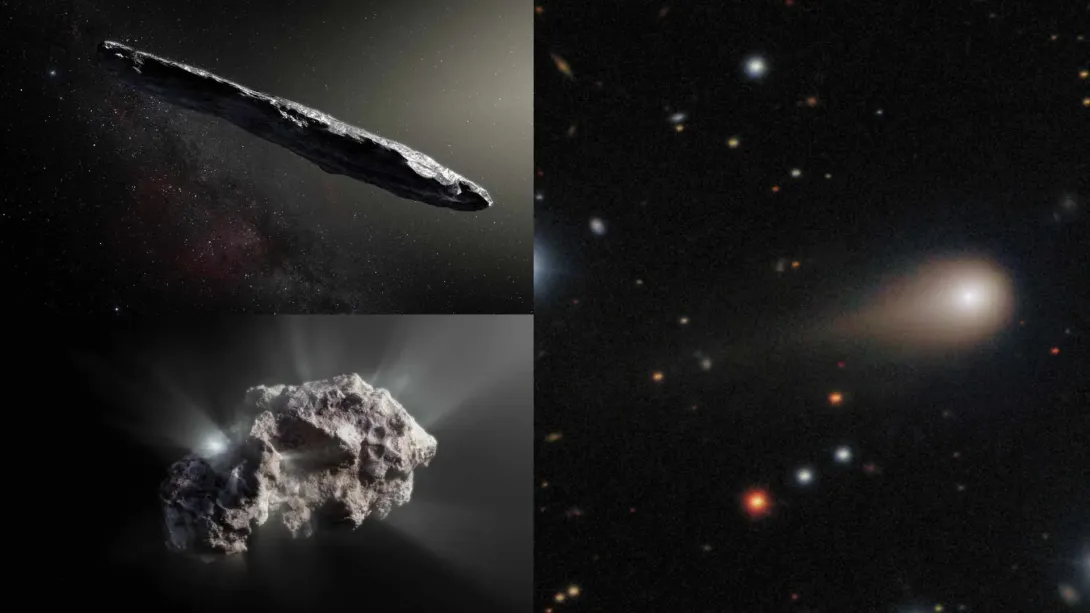
Astronomers have intensified their study of the interstellar comet 3I/ATLAS, offering a rare opportunity to explore material from beyond our solar system. Discovered as it entered the inner solar system, the comet’s trajectory and composition provide insights into the processes shaping other planetary systems. Observations using ground-based telescopes and space observatories have revealed unique chemical signatures, dust properties, and gas emissions, highlighting differences from native comets. Scientists hope these findings will enhance understanding of cosmic evolution, planetary formation, and interstellar chemistry. 3I/ATLAS represents one of the few accessible interstellar objects, offering a window into the broader galactic environment.
A Rare Interstellar Visitor
3I/ATLAS, classified as an interstellar comet, originates from outside the solar system, making its passage a significant scientific event. Unlike typical comets, it follows a hyperbolic trajectory, confirming its extragalactic origin. Its discovery has prompted an international observation campaign, enabling astronomers to track its motion, brightness, and evolving tail structure in unprecedented detail.
The comet’s unique path and high velocity allow researchers to test models of interstellar object behavior and improve detection methods for future visitors.
Composition and Observational Insights
Spectroscopic analysis of 3I/ATLAS has revealed atypical chemical compositions, including volatile compounds rarely observed in solar system comets. Dust particle studies suggest differences in size, density, and reflectivity, providing clues about the conditions in its home stellar system.
Gas emissions, including water, carbon monoxide, and other trace molecules, are being monitored to understand sublimation dynamics. These data help reconstruct the comet’s history and shed light on material transport across interstellar space.
Technological Approaches and Collaboration
Observations of 3I/ATLAS leverage both ground-based telescopes and orbital instruments. High-resolution imaging and spectroscopy are coordinated across multiple observatories worldwide, allowing continuous tracking. International collaboration ensures comprehensive data collection, enabling cross-validation of findings and integration with theoretical models of cometary and interstellar physics.
Advanced software and AI-driven analysis tools assist in detecting subtle variations in brightness and spectral lines, enhancing the precision of the study.
Implications for Planetary Science
Studying 3I/ATLAS helps scientists compare planetary formation processes across stellar systems. Variations in chemical composition and dust properties inform theories about planetary disk evolution, migration of materials, and conditions conducive to planet formation.
Insights from interstellar objects may also guide the search for habitable exoplanets by revealing the distribution of water and organic compounds beyond our solar system.
Future Prospects
As 3I/ATLAS continues its journey through the solar system, astronomers plan to collect additional high-resolution spectral and imaging data. The study of interstellar comets may expand with improved detection capabilities, providing more opportunities to examine material from distant star systems.
The observations of 3I/ATLAS will serve as a reference for future interstellar object encounters, establishing a framework for understanding the diversity of matter in the galaxy.
Conclusion
The interstellar comet 3I/ATLAS represents a rare and invaluable window into the galactic environment beyond our solar system. By examining its trajectory, composition, and physical properties, scientists are gaining critical insights into planetary formation, interstellar chemistry, and the dynamic processes shaping distant worlds. The study exemplifies the power of global collaboration, cutting-edge technology, and human curiosity in unlocking the secrets of the cosmos.
Comments